• HOME
  • NEWS
  • EXPLORE
    • CAREER
      • Companies
      • Jobs
    • EVENTS
    • iGEM
      • News
      • Team
    • PHOTOS
    • VIDEO
    • WIKI
  • BLOG
  • COMMUNITY
    • FACEBOOK
    • INSTAGRAM
    • TWITTER
Wednesday, January 14, 2026
BIOENGINEER.ORG
No Result
View All Result
  • Login
  • HOME
  • NEWS
  • EXPLORE
    • CAREER
      • Companies
      • Jobs
        • Lecturer
        • PhD Studentship
        • Postdoc
        • Research Assistant
    • EVENTS
    • iGEM
      • News
      • Team
    • PHOTOS
    • VIDEO
    • WIKI
  • BLOG
  • COMMUNITY
    • FACEBOOK
    • INSTAGRAM
    • TWITTER
  • HOME
  • NEWS
  • EXPLORE
    • CAREER
      • Companies
      • Jobs
        • Lecturer
        • PhD Studentship
        • Postdoc
        • Research Assistant
    • EVENTS
    • iGEM
      • News
      • Team
    • PHOTOS
    • VIDEO
    • WIKI
  • BLOG
  • COMMUNITY
    • FACEBOOK
    • INSTAGRAM
    • TWITTER
No Result
View All Result
Bioengineer.org
No Result
View All Result
Home NEWS Science News Chemistry

Researchers develop new way to break reciprocity law

Bioengineer by Bioengineer
December 23, 2020
in Chemistry
Reading Time: 2 mins read
0
IMAGE
Share on FacebookShare on TwitterShare on LinkedinShare on RedditShare on Telegram

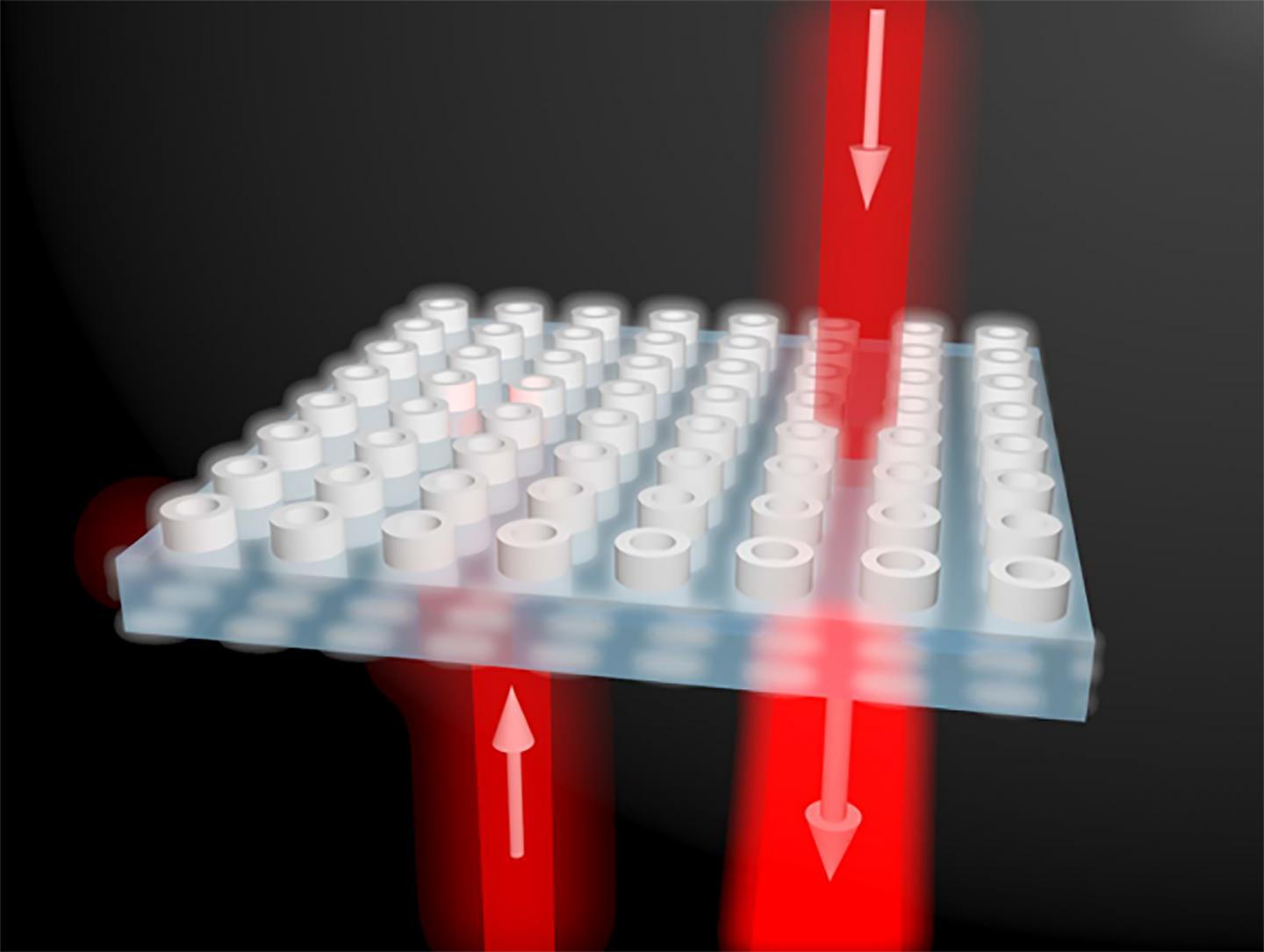
The breakthrough makes a significant step forward in photonics and microwave technology by eliminating the need for bulky magnets
IMAGE

Credit: Xuchen Wang / Aalto University

An international research team lead by Aalto University has found a new and simple route to break the reciprocity law in the electromagnetic world, by changing material properties periodically in time. The breakthrough could help to create efficient nonreciprocal devices, such as compact isolators and circulators, that are needed for the next generation of microwave and optical communications systems.

When we look through a window and see our neighbour on the street, the neighbour can also see us. This is called reciprocity, and it is the most common physical phenomenon in nature. Electromagnetic signals propagating between two sources is always governed by reciprocity law: if the signal from source A can be received by source B, then the signal from source B can also be received by source A with equal efficiency.

Researchers from Aalto University, Stanford University, and Swiss Federal Institute of Technology in Lausanne (EPFL) have successfully demonstrated that the reciprocity law can be broken if the property of the propagation medium periodically changes in time. Propagation medium refers to a material in which light and electromagnetic waves survive and propagate from one point to another.

The team theoretically demonstrated that, if the medium is shaped into an asymmetric structure and its physical property varies globally in time, the signal generated by source A can be received by source B but not the other way around. This creates a strong nonreciprocal effect, since the signal from Source B cannot be received by source A.

‘This is an important milestone in both the physics and engineering communities. We need one-way light transmission for a variety of applications, like stabilising laser operation or designing future communication systems, such as full-duplex systems with increased channel capacity,’ says postdoctoral researcher Xuchen Wang from Aalto University.

Previously, creating a nonreciprocal effect has required external magnets biasing, which makes devices bulky, temperature unstable, and sometimes incompatible with other components. The new findings provide the simplest and most compact way to break electromagnetic reciprocity, without the need of bulky and heavy magnets.

‘Such “time-only” variations allow us to design simple and compact material platforms capable of one-way light transmission and even amplification,’ Xuchen explains.

The results are reported in Physical Review Letters on 22 December 2020. The study has received funding from the Academy of Finland, European Union’s Horizon 2020 Future Emerging Technologies call (FETOPEN – RIA) under project VISORSURF, the Finnish Foundation for Technology Promotion, and the U.S. Air Force Office of Scientific Research MURI project (Grant No. FA9550-18-1-0379).

###

Media Contact
Xuchen Wang
[email protected]

Original Source

https://www.aalto.fi/en/news/researchers-develop-new-way-to-break-reciprocity-law

Related Journal Article

http://dx.doi.org/10.1103/PhysRevLett.125.266102

Tags: Chemistry/Physics/Materials SciencesMaterialsTechnology/Engineering/Computer Science
Share12Tweet8Share2ShareShareShare2

Related Posts

blank

Thermal [2+2] Cycloaddition Builds Gem-Difluoro Bicycloalkanes

January 13, 2026
blank

Cobalt-Catalyzed Thioester Coupling via Siloxycarbene

January 12, 2026

Advancing Alkene Chemistry: Homologative Difunctionalization Breakthrough

January 8, 2026

Biocompatible Ligand Enables Safe In-Cell Protein Arylation

January 8, 2026
Please login to join discussion

POPULAR NEWS

  • Enhancing Spiritual Care Education in Nursing Programs

    155 shares
    Share 62 Tweet 39
  • PTSD, Depression, Anxiety in Childhood Cancer Survivors, Parents

    147 shares
    Share 59 Tweet 37
  • Robotic Ureteral Reconstruction: A Novel Approach

    75 shares
    Share 30 Tweet 19
  • Study Reveals Lipid Accumulation in ME/CFS Cells

    53 shares
    Share 21 Tweet 13

About

BIOENGINEER.ORG

We bring you the latest biotechnology news from best research centers and universities around the world. Check our website.

Follow us

Recent News

Smartphone Measures Vasomotor Function via Fingertip Elasticity

Fecal Transplants Show Promise for Anorexia Treatment

ICU Nurses’ Resilience Shields Against Compassion Fatigue

Subscribe to Blog via Email

Enter your email address to subscribe to this blog and receive notifications of new posts by email.

Join 71 other subscribers
  • Contact Us

Bioengineer.org © Copyright 2023 All Rights Reserved.

Welcome Back!

Login to your account below

Forgotten Password?

Retrieve your password

Please enter your username or email address to reset your password.

Log In
No Result
View All Result
  • Homepages
    • Home Page 1
    • Home Page 2
  • News
  • National
  • Business
  • Health
  • Lifestyle
  • Science

Bioengineer.org © Copyright 2023 All Rights Reserved.