• HOME
  • NEWS
  • EXPLORE
    • CAREER
      • Companies
      • Jobs
    • EVENTS
    • iGEM
      • News
      • Team
    • PHOTOS
    • VIDEO
    • WIKI
  • BLOG
  • COMMUNITY
    • FACEBOOK
    • INSTAGRAM
    • TWITTER
Thursday, March 26, 2026
BIOENGINEER.ORG
No Result
View All Result
  • Login
  • HOME
  • NEWS
  • EXPLORE
    • CAREER
      • Companies
      • Jobs
        • Lecturer
        • PhD Studentship
        • Postdoc
        • Research Assistant
    • EVENTS
    • iGEM
      • News
      • Team
    • PHOTOS
    • VIDEO
    • WIKI
  • BLOG
  • COMMUNITY
    • FACEBOOK
    • INSTAGRAM
    • TWITTER
  • HOME
  • NEWS
  • EXPLORE
    • CAREER
      • Companies
      • Jobs
        • Lecturer
        • PhD Studentship
        • Postdoc
        • Research Assistant
    • EVENTS
    • iGEM
      • News
      • Team
    • PHOTOS
    • VIDEO
    • WIKI
  • BLOG
  • COMMUNITY
    • FACEBOOK
    • INSTAGRAM
    • TWITTER
No Result
View All Result
Bioengineer.org
No Result
View All Result
Home NEWS Science News Chemistry

Hand-held device measures aerosols for coronavirus risk assessment

Bioengineer by Bioengineer
December 22, 2020
in Chemistry
Reading Time: 3 mins read
0
IMAGE
Share on FacebookShare on TwitterShare on LinkedinShare on RedditShare on Telegram

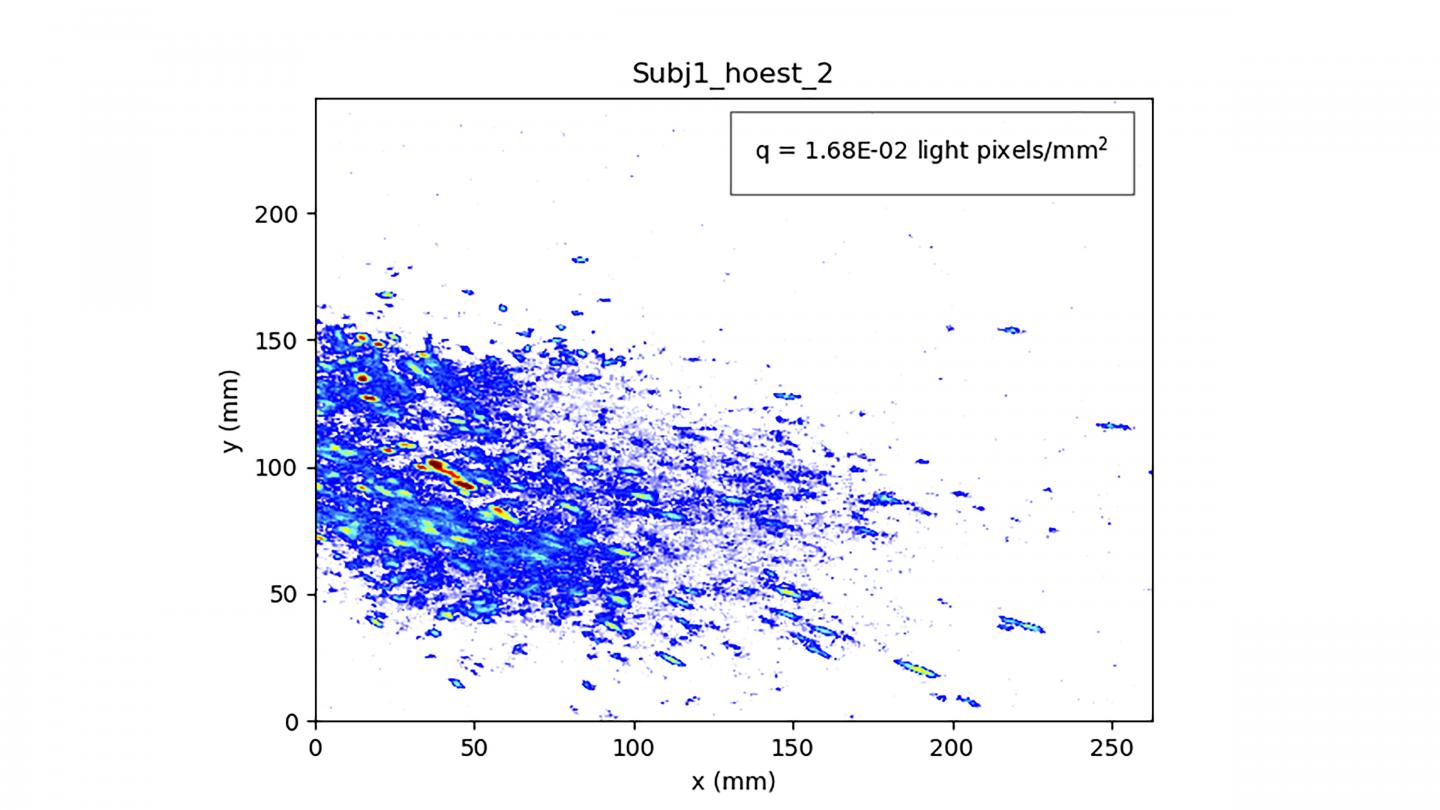
A portable particle detector can determine aerosol concentrations in public spaces.
IMAGE

Credit: Daniel Bonn, University of Amsterdam

WASHINGTON, December 22, 2020 — Because of the role they play in coronavirus transmission, understanding aerosol concentrations and persistence in public spaces can help determine infection risks. However, measuring these concentrations is difficult, requiring specialized personnel and equipment.

That is, until now.

Researchers from the Cardiology Centers of the Netherlands and the University of Amsterdam demonstrate that a commercial hand-held particle counter can be used for this purpose and help determine the impacts of risk-reducing measures, like ventilation improvements. They describe the quick and easy, portable process in the journal Physics of Fluids, from AIP Publishing.

The key challenge with using hand-held particle counters is dealing with the background dust prevalent in public spaces. The question then becomes, can you distinguish these dust particles from aerosols that arise from breathing, speaking, sneezing, and coughing?

Because dust and aerosols inhaled into human lungs differ in size, the researchers developed a way to subtract the dust signal in the particle counter by measuring the dust for some time, and watching how the signal changes after aerosols are added to the mix.

“There’s a lot of fine dust, so we can’t really measure aerosols in that range, but there’s a reasonable sized range where you can detect the aerosols,” said Daniel Bonn, one of the authors.

They compared the aerosol concentration determined by this method to laboratory-based techniques and found the results match up perfectly. Though this work reports on one specific hand-held particle counter — the Fluke 985, which is used to monitor the dust and air quality in clean rooms — Bonn noted the results aren’t unique to this device and can be extended to other particle counters as well.

Though the method does not directly measure the presence of viral particles, the detected aerosol concentration can be combined with virus data from other studies to obtain a practical risk assessment for a specific type of public space. The findings suggest well-ventilated areas can have aerosol concentrations more than 100 times lower than poorly ventilated areas, such as public elevators or restrooms.

“There are people worried about going to the gym, coming to the office, taking the train. All that can at least be evaluated,” Bonn said. “The motto remains ventilation, ventilation, ventilation.”

He said while ventilation plays a large role in indoor spaces, aerosols are not the only route to infection, and social distancing and hand-washing remain vital.

###

The article, “Measurement of small droplet aerosol concentrations in public spaces using handheld particle counters,” is authored by Aernout Somsen, Cees van Rijn, Stefan Kooij, Reinout Alexander Bem, and Daniel Bonn. The article will appear in Physics of Fluids on Dec. 22, 2020 (DOI: 10.1063/5.0035701). After that date, it can be accessed at https://aip.scitation.org/doi/full/10.1063/5.0035701.

ABOUT THE JOURNAL

Physics of Fluids is devoted to the publication of original theoretical, computational, and experimental contributions to the dynamics of gases, liquids, and complex or multiphase fluids. See https://aip.scitation.org/journal/phf.

Media Contact
Larry Frum
[email protected]

Related Journal Article

http://dx.doi.org/10.1063/5.0035701

Tags: Atomic/Molecular/Particle PhysicsChemistry/Physics/Materials SciencesEpidemiologyInfectious/Emerging DiseasesMedicine/HealthParticle PhysicsSocial/Behavioral ScienceTechnology/Engineering/Computer ScienceVirology
Share12Tweet8Share2ShareShareShare2

Related Posts

Isolated H2-Reduced Clusters Boost CO2-to-Methanol Catalysis

Isolated H2-Reduced Clusters Boost CO2-to-Methanol Catalysis

March 25, 2026
blank

Physicists Identify Electronic Drivers Behind Flat Band Quantum Materials

March 21, 2026

Würzburg Chemistry Professor Claudia Höbartner Receives Prestigious Honor

March 20, 2026

Scientists Reveal How Magnets Control Metamaterial Behavior

March 20, 2026
Please login to join discussion

POPULAR NEWS

  • blank

    Revolutionary AI Model Enhances Precision in Detecting Food Contamination

    96 shares
    Share 38 Tweet 24
  • Imagine a Social Media Feed That Challenges Your Views Instead of Reinforcing Them

    1003 shares
    Share 397 Tweet 248
  • Uncovering Functions of Cavernous Malformation Proteins in Organoids

    54 shares
    Share 22 Tweet 14
  • Promising Outcomes from First Clinical Trials of Gene Regulation in Epilepsy

    51 shares
    Share 20 Tweet 13

About

We bring you the latest biotechnology news from best research centers and universities around the world. Check our website.

Follow us

Recent News

In-Sensor Cryptography Links Physical Process to Digital Identity

Can Psychosocial Factors Influence Cancer Risk?

Depression Factors in Elderly: Pre vs. Post-COVID Analysis

Subscribe to Blog via Email

Success! An email was just sent to confirm your subscription. Please find the email now and click 'Confirm' to start subscribing.

Join 78 other subscribers
  • Contact Us

Bioengineer.org © Copyright 2023 All Rights Reserved.

Welcome Back!

Login to your account below

Forgotten Password?

Retrieve your password

Please enter your username or email address to reset your password.

Log In
No Result
View All Result
  • Homepages
    • Home Page 1
    • Home Page 2
  • News
  • National
  • Business
  • Health
  • Lifestyle
  • Science

Bioengineer.org © Copyright 2023 All Rights Reserved.