• HOME
  • NEWS
  • EXPLORE
    • CAREER
      • Companies
      • Jobs
    • EVENTS
    • iGEM
      • News
      • Team
    • PHOTOS
    • VIDEO
    • WIKI
  • BLOG
  • COMMUNITY
    • FACEBOOK
    • INSTAGRAM
    • TWITTER
Saturday, February 7, 2026
BIOENGINEER.ORG
No Result
View All Result
  • Login
  • HOME
  • NEWS
  • EXPLORE
    • CAREER
      • Companies
      • Jobs
        • Lecturer
        • PhD Studentship
        • Postdoc
        • Research Assistant
    • EVENTS
    • iGEM
      • News
      • Team
    • PHOTOS
    • VIDEO
    • WIKI
  • BLOG
  • COMMUNITY
    • FACEBOOK
    • INSTAGRAM
    • TWITTER
  • HOME
  • NEWS
  • EXPLORE
    • CAREER
      • Companies
      • Jobs
        • Lecturer
        • PhD Studentship
        • Postdoc
        • Research Assistant
    • EVENTS
    • iGEM
      • News
      • Team
    • PHOTOS
    • VIDEO
    • WIKI
  • BLOG
  • COMMUNITY
    • FACEBOOK
    • INSTAGRAM
    • TWITTER
No Result
View All Result
Bioengineer.org
No Result
View All Result
Home NEWS Science News Biology

Brain stem cells divide over months

Bioengineer by Bioengineer
December 21, 2020
in Biology
Reading Time: 2 mins read
0
IMAGE
Share on FacebookShare on TwitterShare on LinkedinShare on RedditShare on Telegram

IMAGE

Credit: UZH

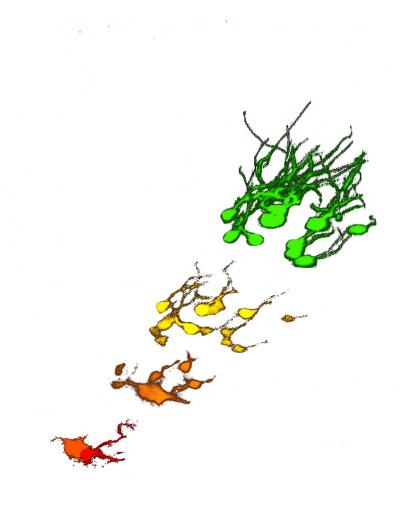
Stem cells create new nerve cells in the brain over the entire life span. One of the places this happens is the hippocampus, a region of the brain that plays a significant role in many learning processes. A reduction in the number of newly formed nerve cells has been observed, for example, in the context of depression and Alzheimer’s disease, and is associated with reduced memory performance in these conditions.

From stem cell behavior to the activity of genes in individual cells

In a study published in Nature Neuroscience, the group around Sebastian Jessberger, a professor at the University of Zurich’s Brain Research Institute, has shown that stem cells in the hippocampus of mice are active over a period of several months. The researchers, led by PhD candidate Sara Bottes and postdocs Baptiste Jaeger and Gregor Pilz, employed state-of-the-art microscopy and genetic analyses (using single-cell RNA sequencing) of stem cells and their daughter cells to analyze the formation of new nerve cells. This enabled them to observe that specific stem cell populations are active over months and can divide repeatedly. This had already been suspected in earlier studies, but this is the first time there has been direct evidence. The researchers have also been able to use single-cell RNA sequencing of stem cells and their daughter cells to demonstrate that stem cells with different division behavior (few cell divisions as opposed to long-lasting stem cell activity) can be differentiated on the basis of their molecular composition and expression of genes.

Harnessing stem cells for therapeutic purposes

“Combining two modern methods – two-photon microscopy and single-cell RNA sequencing – has enabled us to identify precisely the stem cells that can divide over the course of months,” explains Jessberger. He adds that the evidence they have now presented of long-lasting stem cell division has implications for future therapeutic approaches: “We now know that there really are stem cells that divide over a period of many months. Single-cell RNA sequencing gives us our first insight into what genes are important in terms of the division behavior of individual cells.”

The new findings will form the basis of future endeavors to investigate in detail how specific genes control the activity of stem cells. Jessberger sums up the next research objectives: “Imaging and single-cell RNA sequencing have given us completely new insights that we’ll now use to be able to systematically regulate the activity of certain genes in the future. Since we now know that there are stem cells that can divide over a longer period, going forward we want to try to increase the division activity of these cells and thus the formation of new nerve cells, for example in the context of neurodegenerative conditions such as Alzheimer’s disease.”

###

Media Contact
Sebastian Jessberger
[email protected]

Related Journal Article

http://dx.doi.org/10.1038/s41593-020-00759-4

Tags: BiochemistryBiologyCell BiologyMedicine/HealthMicrobiology
Share12Tweet8Share2ShareShareShare2

Related Posts

Florida Cane Toad: Complex Spread and Selective Evolution

Florida Cane Toad: Complex Spread and Selective Evolution

February 7, 2026
New Study Uncovers Mechanism Behind Burn Pit Particulate Matter–Induced Lung Inflammation

New Study Uncovers Mechanism Behind Burn Pit Particulate Matter–Induced Lung Inflammation

February 6, 2026

DeepBlastoid: Advancing Automated and Efficient Evaluation of Human Blastoids with Deep Learning

February 6, 2026

Navigating the Gut: The Role of Formic Acid in the Microbiome

February 6, 2026
Please login to join discussion

POPULAR NEWS

  • Robotic Ureteral Reconstruction: A Novel Approach

    Robotic Ureteral Reconstruction: A Novel Approach

    82 shares
    Share 33 Tweet 21
  • Digital Privacy: Health Data Control in Incarceration

    63 shares
    Share 25 Tweet 16
  • Study Reveals Lipid Accumulation in ME/CFS Cells

    57 shares
    Share 23 Tweet 14
  • Breakthrough in RNA Research Accelerates Medical Innovations Timeline

    53 shares
    Share 21 Tweet 13

About

We bring you the latest biotechnology news from best research centers and universities around the world. Check our website.

Follow us

Recent News

Evaluating Pediatric Emergency Care Quality in Ethiopia

TPMT Expression Predictions Linked to Azathioprine Side Effects

Improving Dementia Care with Enhanced Activity Kits

Subscribe to Blog via Email

Success! An email was just sent to confirm your subscription. Please find the email now and click 'Confirm' to start subscribing.

Join 73 other subscribers
  • Contact Us

Bioengineer.org © Copyright 2023 All Rights Reserved.

Welcome Back!

Login to your account below

Forgotten Password?

Retrieve your password

Please enter your username or email address to reset your password.

Log In
No Result
View All Result
  • Homepages
    • Home Page 1
    • Home Page 2
  • News
  • National
  • Business
  • Health
  • Lifestyle
  • Science

Bioengineer.org © Copyright 2023 All Rights Reserved.