• HOME
  • NEWS
  • EXPLORE
    • CAREER
      • Companies
      • Jobs
    • EVENTS
    • iGEM
      • News
      • Team
    • PHOTOS
    • VIDEO
    • WIKI
  • BLOG
  • COMMUNITY
    • FACEBOOK
    • INSTAGRAM
    • TWITTER
Sunday, May 10, 2026
BIOENGINEER.ORG
No Result
View All Result
  • Login
  • HOME
  • NEWS
  • EXPLORE
    • CAREER
      • Companies
      • Jobs
        • Lecturer
        • PhD Studentship
        • Postdoc
        • Research Assistant
    • EVENTS
    • iGEM
      • News
      • Team
    • PHOTOS
    • VIDEO
    • WIKI
  • BLOG
  • COMMUNITY
    • FACEBOOK
    • INSTAGRAM
    • TWITTER
  • HOME
  • NEWS
  • EXPLORE
    • CAREER
      • Companies
      • Jobs
        • Lecturer
        • PhD Studentship
        • Postdoc
        • Research Assistant
    • EVENTS
    • iGEM
      • News
      • Team
    • PHOTOS
    • VIDEO
    • WIKI
  • BLOG
  • COMMUNITY
    • FACEBOOK
    • INSTAGRAM
    • TWITTER
No Result
View All Result
Bioengineer.org
No Result
View All Result
Home NEWS Science News Chemistry

New model reveals previously unrecognized complexity of oceanic earthquake zones

Bioengineer by Bioengineer
December 21, 2020
in Chemistry
Reading Time: 2 mins read
0
IMAGE
Share on FacebookShare on TwitterShare on LinkedinShare on RedditShare on Telegram

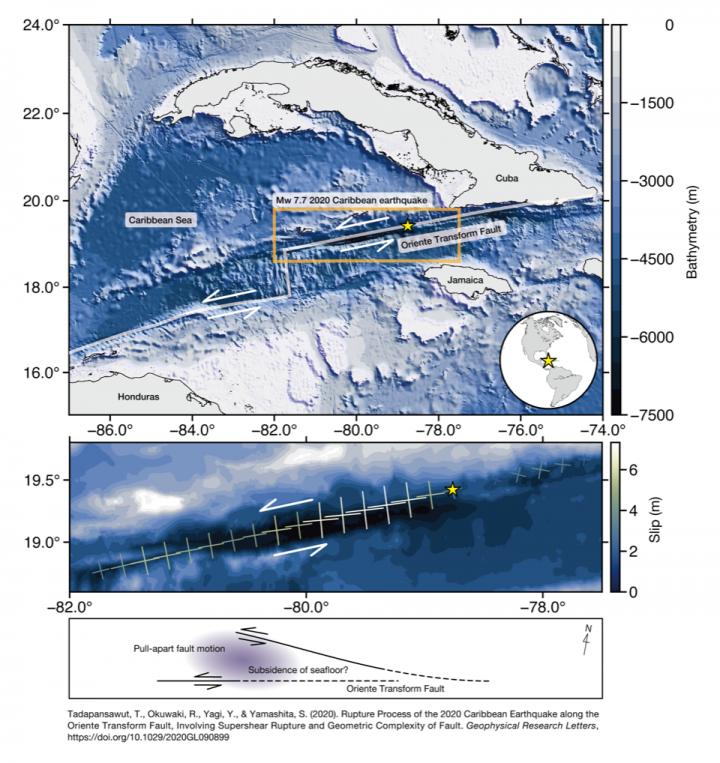
University of Tsukuba researchers have developed a state-of-the-art model, which has revealed major complexity in rupture processes even in simple oceanic faults
IMAGE

Credit: University of Tsukuba

Tsukuba, Japan – Researchers from the University of Tsukuba applied seismic data from around the world to build a model of the 2020 Caribbean earthquake. Oceanic transform faults are generally considered to be linear and simple and have been widely used in studies of earthquake dynamics. However, the research team found that high complexity in rupture speed and direction can occur even in a supposedly simple linear fault system.

On 28 January 2020, a large oceanic earthquake with magnitude 7.7 occurred at the Oriente transform fault in the Caribbean Sea, between Jamaica and Cuba. It caused a minor tsunami of 0.11 m height and was felt as far afield as Florida.

A research team at the University of Tsukuba have developed a new finite-fault inversion method for building models based on teleseismic waveform data from earthquake monitoring stations. This new approach to using the data takes a more flexible approach to resolving the fault geometry. Rather than relying on prior assumptions, the faulting components are separately evaluated in a wider model in both time and space, allowing all possible rupture evolutions to be considered. The team were keen to use the Caribbean earthquake to help to understand the faulting processes that occur during these shallow oceanic quakes.

“Some cases of complex rupture dynamics have recently been reported in previous earthquake studies, raising the question of whether or not we are correctly modeling these even in supposedly simple fault systems,” says study author Professor Yuji Yagi. “The initial monitoring of this January 2020 event suggested variations in the waveform shape between two stations at similar distances from the epicenter, suggesting that there remains complexity to be explored at this fault.”

This was an excellent opportunity to test the new method developed by the team, which used data from 52 seismic stations to construct a detailed model of the geophysical processes within the fault that gave rise to the earthquake.

“The results revealed complex rupture during the earthquake, caused by a bend in the fault that led to the changes in rupture speed and direction detected in the monitoring data,” explains author Professor Ryo Okuwaki. “These variations triggered several successive rupture episodes that occurred along the 300-km-long fault.” The modeling approach also allows some suggestions to be made about the possible occurrence of subsidence and the shape of the surrounding seabed following the earthquake event.

These findings reveal that oceanic transform faults, considered to be simple and linear, may be much more complicated than previously accepted, and therefore require a more comprehensive approach to earthquake modeling. This work will shed light on a possible interaction between the earthquake-fault motion and the evolution of the ocean floor around the transform boundary.

###

The article, “Rupture Process of the 2020 Caribbean Earthquake along the Oriente Transform Fault, Involving Supershear Rupture and Geometric Complexity of Fault” was published in Geophysical Research Letters at DOI: 10.1029/2020GL090899.

Media Contact
Naoko Yamashina
[email protected]

Related Journal Article

http://dx.doi.org/10.1029/2020GL090899

Tags: Earth ScienceGeographyGeology/SoilGeophysics/GravityPlate Tectonics
Share12Tweet8Share2ShareShareShare2

Related Posts

Miniature Sensor Uses Light to Detect Touch — Chemistry

Miniature Sensor Uses Light to Detect Touch

May 8, 2026
Iron Minerals Determine Whether Dissolved Organic Matter Fuels Microbes or Becomes Long-Term Carbon Storage — Chemistry

Iron Minerals Determine Whether Dissolved Organic Matter Fuels Microbes or Becomes Long-Term Carbon Storage

May 8, 2026

Kate Evans Appointed Associate Lab Director for Biological and Environmental Systems Science at ORNL

May 8, 2026

Advancing Multiscale Modeling and Overcoming Operational Challenges in Autothermal COâ‚‚-to-Methanol Reactors

May 8, 2026
Please login to join discussion

POPULAR NEWS

  • Research Indicates Potential Connection Between Prenatal Medication Exposure and Elevated Autism Risk

    840 shares
    Share 336 Tweet 210
  • New Study Reveals Plants Can Detect the Sound of Rain

    727 shares
    Share 290 Tweet 181
  • Scientists Investigate Possible Connection Between COVID-19 and Increased Lung Cancer Risk

    68 shares
    Share 27 Tweet 17
  • Salmonella Haem Blocks Macrophages, Boosts Infection

    61 shares
    Share 24 Tweet 15

About

We bring you the latest biotechnology news from best research centers and universities around the world. Check our website.

Follow us

Recent News

Evaluating Digoxin Use in Patients with Symptomatic Rheumatic Heart Disease

Evaluating the Effectiveness and Safety of Digitalis Glycosides in Treating Heart Failure

Urdu Fall Risk Questionnaire Adapted for Elderly

Subscribe to Blog via Email

Enter your email address to subscribe to this blog and receive notifications of new posts by email.

Join 82 other subscribers
  • Contact Us

Bioengineer.org © Copyright 2023 All Rights Reserved.

Welcome Back!

Login to your account below

Forgotten Password?

Retrieve your password

Please enter your username or email address to reset your password.

Log In
No Result
View All Result
  • Homepages
    • Home Page 1
    • Home Page 2
  • News
  • National
  • Business
  • Health
  • Lifestyle
  • Science

Bioengineer.org © Copyright 2023 All Rights Reserved.