Studying quasiparticles that are part light, part matter
Credit: FLEET
Why do two-dimensional exciton-polaritons interact?
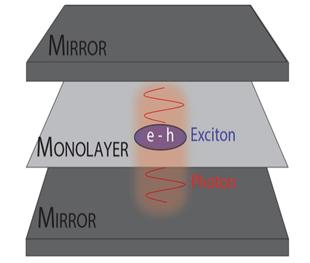
The intriguing quasiparticle the exciton-polariton is part light (photon), and part matter (exciton).
Their excitonic (matter) part confers them the ability to interact with other particles –a property lacking to bare photons.
In theory, when confined to only two dimensions, very slow (ie, very cold) excitons should cease any interaction with one another. However in practice, this behaviour is not observed with exciton-polaritons.
In a new study by FLEET researchers at Monash University, the answer is found to lie in the ‘light-like’ characteristics of these quasiparticles.
This is important for future applications using polaritons in atomically-thin semiconductors, such as ultra-low energy electronics.
ENHANCED INTERACTIONS THROUGH STRONG LIGHT-MATTER COUPLING
‘We sought answers to a fundamental question about exciton-polaritons not asked previously,” explains lead author Dr Olivier Bleu.
“If polaritons live in two-dimensions, why is the disappearance of their interactions at slow velocities not happening in experiments, as predicted by quantum scattering theory?”
The team demonstrated that the strong-coupling between excitons and photons, together with the huge exciton-photon mass ratio, modifies the scattering behaviour expected for ‘bare’ two-dimensional excitons and implies that polariton interactions remain finite.
“More precisely, we showed that the regime where the interactions should vanish is not observable since it would require a sample much larger than the known universe!”, explains co-author Dr Jesper Levinsen.
The results show that polaritons interact more than excitons, which contrasts with the common assumption about these key quasiparticles.
“This work sheds new light on the interactions between hybrid light-matter quasiparticles, and will allow us to deepen our understanding of these systems,” says corresponding author A/Prof Meera Parish.
QUASIPARTICLES THAT ARE BOTH LIGHT AND MATTER
Exciton-polaritons form when excitons (electron-hole pairs) are strongly-coupled with light (photons) trapped in an optical cavity.
This ‘split personality’ gives the exciton-polariton unique properties, taking some of the characteristics of light, and some of the characteristics of matter.
Their capacity to interact is at the heart of a variety of fascinating phenomena observable in experiments and still not completely understood: ranging from polariton Bose-Einstein condensation and superfluidity to quantum optical effects.
###
THE STUDY
Polariton interactions in microcavities with atomically thin semiconductor layers was published in Physical Review Research in November 2020. (DOI 10.1103/physrevresearch.2.043185)
Funding was received from the Australian Research Council (Centres of Excellence and Future Fellowship programs).
NON-EQUILIBRIUM PHYSICS AT FLEET
The study was conducted in Dr Jesper Levinsen and A/Prof Meera Parish’s group at Monash University, which investigates the behaviour of large groups of interacting quantum particles, which can exhibit exotic behaviour, such as superfluidity where they flow without encountering resistance.
This work expands our fundamental knowledge of quantum physics in systems ranging from cold atomic gases to solid-state semiconductors, and has the potential to underpin a new generation of near-zero resistance, ultra-low energy electronic devices, sought by FLEET.
Within FLEET, the study of exciton-polaritons falls under both Research theme 2 (exciton superfluids) and Research Theme 3 (non-equilibrium systems).
FLEET is an Australian Research Council-funded research centre bringing together over a hundred Australian and international experts to develop a new generation of ultra-low energy electronics.
Media Contact
Errol Hunt
[email protected]
Original Source
http://www.
Related Journal Article
http://dx.