• HOME
  • NEWS
  • EXPLORE
    • CAREER
      • Companies
      • Jobs
    • EVENTS
    • iGEM
      • News
      • Team
    • PHOTOS
    • VIDEO
    • WIKI
  • BLOG
  • COMMUNITY
    • FACEBOOK
    • INSTAGRAM
    • TWITTER
Thursday, March 26, 2026
BIOENGINEER.ORG
No Result
View All Result
  • Login
  • HOME
  • NEWS
  • EXPLORE
    • CAREER
      • Companies
      • Jobs
        • Lecturer
        • PhD Studentship
        • Postdoc
        • Research Assistant
    • EVENTS
    • iGEM
      • News
      • Team
    • PHOTOS
    • VIDEO
    • WIKI
  • BLOG
  • COMMUNITY
    • FACEBOOK
    • INSTAGRAM
    • TWITTER
  • HOME
  • NEWS
  • EXPLORE
    • CAREER
      • Companies
      • Jobs
        • Lecturer
        • PhD Studentship
        • Postdoc
        • Research Assistant
    • EVENTS
    • iGEM
      • News
      • Team
    • PHOTOS
    • VIDEO
    • WIKI
  • BLOG
  • COMMUNITY
    • FACEBOOK
    • INSTAGRAM
    • TWITTER
No Result
View All Result
Bioengineer.org
No Result
View All Result
Home NEWS Science News

A shock to the PPE system

Bioengineer by Bioengineer
December 17, 2020
in Science News
Reading Time: 3 mins read
0
IMAGE
Share on FacebookShare on TwitterShare on LinkedinShare on RedditShare on Telegram

IMAGE

Credit: Institute of Industrial Science, the University of Tokyo

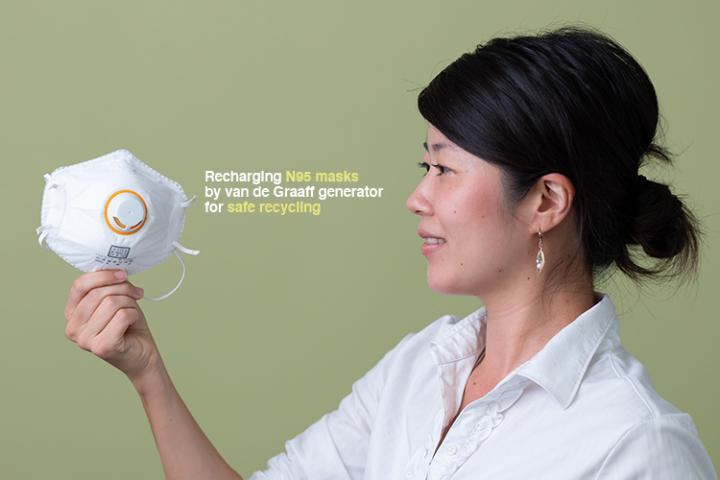
Tokyo, Japan – A researcher from the Institute of Industrial Science at The University of Tokyo has demonstrated a novel method for recharging sterilized N95 masks so that they can be reused. By exposing the masks to 100 kilovolts for 3 minutes after sterilization in hot water or an autoclave, they regained their static charge. This work can be rapidly applied to help meet the huge demand for protective equipment that can prevent the spread of the COVID virus.

During the current COVID pandemic, N95 masks have been indispensable for keeping health care workers and first responders safe. The name comes from the fact that these masks can filter more than 95% of airborne particles, even though they have pore sizes ten times larger than the small aerosol particles that can carry the virus. The trick is that the N95 masks are made of electrospun polypropylene fibers, which retain a static electric charge that can attract and trap the charged aerosols. However, this static charge cannot withstand normal sterilization procedures, such as washing in hot water or autoclaving. Even the moisture in the wearer’s breath can degrade the effectiveness of the electric attraction. For this reason, the masks are often discarded after a single use, which greatly increases the gap between the number of N95 masks needed and the number available.

Now, a researcher at The University of Tokyo has shown that sterilized masks can be returned to use after being recharged using a van de Graaff generator. These devices, familiar to many science museum visitors, use the friction from a spinning belt to generate very high voltages between two metal conductors. “Making use of the high voltage provided by the van de Graaff generator, this method is much faster than alternative methods,” study author Kaori Sugihara says. To regenerate a mask that had been previously sterilized, it was attached to the larger metallic sphere, while the smaller sphere was placed several centimeters away for 3 minutes. The regenerated masks were tested and shown to be comparable in filtering ability to unused masks.

“Hopefully, this method will allow many more people to have access to N95 masks each day, which is our best line of defense against COVID transmission,” Sugihara says. Because van de Graaff generators are much cheaper and safer to use than other high voltage sources, this method can be implemented easily in hospitals and other locations where N95 masks are most needed. The work is published in Soft Matter as “Recharging N95 masks by van de Graaff generator for safe recycling.”

###

About Institute of Industrial Science (IIS), the University of Tokyo Institute of Industrial Science (IIS), the University of Tokyo is one of the largest university-attached research institutes in Japan.

More than 120 research laboratories, each headed by a faculty member, comprise IIS, with more than 1,000 members including approximately 300 staff and 700 students actively engaged in education and research. Our activities cover almost all the areas of engineering disciplines. Since its foundation in 1949, IIS has worked to bridge the huge gaps that exist between academic disciplines and realworld applications.

Media Contact
Kaori Sugihara
[email protected]

Original Source

https://www.iis.u-tokyo.ac.jp/en/news/3444/

Related Journal Article

http://dx.doi.org/10.1039/d0sm02004d

Tags: Biomechanics/BiophysicsBiomedical/Environmental/Chemical EngineeringChemistry/Physics/Materials SciencesHealth CareIndustrial Engineering/ChemistryInfectious/Emerging DiseasesMaterialsPolymer Chemistry
Share12Tweet8Share2ShareShareShare2

Related Posts

Starburst Winds Drain Supernova Energy Quickly

Starburst Winds Drain Supernova Energy Quickly

March 26, 2026
Decoding the Phosphorus Puzzle: How Microplastics and Hydrochar Transform Nutrient Dynamics in Rice Paddies

Decoding the Phosphorus Puzzle: How Microplastics and Hydrochar Transform Nutrient Dynamics in Rice Paddies

March 26, 2026

Microtubules Found to Actively Ensure Accurate Chromosome Distribution During Cell Division

March 25, 2026

Aversive Learning Hijacks Brain Sugar Sensor

March 25, 2026
Please login to join discussion

POPULAR NEWS

  • blank

    Revolutionary AI Model Enhances Precision in Detecting Food Contamination

    96 shares
    Share 38 Tweet 24
  • Imagine a Social Media Feed That Challenges Your Views Instead of Reinforcing Them

    1003 shares
    Share 397 Tweet 248
  • Uncovering Functions of Cavernous Malformation Proteins in Organoids

    54 shares
    Share 22 Tweet 14
  • Promising Outcomes from First Clinical Trials of Gene Regulation in Epilepsy

    51 shares
    Share 20 Tweet 13

About

We bring you the latest biotechnology news from best research centers and universities around the world. Check our website.

Follow us

Recent News

In-Sensor Cryptography Links Physical Process to Digital Identity

Can Psychosocial Factors Influence Cancer Risk?

Depression Factors in Elderly: Pre vs. Post-COVID Analysis

Subscribe to Blog via Email

Success! An email was just sent to confirm your subscription. Please find the email now and click 'Confirm' to start subscribing.

Join 78 other subscribers
  • Contact Us

Bioengineer.org © Copyright 2023 All Rights Reserved.

Welcome Back!

Login to your account below

Forgotten Password?

Retrieve your password

Please enter your username or email address to reset your password.

Log In
No Result
View All Result
  • Homepages
    • Home Page 1
    • Home Page 2
  • News
  • National
  • Business
  • Health
  • Lifestyle
  • Science

Bioengineer.org © Copyright 2023 All Rights Reserved.