• HOME
  • NEWS
  • EXPLORE
    • CAREER
      • Companies
      • Jobs
    • EVENTS
    • iGEM
      • News
      • Team
    • PHOTOS
    • VIDEO
    • WIKI
  • BLOG
  • COMMUNITY
    • FACEBOOK
    • INSTAGRAM
    • TWITTER
Sunday, May 10, 2026
BIOENGINEER.ORG
No Result
View All Result
  • Login
  • HOME
  • NEWS
  • EXPLORE
    • CAREER
      • Companies
      • Jobs
        • Lecturer
        • PhD Studentship
        • Postdoc
        • Research Assistant
    • EVENTS
    • iGEM
      • News
      • Team
    • PHOTOS
    • VIDEO
    • WIKI
  • BLOG
  • COMMUNITY
    • FACEBOOK
    • INSTAGRAM
    • TWITTER
  • HOME
  • NEWS
  • EXPLORE
    • CAREER
      • Companies
      • Jobs
        • Lecturer
        • PhD Studentship
        • Postdoc
        • Research Assistant
    • EVENTS
    • iGEM
      • News
      • Team
    • PHOTOS
    • VIDEO
    • WIKI
  • BLOG
  • COMMUNITY
    • FACEBOOK
    • INSTAGRAM
    • TWITTER
No Result
View All Result
Bioengineer.org
No Result
View All Result
Home NEWS Science News Chemistry

New path to rare earth mineral formation has implications for green energy and smart tech

Bioengineer by Bioengineer
December 17, 2020
in Chemistry
Reading Time: 3 mins read
0
IMAGE
Share on FacebookShare on TwitterShare on LinkedinShare on RedditShare on Telegram

IMAGE

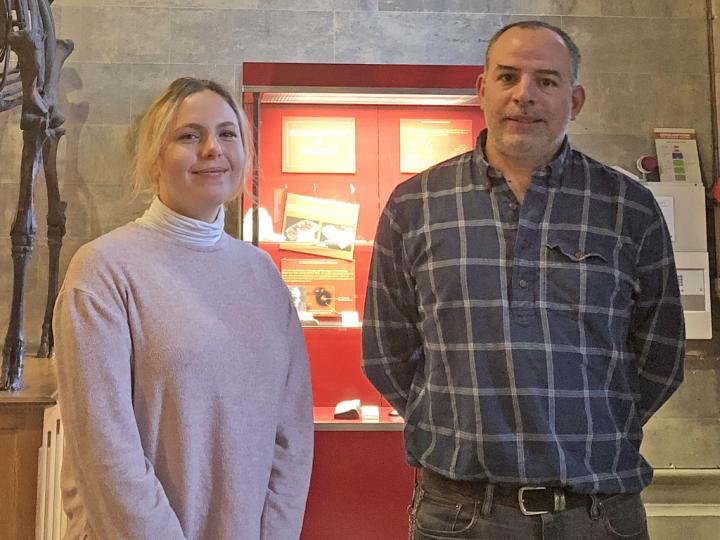
Credit: Trinity College Dublin

Researchers from Trinity College Dublin have shed new light on the formation mechanisms of a rare earth-bearing mineral that is in increasingly high demand across the globe for its use in the green energy and tech industries.

Their discovery has important economic implications because there are no substitute alternatives to these rare earth elements (REEs), which are indispensable due to their ability to form small and very powerful magnets essential for smart devices and low-carbon energy generation (e.g., electronics, wind turbines, hybrid cars).

Most REEs are exploited in carbonatite deposits (the largest known carbonatite is the Bayan Obo in China), but scientists still debate how and why they form due to their complicated mineralogy, element composition and geologic history.

There are more than 250 known REE-bearing minerals, but only three are economically viable and exploited commercially. Bastnäsite is likely the primary valuable mineral for REES in the world and was the focus of the Trinity team’s study.

By considering how water containing REEs interacted with calcite, a mineral that is ubiquitous in nature and often present in hydrothermal environments, the team discovered a new pathway by which bastnäsite formed.

Adrienn Maria Szucs, PhD Candidate, Trinity, is the first author of the study, which has just been published by the international journal Crystal Growth & Design. She said:

“The fact that we need more REEs urges us to find out more about the geochemical behaviour of these precious elements. Simply, we need to know a lot more about REEs, and how and why they form, if we want more of them.

“The crystallisation pathway we discovered reveals that in some rare earth-bearing deposits the origin of bastnäsite could be simply a consequence of the interaction of calcite with rare earth-rich fluids. This is not the only reaction that forms bastnäsite but the discovery is particularly important because calcite is found everywhere and is also the most stable calcium carbonate in nature. As a result, it suggests it should be possible to support the formation of bastnäsite under the right conditions.”

Juan Diego Rodriguez-Blanco, Ussher Assistant Professor in Nanomineralogy at Trinity, and funded investigator in the Irish Centre for Research in Applied Geosciences (iCRAG), is the Principal Investigator. He said:

“The use of REEs for high-tech products is continually increasing over the years, and therefore the demand for them is also shooting up. This has generated significant geopolitical competition because many REEs have become very valuable.

“Unfortunately, extracting and refining REEs is both financially and environmentally expensive, so work like this is important for bettering our understanding of formation mechanisms of bastnäsite, which in turn helps us improve existing extraction and refinement methods.”

###

This research was supported by funding from Trinity’s Provost PhD Awards, Science Foundation Ireland, Geological Survey of Ireland and the Environmental Protection Agency under the SFI Frontiers for the Future Programme, and by the Horizon 2020 Research and Innovation Programme’s MetalIntelligence project.

Media Contact
Juan Diego Rodriguez-Blanco
[email protected]

Related Journal Article

http://dx.doi.org/10.1021/acs.cgd.0c01313

Tags: Earth ScienceElectrical Engineering/ElectronicsGeology/SoilGeophysicsGeophysics/Gravity
Share12Tweet8Share2ShareShareShare2

Related Posts

Miniature Sensor Uses Light to Detect Touch — Chemistry

Miniature Sensor Uses Light to Detect Touch

May 8, 2026
Iron Minerals Determine Whether Dissolved Organic Matter Fuels Microbes or Becomes Long-Term Carbon Storage — Chemistry

Iron Minerals Determine Whether Dissolved Organic Matter Fuels Microbes or Becomes Long-Term Carbon Storage

May 8, 2026

Kate Evans Appointed Associate Lab Director for Biological and Environmental Systems Science at ORNL

May 8, 2026

Advancing Multiscale Modeling and Overcoming Operational Challenges in Autothermal CO₂-to-Methanol Reactors

May 8, 2026
Please login to join discussion

POPULAR NEWS

  • Research Indicates Potential Connection Between Prenatal Medication Exposure and Elevated Autism Risk

    840 shares
    Share 336 Tweet 210
  • New Study Reveals Plants Can Detect the Sound of Rain

    727 shares
    Share 290 Tweet 181
  • Scientists Investigate Possible Connection Between COVID-19 and Increased Lung Cancer Risk

    68 shares
    Share 27 Tweet 17
  • Salmonella Haem Blocks Macrophages, Boosts Infection

    61 shares
    Share 24 Tweet 15

About

We bring you the latest biotechnology news from best research centers and universities around the world. Check our website.

Follow us

Recent News

Evaluating Digoxin Use in Patients with Symptomatic Rheumatic Heart Disease

Evaluating the Effectiveness and Safety of Digitalis Glycosides in Treating Heart Failure

Urdu Fall Risk Questionnaire Adapted for Elderly

Subscribe to Blog via Email

Enter your email address to subscribe to this blog and receive notifications of new posts by email.

Join 82 other subscribers
  • Contact Us

Bioengineer.org © Copyright 2023 All Rights Reserved.

Welcome Back!

Login to your account below

Forgotten Password?

Retrieve your password

Please enter your username or email address to reset your password.

Log In
No Result
View All Result
  • Homepages
    • Home Page 1
    • Home Page 2
  • News
  • National
  • Business
  • Health
  • Lifestyle
  • Science

Bioengineer.org © Copyright 2023 All Rights Reserved.