• HOME
  • NEWS
  • EXPLORE
    • CAREER
      • Companies
      • Jobs
    • EVENTS
    • iGEM
      • News
      • Team
    • PHOTOS
    • VIDEO
    • WIKI
  • BLOG
  • COMMUNITY
    • FACEBOOK
    • INSTAGRAM
    • TWITTER
Monday, May 11, 2026
BIOENGINEER.ORG
No Result
View All Result
  • Login
  • HOME
  • NEWS
  • EXPLORE
    • CAREER
      • Companies
      • Jobs
        • Lecturer
        • PhD Studentship
        • Postdoc
        • Research Assistant
    • EVENTS
    • iGEM
      • News
      • Team
    • PHOTOS
    • VIDEO
    • WIKI
  • BLOG
  • COMMUNITY
    • FACEBOOK
    • INSTAGRAM
    • TWITTER
  • HOME
  • NEWS
  • EXPLORE
    • CAREER
      • Companies
      • Jobs
        • Lecturer
        • PhD Studentship
        • Postdoc
        • Research Assistant
    • EVENTS
    • iGEM
      • News
      • Team
    • PHOTOS
    • VIDEO
    • WIKI
  • BLOG
  • COMMUNITY
    • FACEBOOK
    • INSTAGRAM
    • TWITTER
No Result
View All Result
Bioengineer.org
No Result
View All Result
Home NEWS Science News Biology

Effects of organohalogen pollution are coded in gene expression profiles of Baltic salmon

Bioengineer by Bioengineer
December 16, 2020
in Biology
Reading Time: 1 min read
0
IMAGE
Share on FacebookShare on TwitterShare on LinkedinShare on RedditShare on Telegram

IMAGE

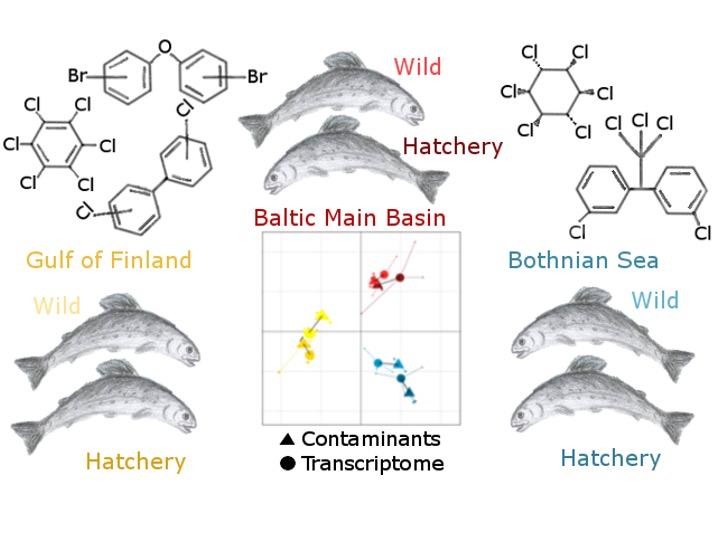
Credit: Reprinted with permission from Environmental Science & Technology. © 2020 American Chemical Society

Hatchery-reared Atlantic salmon (Salmo salar) have been released to support the wild salmon stocks in the Baltic Sea for decades. During their feeding migration, salmon are exposed to organohalogen compounds (OHCs). Here, we investigated the OHC levels and transcriptome profiles in the liver of wild and hatchery-reared salmon collected from the Baltic main basin, the Bothnian Sea, and the Gulf of Finland and examined whether salmon origin and OHC levels contributed to the hepatic transcriptome profiles. There were no differences in the OHC concentrations and transcriptome profiles between wild and hatchery-reared fish but there were large differences among the areas. Several transcript levels were associated with polychlorinated biphenyls, chlordanes, and dichlorodiphenyltrichloroethane in a concentration-dependent manner. When comparing the different areas, lipid metabolism, environmental stress, cell growth and death-related pathways were enriched in the liver transcriptome. Coinertia analysis, a multivariate method, showed that the covariation in the OHC levels and the transcriptome were significantly similar. These results suggest that the hepatic transcriptomes in wild and hatchery-reared salmon are more affected by the OHC level than the salmon’s origin. This paper was published in an American Chemical Society Journal, Environmental Science and Technology on November 9, 2020.

###

Media Contact
Public Relations Division
[email protected]

Related Journal Article

http://dx.doi.org/10.1021/acs.est.0c04763

Tags: BioinformaticsBiologyEcology/EnvironmentFisheries/AquacultureMarine/Freshwater BiologyPollution/RemediationToxicologyZoology/Veterinary Science
Share12Tweet8Share2ShareShareShare2

Related Posts

Ancient Plant Populations Reveal Fresh Insights into Climate Resilience — Biology

Ancient Plant Populations Reveal Fresh Insights into Climate Resilience

May 8, 2026
Rare Brain Disorders in Children Linked to Mutations in Lesser-Known Protein Complex — Biology

Rare Brain Disorders in Children Linked to Mutations in Lesser-Known Protein Complex

May 8, 2026

From Odd Insect to Underwater Predator: The Remarkable Evolution of a Bloodthirsty Fruit Fly

May 8, 2026

SNU Professor Sangwoo Seo’s Team Develops Next-Generation CRISPR Biocontainment Technology to Control Microbial Survival Without DNA Cleavage

May 8, 2026
Please login to join discussion

POPULAR NEWS

  • Research Indicates Potential Connection Between Prenatal Medication Exposure and Elevated Autism Risk

    840 shares
    Share 336 Tweet 210
  • New Study Reveals Plants Can Detect the Sound of Rain

    727 shares
    Share 290 Tweet 181
  • Salmonella Haem Blocks Macrophages, Boosts Infection

    61 shares
    Share 24 Tweet 15
  • Breastmilk Balances E. coli and Beneficial Bacteria in Infant Gut Microbiomes

    57 shares
    Share 23 Tweet 14

About

We bring you the latest biotechnology news from best research centers and universities around the world. Check our website.

Follow us

Recent News

New Post-Hoc Analysis Explores Daily Oral Orforglipron Use in Adults Over 65 with Obesity, Regardless of Diabetes Status

Evaluating Digoxin Use in Patients with Symptomatic Rheumatic Heart Disease

Evaluating the Effectiveness and Safety of Digitalis Glycosides in Treating Heart Failure

Subscribe to Blog via Email

Enter your email address to subscribe to this blog and receive notifications of new posts by email.

Join 82 other subscribers
  • Contact Us

Bioengineer.org © Copyright 2023 All Rights Reserved.

Welcome Back!

Login to your account below

Forgotten Password?

Retrieve your password

Please enter your username or email address to reset your password.

Log In
No Result
View All Result
  • Homepages
    • Home Page 1
    • Home Page 2
  • News
  • National
  • Business
  • Health
  • Lifestyle
  • Science

Bioengineer.org © Copyright 2023 All Rights Reserved.