• HOME
  • NEWS
  • EXPLORE
    • CAREER
      • Companies
      • Jobs
    • EVENTS
    • iGEM
      • News
      • Team
    • PHOTOS
    • VIDEO
    • WIKI
  • BLOG
  • COMMUNITY
    • FACEBOOK
    • INSTAGRAM
    • TWITTER
Saturday, February 7, 2026
BIOENGINEER.ORG
No Result
View All Result
  • Login
  • HOME
  • NEWS
  • EXPLORE
    • CAREER
      • Companies
      • Jobs
        • Lecturer
        • PhD Studentship
        • Postdoc
        • Research Assistant
    • EVENTS
    • iGEM
      • News
      • Team
    • PHOTOS
    • VIDEO
    • WIKI
  • BLOG
  • COMMUNITY
    • FACEBOOK
    • INSTAGRAM
    • TWITTER
  • HOME
  • NEWS
  • EXPLORE
    • CAREER
      • Companies
      • Jobs
        • Lecturer
        • PhD Studentship
        • Postdoc
        • Research Assistant
    • EVENTS
    • iGEM
      • News
      • Team
    • PHOTOS
    • VIDEO
    • WIKI
  • BLOG
  • COMMUNITY
    • FACEBOOK
    • INSTAGRAM
    • TWITTER
No Result
View All Result
Bioengineer.org
No Result
View All Result
Home NEWS Science News Biology

Biologists clarify how three species of cephalopods coexist in the Arctic

Bioengineer by Bioengineer
December 15, 2020
in Biology
Reading Time: 2 mins read
0
IMAGE
Share on FacebookShare on TwitterShare on LinkedinShare on RedditShare on Telegram

A paper appeared in Scientific Reports.
IMAGE

Credit: Olga Zimina

Co-author from Kazan Federal University, Professor Rushan Sabirov explains, “In ecosystems, two or more closely related species of organisms with similar ecology and morphological appearance often inhabit the same territory. These species are called sympatric. According to classical ecological theory, one of the species will lose out in competition and eventually die out. In reality, closely related sympatric species coexist successfully for a long time. It is very important to understand how the division of resources and favorable biotope sites between sympatric species in the Arctic occurs, because Arctic ecosystems are extremely susceptible to external influences.”

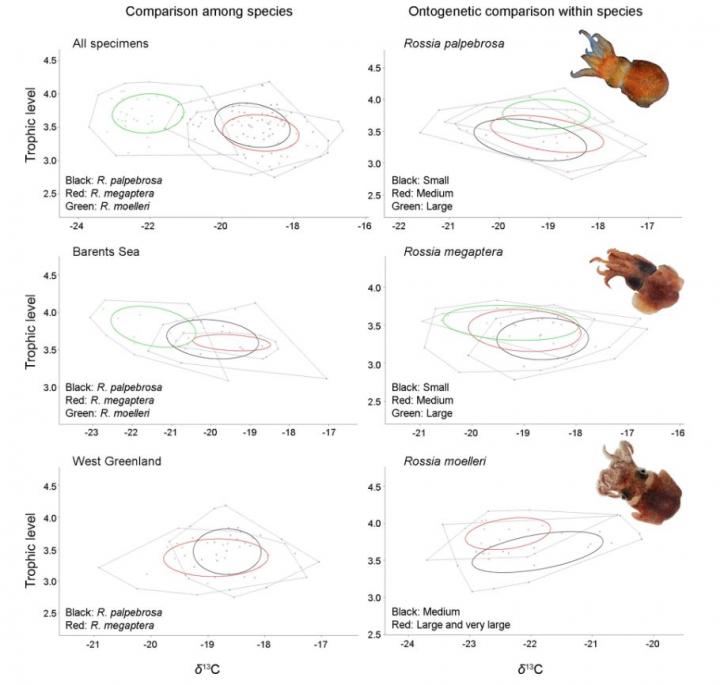
By analyzing the content of stable heavy isotopes of carbon (δ13C) and nitrogen (δ15N) in the beaks, the researchers studied three closely related cephalopod species: the highly boreal Rossia megaptera, the wide-boreal-Arctic Rossia palpebrosa, and the Arctic endemic Rossia moelleri, which are sympatric in the Arctic.

“It has been found that these species of Arctic cephalopods have seven characteristics that allow them to avoid competition: a certain pelagic lifestyle; ability to migrate; pronounced dimensional sexual dimorphism; geographical variability in diet; range of the diet; ontogenetic variability of isotopic niches; sexual variability of isotopic niches. Moreover, none of these seven traits occurs in all three species at the same time. Thus, a decrease in competition between closely related sympatric species is observed due to ecological adaptations, which are diagnosed only when studying a large sample with equal proportions of sexes and all ontogenetic stages using non-classical methods, such as ecological applications of isotope analysis,” explains Associate Professor Aleksey Golikov.

As the researchers conclude, none of the species should suffer from the warming in the Arctic, and Rossia megaptera may even become more competitive because of that.

Studies of Arctic ecosystems are in line with Russia’s Strategy for the Development of the Arctic Zone of Russian and National Security until 2035.

###

The publication was co-written by Kazan Federal University, Polar Institute of Marine Fisheries and Oceanography (Murmansk, Russia), University of Coimbra (Portugal), Greenland Institute of Natural Resources, Icelandic Institute of Natural History, and Institute of Marine Research (Norway).

Media Contact
Yury Nurmeev
[email protected]

Original Source

https://kpfu.ru/eng/news-eng/biologists-clarify-how-three-species-coexist.html

Related Journal Article

http://dx.doi.org/10.1038/s41598-020-78645-z

Tags: BiodiversityBiologyClimate ChangeMarine/Freshwater Biology
Share12Tweet8Share2ShareShareShare2

Related Posts

Florida Cane Toad: Complex Spread and Selective Evolution

Florida Cane Toad: Complex Spread and Selective Evolution

February 7, 2026
New Study Uncovers Mechanism Behind Burn Pit Particulate Matter–Induced Lung Inflammation

New Study Uncovers Mechanism Behind Burn Pit Particulate Matter–Induced Lung Inflammation

February 6, 2026

DeepBlastoid: Advancing Automated and Efficient Evaluation of Human Blastoids with Deep Learning

February 6, 2026

Navigating the Gut: The Role of Formic Acid in the Microbiome

February 6, 2026
Please login to join discussion

POPULAR NEWS

  • Robotic Ureteral Reconstruction: A Novel Approach

    Robotic Ureteral Reconstruction: A Novel Approach

    82 shares
    Share 33 Tweet 21
  • Digital Privacy: Health Data Control in Incarceration

    63 shares
    Share 25 Tweet 16
  • Study Reveals Lipid Accumulation in ME/CFS Cells

    57 shares
    Share 23 Tweet 14
  • Breakthrough in RNA Research Accelerates Medical Innovations Timeline

    53 shares
    Share 21 Tweet 13

About

We bring you the latest biotechnology news from best research centers and universities around the world. Check our website.

Follow us

Recent News

Evaluating Pediatric Emergency Care Quality in Ethiopia

TPMT Expression Predictions Linked to Azathioprine Side Effects

Improving Dementia Care with Enhanced Activity Kits

Subscribe to Blog via Email

Success! An email was just sent to confirm your subscription. Please find the email now and click 'Confirm' to start subscribing.

Join 73 other subscribers
  • Contact Us

Bioengineer.org © Copyright 2023 All Rights Reserved.

Welcome Back!

Login to your account below

Forgotten Password?

Retrieve your password

Please enter your username or email address to reset your password.

Log In
No Result
View All Result
  • Homepages
    • Home Page 1
    • Home Page 2
  • News
  • National
  • Business
  • Health
  • Lifestyle
  • Science

Bioengineer.org © Copyright 2023 All Rights Reserved.