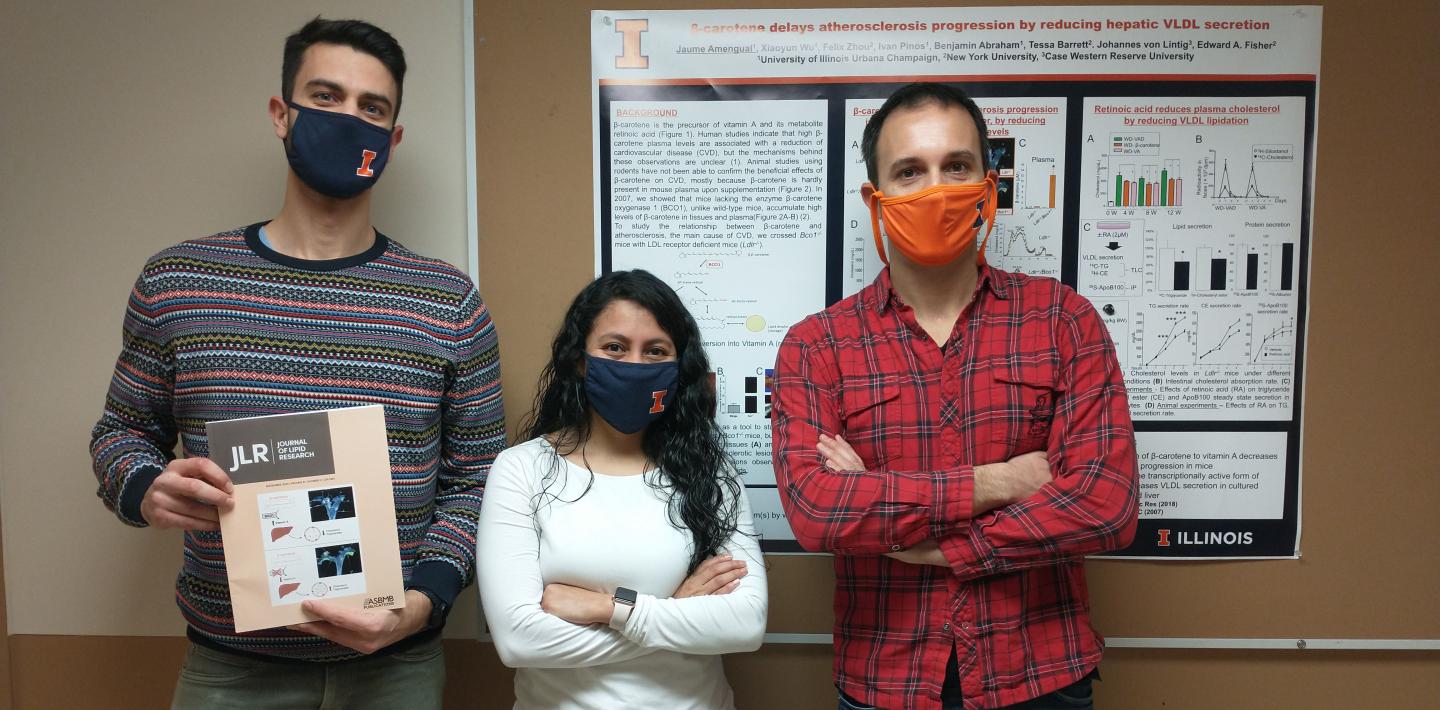
Credit: College of ACES.
URBANA, Ill. – Carrots are a good source of beta-carotene, which is a precursor of vitamin A. But to get the full health benefits of this superfood, you need an active enzyme to produce this vitamin.
Beta-carotene is the bioactive compound that gives carrots their orange color. Studies with humans and mice show the conversion of beta-carotene to vitamin A reduces “bad” cholesterol in the blood. Thus, beta-carotene can help protect against atherosclerosis development, which leads to the accumulation of fats and cholesterol in our arteries. Atherosclerosis cardiovascular disease is the primary cause of death worldwide, says Jaume Amengual, assistant professor of personalized nutrition in the Department of Food Science and Human Nutrition at University of Illinois.
Amengual and his colleagues conducted two studies to further understand the effects of beta-carotene on cardiovascular health. They confirmed its importance, but identified a critical step in the process.
Beta-carotene converts to vitamin A with the help of an enzyme called beta-carotene oxygenase 1 (BCO1). A genetic variation determines if you have a more or less active version of BCO1. People with a less active enzyme could need other sources for vitamin A in their diet, Amengual says.
The first study, published in the Journal of Nutrition, analyzed blood and DNA samples from 767 healthy young adults aged 18 to 25. As expected the researchers found a correlation between BCO1 activity and bad cholesterol level.
“People who had a genetic variant associated with making the enzyme BCO1 more active had lower cholesterol in their blood. That was our first observation,” Amengual notes.
To follow up on these findings, Amengual and his colleagues conducted a second study, published in the Journal of Lipid Research, using mice.
“In the human study, we saw that cholesterol was higher in people who do not produce much vitamin A. To know if that observation has an effect in the long run, we would have to wait 70 years to see if they develop cardiovascular. In real life, that is not doable. That’s why we use animals for certain studies, so we can speed up the process,” he explains.
“The main findings of the mice study reproduce what we found in humans. We saw that when we give beta-carotene to mice, they have lower cholesterol levels. These mice develop smaller atherosclerosis lesions, or plaques, in their arteries. This means that mice fed beta-carotene are more protected against atherosclerosis than those fed a diet without this bioactive compound,” Amengual states.
In the second study, the researchers also investigated the biochemical pathways of these processes, determining where in the body the effect occurs.
“We narrow it down to the liver as the organ in charge of producing and secreting lipoproteins to the bloodstream, including those lipoproteins known as bad cholesterol. We observed that in mice with high levels of vitamin A, the secretion of lipids into the bloodstream slows down,” Amengual notes.
Understanding how the BCO1 enzyme relates to cholesterol has important implications. Typically, high beta-carotene levels in the blood are associated with health benefits. But it could also be a sign of a less active BCO1 enzyme that is not converting the beta-carotene we eat into vitamin A.
Up to 50% of the population have the less-active variant of the enzyme, Amengual notes. That means their body is slower at producing vitamin A from a plant source, and they could need to get this nutrient directly from an animal source such as milk, or cheese, for example.
###
The Department of Food Science and Human Nutrition is in the College of Agricultural, Consumer and Environmental Sciences, University of Illinois.
The first study, “β-Carotene Oxygenase 1 Activity Modulates Circulating Cholesterol Concentrations in Mice and Humans,” is published in the Journal of Nutrition. [https:/
Authors include Jaume Amengual, Johana Coronel, Courtney Marques, Celia Aradillas-García, Juan Manuel Vargas Morales, Flavia CD Andrade, John W Erdman, Jr, and Margarita Teran-Garcia.
The second study, “β-carotene conversion to vitamin A delays atherosclerosis progression by decreasing hepatic lipid secretion in mice,” is published in the Journal of Lipid Research. [DOI: 10.1194/jlr.RA120001066]
Authors include Felix Zhou, Xiaoyun Wu, Ivan Pinos, Benjamin Abraham, Tessa Barrett, Johannes von Lintig, Edward Fisher, and Jaume Amengual.
Support for the research was provided by the American Heart Association, the National Institutes of Health, the United States Department of Agriculture, the University of Illinois, and the Autonomous University of San Luis Potosi.
Media Contact
MARIANNE STEIN
[email protected]
Original Source
https:/
Related Journal Article
http://dx.