College students reported cutting back consumption
Credit: Jennifer Falbe
As municipalities have taxed sugar-sweetened beverages and schools and worksites have banned their sales, university researchers have found that simple warning labels on such beverages in a college cafeteria helped students reduce their reported consumption of drinks by 14.5 percent. The results signal that such labels could reduce sugar consumption in larger settings.
“Sugar-sweetened beverages are a major driver of chronic disease. Health warning labels may reduce the intake of sugar-sweetened beverages, but the effectiveness of such labels in real-world settings is only beginning to be established,” said Jennifer Falbe, assistant professor of Nutrition and Human Development at University of California, Davis, who is a senior author of the study and designed the warning label used. “This experiment takes the evidence a step further by looking at young adult behavior in a setting that they frequent each day,” she said. The study was conducted by the University of Michigan School of Public Health and UC Davis.
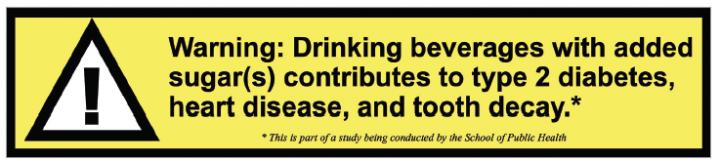
Taking a cue from tobacco control efforts, researchers placed warning labels on beverage dispensers at a University of Michigan cafeteria for one semester in 2019. In language based on previous proposed California legislation, the bright yellow labels with a large triangle and exclamation mark state:
“Warning: Drinking beverages with added sugar(s) contributes to type 2 diabetes, heart disease, and tooth decay.” Two other cafeterias on campus — located geographically distant from the cafeteria with the labels — served as control sites, and displayed no warning labels.
Nearly 1,000 college students were contacted by email before and after the warning labels were implemented to ask them to participate in surveys with no specific mention of sugar-sweetened beverages. Participants were given a $10 gift card after completing each survey.
In total, 840 students across all cafeterias were included in the study. At the intervention site, consumption of sugar-sweetened drinks that had the warning label declined by 18.5 percent compared to a decline of 4.7 percent at the control sites at which no label was used. Students exposed to the warning labels also reduced their consumption of 100-percent juice drinks by 21 percent even though, in the experiment, juices had not been labeled as sugar-sweetened beverages.
A tool to reduce sugar consumption
“The results of this study indicate that warning labels may be effective tools for reducing consumption of sugar-sweetened beverages, particularly beverages such as sweetened teas, pink lemonade and chocolate milk for which the sugar content is not immediately obvious or well known,” said Cindy Leung, assistant professor of Nutritional Sciences at the University of Michigan School of Public Health and lead author of the study.
“Sugar-sweetened beverages remain ubiquitous in retail and cafeteria settings. As we explore avenues to promote healthy food and beverage choices, warning labels are a potential tool to reduce their consumption that should be tested in other populations and other settings.” said Julia Wolfson, assistant professor of Health Management and Policy at the U-M School of Public Health and co-author of the study.
The study, “Warning Labels Reduce Sugar-Sweetened Beverage Intake among College Students,” was published last month in the Journal of Nutrition. Additional co-authors are Robert Hsu, Keith Soster and Steve Mangan, all of University of Michigan, Ann Arbor. Falbe teaches in the UC Davis Department of Human Ecology.
“These results provide evidence to inform future institutional strategies… and legislative efforts to use warning labels as a promising approach to SSB consumption,” the researchers concluded.
For instance, nine jurisdictions, including California, have introduced, at various times, sugar-sweetened beverage warning label legislation. “These laws could ensure that consumers have the necessary information to make informed choices,” Falbe said.
###
The research was funded by a grant from Poverty Solutions at the University of Michigan, the McNerney Award from the Department of Health Management and Policy at the University of Michigan School of Public Health, and the National Institutes of Health.
The study is available here:
https:/
Media Contact
Karen Nikos-Rose
[email protected]
Original Source
https:/
Related Journal Article
http://dx.
https://scienmag.com/warning-labels-reduce-sugary-drink-consumption-in-university-setting-researchers-found/