Changes in the Antarctic ice sheet were driven by the melting ice sheets in the Northern Hemisphere
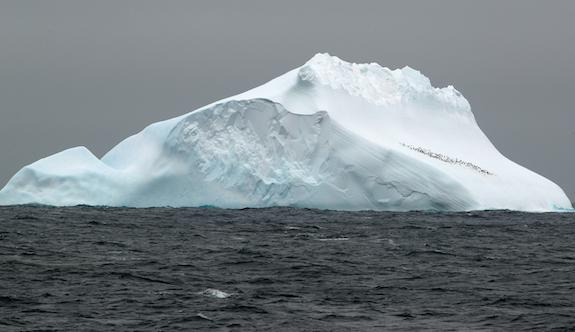
Credit: Thomas Ronge
Over the past 40,000 years, ice sheets thousands of kilometres apart have influenced one another through sea level changes, according to research published today in Nature. New modelling of ice sheet changes during the most recent glacial cycle by a McGill-led team offers a clearer idea of the mechanisms that drive change than had previously existed and explains newly available geological records. The study demonstrates, for the first time, that during this period, changes in the Antarctic ice sheet were driven by the melting ice sheets in the Northern Hemisphere.
As the climate cooled, during the last Ice Age, water became locked up in land ice in the Northern Hemisphere leading to dropping sea levels in Antarctica and consequent growth of the ice sheet. As the climate warmed, on the other hand, as it did through the period of deglaciation, the retreating ice in the Northern Hemisphere led to rising water levels around Antarctica, which in turn drove a retreat of the Antarctic ice sheet.
“Ice sheets can influence each other over great distances due to the water that flows between them,” explains senior author Natalya Gomez, from McGill’s Department of Earth and Planetary Sciences. “It’s as though they were talking to one another through sea level changes.”
Finding answers in ocean sediment and records of past shorelines
“Polar ice sheets are not just large, static mounds of ice. They evolve on various different time scales and are in constant flux, with the ice growing and retreating depending on the climate and the surrounding water levels,” explains Gomez. “They gain ice as snow piles up on top of them, then spread outwards under their own weight, and stream out into the surrounding ocean where their edges break off into icebergs.”
In order to investigate the mechanisms involved in driving changes in the Antarctic ice sheet over geologic time scales, the study draws on numerical modeling and a wide range of geological records, from cores of sediment from the ocean bottom near Antarctica to records of land exposure and past shorelines.
With this information, the researchers were able, for the first time, to simulate, simultaneously, changes in both sea levels and ice dynamics in both hemispheres over the past 40,000 years. This time frame provides the basis for a broad understanding of how climate factors affect ice sheets, since it covers the period leading up to the peak of last Ice Age, between 26,000-20,000 years ago up to the present.
Water and ice sheets on the move
The records suggest that there the ice loss from the Antarctic ice sheet over this period was significant, with intermittent periods of accelerated retreat. The researchers found that the only mechanism that could explain this response were the sea level changes in Antarctica caused by changes to the ice sheets in the Northern Hemisphere.
“We found a very variable signal of ice-mass loss over the last 20,000 years, left behind by icebergs breaking off Antarctica and melting down in the surrounding oceans,” says Michael Weber, from the Department of Geochemistry and Petrology at the University of Bonn. “This evidence could hardly be reconciled with existing models until we accounted for how the ice sheets in both hemispheres interact with one another across the globe.”
“The scale and complexity of ice sheets and the oceans, and the secrets of the Earth’s past climate that are locked up in the geological record are fascinating and inspiring,” concludes Gomez. “Our results highlight how interconnected the Earth system is, with changes in one part of the planet driving changes in another. In the modern era, we haven’t seen the kind of large ice sheet retreat that we might see in our future warming world. Looking to records and models of changes in Earth’s history can inform us about this.”
###
Media Contact
Katherine Gombay
[email protected]
Original Source
https:/
Related Journal Article
http://dx.