• HOME
  • NEWS
  • EXPLORE
    • CAREER
      • Companies
      • Jobs
    • EVENTS
    • iGEM
      • News
      • Team
    • PHOTOS
    • VIDEO
    • WIKI
  • BLOG
  • COMMUNITY
    • FACEBOOK
    • INSTAGRAM
    • TWITTER
Thursday, March 26, 2026
BIOENGINEER.ORG
No Result
View All Result
  • Login
  • HOME
  • NEWS
  • EXPLORE
    • CAREER
      • Companies
      • Jobs
        • Lecturer
        • PhD Studentship
        • Postdoc
        • Research Assistant
    • EVENTS
    • iGEM
      • News
      • Team
    • PHOTOS
    • VIDEO
    • WIKI
  • BLOG
  • COMMUNITY
    • FACEBOOK
    • INSTAGRAM
    • TWITTER
  • HOME
  • NEWS
  • EXPLORE
    • CAREER
      • Companies
      • Jobs
        • Lecturer
        • PhD Studentship
        • Postdoc
        • Research Assistant
    • EVENTS
    • iGEM
      • News
      • Team
    • PHOTOS
    • VIDEO
    • WIKI
  • BLOG
  • COMMUNITY
    • FACEBOOK
    • INSTAGRAM
    • TWITTER
No Result
View All Result
Bioengineer.org
No Result
View All Result
Home NEWS Science News

Tracking COVID-19 trends in hard-hit states

Bioengineer by Bioengineer
November 24, 2020
in Science News
Reading Time: 3 mins read
0
IMAGE
Share on FacebookShare on TwitterShare on LinkedinShare on RedditShare on Telegram

IMAGE

Credit: Nicholas Walker, LSU

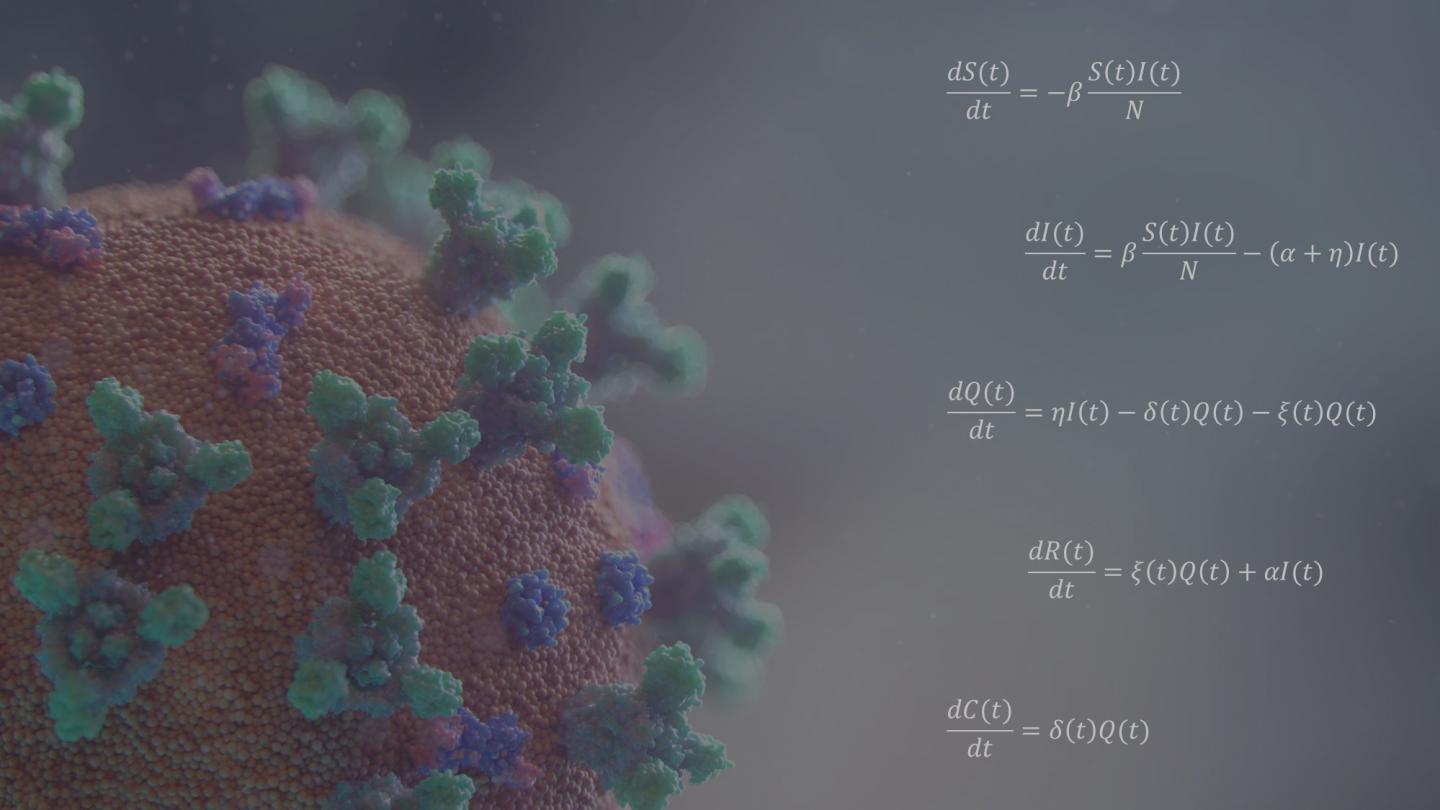
Currently, there are over 10 million confirmed cases and more than 240,000 casualties attributed to COVID-19 in the U.S. Researchers at Louisiana State University have applied computational models to investigate infection rates in relation to social distancing measures. Their paper, Effect of mitigation measures on the spreading of COVID-19 in hard-hit states in the U.S., was recently published in PLOS ONE.

This research compiles the data for each state in the U.S. and calculates the change in the infection rate before and after social distance measures were imposed last spring.

“We investigate the change in the infection rate due to mitigation efforts and project death and infection counts through September 2020 for some of the most heavily impacted states: New York, New Jersey, Michigan, Massachusetts, Illinois, and Louisiana,” said co-author Juana Moreno, LSU Department of Physics & Astronomy and the Center for Computation & Technology associate professor.

Many of the current predictive models of the development of COVID-19, especially after mitigation efforts, partially rely on extrapolations from data collected in other countries. However, understanding the effects of mitigation efforts based on local data is important, since data extrapolated from other areas may not be reliable. As states and countries have implemented different degrees of social distancing measures, the effects on controlling the pandemic simply cannot be translated between regions.

“The interactions among people are complicated and often difficult to model at the individual level. The challenge is similar to the study of a large ensemble of particles where monitoring the motion of each particle is virtually impossible. Mean field approximation is often used to study large populations by coarse graining the individual, or microscopic, details to the population, or macroscopic, averaged quantity,” said lead author Ka-Ming Tam, LSU Department of Physics & Astronomy research assistant professor.

With the current mitigation efforts, five of those six states with the exception of Illinois, have reduced their base reproduction number to a value less than one, stopping the exponential growth of the pandemic.

“The infection rate is an important indicator of the evolution of an epidemic. If it is larger than one, the number of infections is exponentially increasing,” said Nicholas Walker, LSU Department of Physics & Astronomy alumnus and current postdoctoral fellow. “We found that the infection rate is substantially suppressed by social distancing measures. Almost all states had the infection rate dropped below one by the end of the April.”

The analyses by the researchers clearly shows a drop in infection rates following public policy measures such as social distancing and stay-at-home orders.

“We are currently working on the effects of reopening and how the reopening policies in different states have affected the number of fatalities,” Moreno said. “Our current analysis suggests that the face mask mandate is the most important policy for lowering the death count.”

###

Media Contact
Alison Satake
[email protected]

Original Source

https://www.lsu.edu/physics/news/2020/moreno_covid_tracking.php

Related Journal Article

http://dx.doi.org/10.1371/journal.pone.0240877

Tags: Computer ScienceCritical Care/Emergency MedicineDeath/DyingEpidemiologyInfectious/Emerging DiseasesMedicine/HealthTechnology/Engineering/Computer Science
Share12Tweet8Share2ShareShareShare2

Related Posts

Starburst Winds Drain Supernova Energy Quickly

Starburst Winds Drain Supernova Energy Quickly

March 26, 2026
Decoding the Phosphorus Puzzle: How Microplastics and Hydrochar Transform Nutrient Dynamics in Rice Paddies

Decoding the Phosphorus Puzzle: How Microplastics and Hydrochar Transform Nutrient Dynamics in Rice Paddies

March 26, 2026

Microtubules Found to Actively Ensure Accurate Chromosome Distribution During Cell Division

March 25, 2026

Aversive Learning Hijacks Brain Sugar Sensor

March 25, 2026
Please login to join discussion

POPULAR NEWS

  • blank

    Revolutionary AI Model Enhances Precision in Detecting Food Contamination

    96 shares
    Share 38 Tweet 24
  • Imagine a Social Media Feed That Challenges Your Views Instead of Reinforcing Them

    1003 shares
    Share 397 Tweet 248
  • Uncovering Functions of Cavernous Malformation Proteins in Organoids

    54 shares
    Share 22 Tweet 14
  • Promising Outcomes from First Clinical Trials of Gene Regulation in Epilepsy

    51 shares
    Share 20 Tweet 13

About

We bring you the latest biotechnology news from best research centers and universities around the world. Check our website.

Follow us

Recent News

In-Sensor Cryptography Links Physical Process to Digital Identity

Can Psychosocial Factors Influence Cancer Risk?

Depression Factors in Elderly: Pre vs. Post-COVID Analysis

Subscribe to Blog via Email

Enter your email address to subscribe to this blog and receive notifications of new posts by email.

Join 78 other subscribers
  • Contact Us

Bioengineer.org © Copyright 2023 All Rights Reserved.

Welcome Back!

Login to your account below

Forgotten Password?

Retrieve your password

Please enter your username or email address to reset your password.

Log In
No Result
View All Result
  • Homepages
    • Home Page 1
    • Home Page 2
  • News
  • National
  • Business
  • Health
  • Lifestyle
  • Science

Bioengineer.org © Copyright 2023 All Rights Reserved.