Credit: Helmholtz Zentrum München
Our lungs are exposed to a multitude of hazardous airborne particles on a daily basis. Nanoparticles, due to their small size, may reach the sensitive alveolar region of the human lung and trigger inflammation even after a single inhalation leading to severe diseases such as heart disease, brain damage and lung cancer for prolonged exposure. In manufacturing, toxic nanoparticles may be released into the environment during the production, processing, degradation or combustion of materials. Despite advances in models for nanotoxicology, currently neither in vitro nor in silico testing tools can reliably predict adverse outcomes or replace in vivo testing. In order to facilitate the introduction of safer materials into our lives, novel testing strategies are needed to predict the potential toxicity of industrial nanoparticles before and during the manufacturing process.
Unlocking the cellular mechanisms
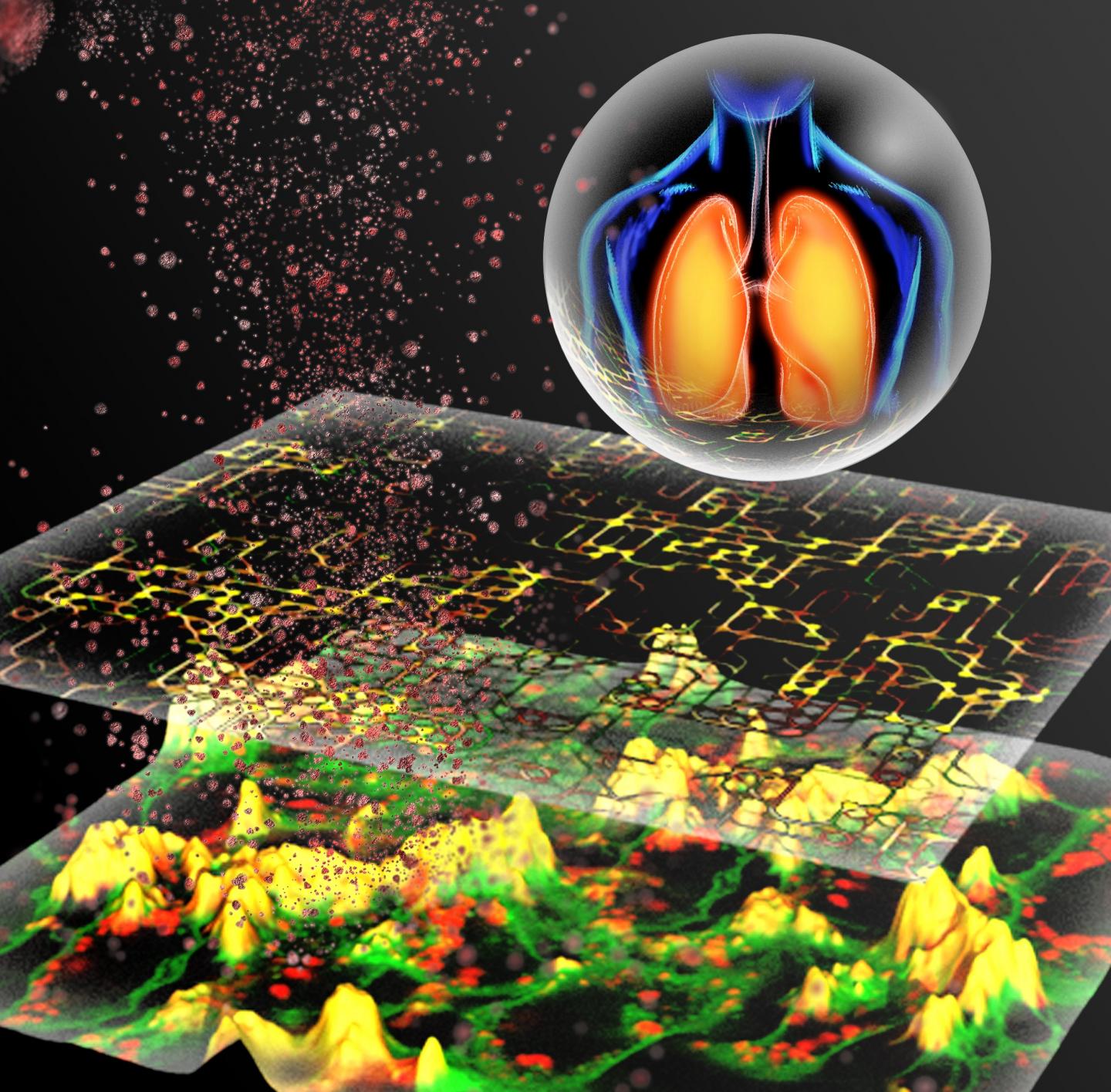
At Helmholtz Zentrum München, the research group of Dr. Tobias Stöger is focusing on an improved mechanistic understanding of the interactions between nanoparticles and lung cells, especially in view of the resulting inflammation. In cooperation with partners from the SmartNanoTox EU project, the research group discovered that for certain materials the long-lasting inflammatory response to a single exposure to a nanoparticle can originate from two cellular key events which were so far unknown: First, the quarantining process which is the deposition of excreted immobile composites of the nanoparticles wrapped with biological molecules on the cell surface. Second, the so-called nanomaterial cycling which entails the movement of the nanoparticles between different alveolar lung cell types.
“With these new insights, we developed a deeper comprehensive approach on how an inflammatory response in the lung originates from particle-cell interactions. Being able to pinpoint the origin to these two key events and quantitatively describe them was a breakthrough as it helped us built our prediction method”, says Stöger.
A step closer to safe-by-design material development
Using only a small set of data from in vitro measurements and by combining it with in silico modeling, the researchers gathered insights on the toxicity of nanoparticles and managed to predict the spectrum of lung inflammation (from acute to chronic) associated with a range of 15 selected materials. Stöger adds: “Being able to make such a prediction means that we can move a step closer to a safe-by-design material development. This will have profound implications on the safety, speed and cost-effectiveness of new materials.”
Additional benefit: Animal-free testing
Currently, safety testing relies heavily on animal studies. While animal experimentation is still indispensable for mechanistic and chronic toxicological studies, they are less suited for predictive tests within a safe-by-design production of new materials. This study introduces an alternative animal-free testing strategy, capable for high-throughput testing and connectable with in silico modelling.
###
About the study
The findings published in this study derive from a collaborative European research project called “SmartNanoTox – Smart Tools for Gauging Nano Hazards” (EU Horizon 2020 project No. 686098). The project is part of the “EU NanoSafety Cluster” which aims to maximize the synergies between European-level projects addressing the safety of materials and technologies enabled by the use of nanoforms.
Original publication
Kokot et al., 2020: Prediction of Chronic Inflammation for Inhaled Particles, the Impact of Material Cycling and Quarantining in the Lung Epithelium. Advanced Materials, DOI: 10.1002/adma.202003913
Helmholtz Zentrum München
Helmholtz Zentrum München is a research center with the mission to discover personalized medical solutions for the prevention and therapy of environmentally-induced diseases and promote a healthier society in a rapidly changing world. It investigates important common diseases which develop from the interaction of lifestyle, environmental factors and personal genetic background, focusing particularly on diabetes mellitus, allergies and chronic lung diseases. Helmholtz Zentrum München is headquartered in Neuherberg in the north of Munich and has about 2,500 staff members. It is a member of the Helmholtz Association, the largest scientific organization in Germany with more than 40,000 employees at 19 research centers.
Media Contact
Verena Schulz
[email protected]
Original Source
https:/
Related Journal Article
http://dx.