• HOME
  • NEWS
  • EXPLORE
    • CAREER
      • Companies
      • Jobs
    • EVENTS
    • iGEM
      • News
      • Team
    • PHOTOS
    • VIDEO
    • WIKI
  • BLOG
  • COMMUNITY
    • FACEBOOK
    • INSTAGRAM
    • TWITTER
Saturday, February 7, 2026
BIOENGINEER.ORG
No Result
View All Result
  • Login
  • HOME
  • NEWS
  • EXPLORE
    • CAREER
      • Companies
      • Jobs
        • Lecturer
        • PhD Studentship
        • Postdoc
        • Research Assistant
    • EVENTS
    • iGEM
      • News
      • Team
    • PHOTOS
    • VIDEO
    • WIKI
  • BLOG
  • COMMUNITY
    • FACEBOOK
    • INSTAGRAM
    • TWITTER
  • HOME
  • NEWS
  • EXPLORE
    • CAREER
      • Companies
      • Jobs
        • Lecturer
        • PhD Studentship
        • Postdoc
        • Research Assistant
    • EVENTS
    • iGEM
      • News
      • Team
    • PHOTOS
    • VIDEO
    • WIKI
  • BLOG
  • COMMUNITY
    • FACEBOOK
    • INSTAGRAM
    • TWITTER
No Result
View All Result
Bioengineer.org
No Result
View All Result
Home NEWS Science News

Guiding the way to improved solar cell performance

Bioengineer by Bioengineer
November 24, 2020
in Science News
Reading Time: 2 mins read
0
IMAGE
Share on FacebookShare on TwitterShare on LinkedinShare on RedditShare on Telegram

IMAGE

Credit: © 2020 KAUST

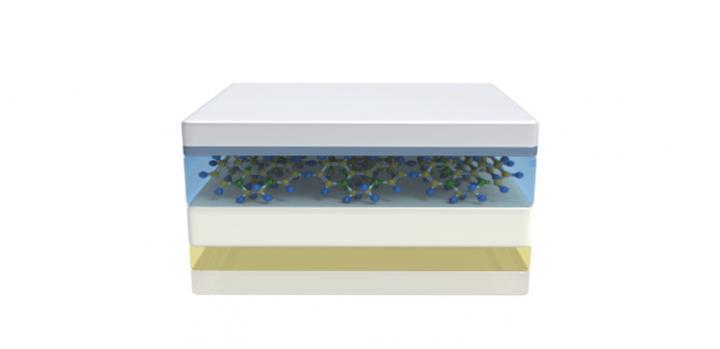
Understanding how particles travel through a device is vital for improving the efficiency of solar cells. Researchers from KAUST, working with an international team of scientists, have now developed a set of design guidelines for enhancing the performance of molecular materials.

When a packet of light, or photon, is absorbed by a semiconductor, it generates a pair of particles known as an exciton. An electron is one part of this pair; the other is its positively charged equivalent, called a hole. Excitons are electrically neutral, so it is impossible to set them in motion by applying an electric field. Instead the excitons “hop” by a random motion or diffusion. The dissociation of the excitons into charges is necessary to create a current but is highly improbable in an organic semiconductor.

“So typically, we need to blend two semiconductors, a so-called electron donor and an electron acceptor, to efficiently generate free charges,” explains Yuliar Firdaus. “The donor and acceptor materials penetrate into one another; maximizing the exciton diffusion length– the distance the exciton can travel before recombining and being lost– is crucial for optimizing the organic solar cell’s performance.

Many previous organic solar cells were made by blending a polymer with molecules, known as fullerenes. But more recently, replacing the fullerene with other organic materials such as nonfullerene small molecules produced impressive improvements in device efficiency.

Firdaus and colleagues combined measurements of the photocurrent with ultrafast spectroscopy to calculate the diffusion length of a wide variety of nonfullerene molecules. They observed very long exciton diffusion lengths, in the range of 20 to 47 nanometers–an improvement on the 5 to 10 nanometer range characteristic of fullerenes.

To better understand this improvement, the team compared data describing the crystallographic structure of the molecules with quantum chemical calculations. In this way they could identify key relationships between the chemical structure of the molecule and the diffusion length. With these connections established, the scientists developed a set of rules to aid in the synthesis of improved materials and, ultimately, help the design of organic photovoltaic devices with improved conversion efficiency.

“Next, we plan to investigate how film processing processes might affect the exciton transfer rate of the existing small-molecule acceptors,” says Firdaus. “We are also interested in translating the molecular design rules to synthesize new acceptor materials with better performance.”

###

Media Contact
Michael Cusack
[email protected]

Original Source

https://discovery.kaust.edu.sa/en/article/1065/guiding-the-way-to-improved-solar-cell-performance

Related Journal Article

http://dx.doi.org/10.1038/s41467-020-19029-9

Tags: Biomedical/Environmental/Chemical EngineeringChemistry/Physics/Materials SciencesEnergy SourcesEnergy/Fuel (non-petroleum)Industrial Engineering/ChemistryMaterials
Share12Tweet8Share2ShareShareShare2

Related Posts

Scientists Identify SARS-CoV-2 PLpro and RIPK1 Inhibitors Showing Potent Synergistic Antiviral Effects in Mouse COVID-19 Model

February 7, 2026

Neg-Entropy: The Key Therapeutic Target for Chronic Diseases

February 7, 2026

Multidisciplinary Evidence-Based Guidelines for Therapeutic Drug Monitoring of Biologics in Inflammatory Bowel Disease

February 7, 2026

Early Tuberculosis Treatment Lowers Sepsis Mortality in People with HIV

February 7, 2026
Please login to join discussion

POPULAR NEWS

  • Robotic Ureteral Reconstruction: A Novel Approach

    Robotic Ureteral Reconstruction: A Novel Approach

    82 shares
    Share 33 Tweet 21
  • Digital Privacy: Health Data Control in Incarceration

    63 shares
    Share 25 Tweet 16
  • Study Reveals Lipid Accumulation in ME/CFS Cells

    57 shares
    Share 23 Tweet 14
  • Breakthrough in RNA Research Accelerates Medical Innovations Timeline

    53 shares
    Share 21 Tweet 13

About

We bring you the latest biotechnology news from best research centers and universities around the world. Check our website.

Follow us

Recent News

Scientists Identify SARS-CoV-2 PLpro and RIPK1 Inhibitors Showing Potent Synergistic Antiviral Effects in Mouse COVID-19 Model

Neg-Entropy: The Key Therapeutic Target for Chronic Diseases

Multidisciplinary Evidence-Based Guidelines for Therapeutic Drug Monitoring of Biologics in Inflammatory Bowel Disease

Subscribe to Blog via Email

Enter your email address to subscribe to this blog and receive notifications of new posts by email.

Join 73 other subscribers
  • Contact Us

Bioengineer.org © Copyright 2023 All Rights Reserved.

Welcome Back!

Login to your account below

Forgotten Password?

Retrieve your password

Please enter your username or email address to reset your password.

Log In
No Result
View All Result
  • Homepages
    • Home Page 1
    • Home Page 2
  • News
  • National
  • Business
  • Health
  • Lifestyle
  • Science

Bioengineer.org © Copyright 2023 All Rights Reserved.