• HOME
  • NEWS
  • EXPLORE
    • CAREER
      • Companies
      • Jobs
    • EVENTS
    • iGEM
      • News
      • Team
    • PHOTOS
    • VIDEO
    • WIKI
  • BLOG
  • COMMUNITY
    • FACEBOOK
    • INSTAGRAM
    • TWITTER
Monday, May 11, 2026
BIOENGINEER.ORG
No Result
View All Result
  • Login
  • HOME
  • NEWS
  • EXPLORE
    • CAREER
      • Companies
      • Jobs
        • Lecturer
        • PhD Studentship
        • Postdoc
        • Research Assistant
    • EVENTS
    • iGEM
      • News
      • Team
    • PHOTOS
    • VIDEO
    • WIKI
  • BLOG
  • COMMUNITY
    • FACEBOOK
    • INSTAGRAM
    • TWITTER
  • HOME
  • NEWS
  • EXPLORE
    • CAREER
      • Companies
      • Jobs
        • Lecturer
        • PhD Studentship
        • Postdoc
        • Research Assistant
    • EVENTS
    • iGEM
      • News
      • Team
    • PHOTOS
    • VIDEO
    • WIKI
  • BLOG
  • COMMUNITY
    • FACEBOOK
    • INSTAGRAM
    • TWITTER
No Result
View All Result
Bioengineer.org
No Result
View All Result
Home NEWS Science News Chemistry

T-cell abnormalities in severe COVID-19 cases

Bioengineer by Bioengineer
November 20, 2020
in Chemistry
Reading Time: 3 mins read
0
IMAGE
Share on FacebookShare on TwitterShare on LinkedinShare on RedditShare on Telegram

IMAGE

Credit: Associate Professor Masahiro Ono

There is an idea within the coronavirus research field that there is some kind of T cell abnormality in critically ill COVID-19 patients, but specific details have not yet been clarified. To shed light on the problem, a research collaboration based in Kumamoto University (Japan) has performed a genetic analysis of T cells from lung tissue of COVID-19 patients. Their work revealed abnormalities in T cells that resulted in overactivation that may cause severe pneumonia. The researchers believe that their findings will lead to new ways of avoiding severe pneumonia caused by coronavirus infections.

COVID-19 continues to have an enormous impact on daily lives. Why some people become severely ill while the majority of those infected are asymptomatic or very mildly ill is still a major unanswered question. Risk factors for severe disease include old age, diabetes, obesity, and hypertension. We also know that critically ill patients experience an increase in inflammation factors (inflammatory cytokines) and immune system overreaction, whereas the number of T cells, the “command centers” for immune cells, is significantly reduced in the blood. However, the medical implications of these findings are still unclear.

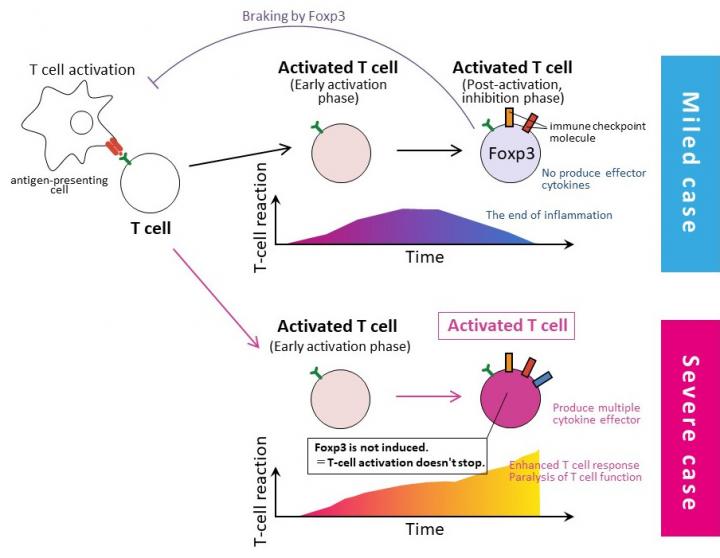
T cells regulate the activity of the immune system by recognizing specific viruses. They also play important roles in virus elimination and the acquisition of immunity. In this study, researchers focused on T cells to determine the causes of severe pneumonia in COVID-19. CD4+ T cells (helper T cells) work to eliminate viruses from the body by promoting the maturation and activation of cytotoxic T cells, which attack virus-infected cells, and B cells, which produce antibodies. On the other hand, when some CD4+ T cells become highly activated, they express the transcription factor FoxP3 and become regulatory T cells which then act as brakes to inhibit T cell responses. This research analyzed genetic data from bronchoalveolar lavage fluids from lungs of patients with COVID-19 from Wuhan, China to characterize the activity and genetic characteristics of the CD4+ T cells present.

Using state-of-the-art bioinformatics techniques, they found that while T cells were markedly activated in the lungs of patients with severe pneumonia, the induction of FoxP3 was inhibited and the T cell braking function stopped working. While T-cell activities are usually balanced between accelerating and braking, one of the most important brakes was not functioning in severe COVID-19 which may have led to severe pneumonia.

“This study has clarified the association between severe pneumonia and T cell abnormalities. We expect that these findings will lead to a better understanding of the mechanisms of severe pneumonia in patients with COVID-19,” said study leader, Associate Professor Masahiro Ono. “A more detailed understanding of the pathogenesis based on this research may contribute to the development of drugs to prevent the development of severe COVID-19 and to diagnose the risk of severe disease.”

###

This research was published online in Frontiers in Immunology on 8 October 2020.

Source:

Kalfaoglu, B., Almeida-Santos, J., Tye, C. A., Satou, Y., & Ono, M. (2020). T-Cell Hyperactivation and Paralysis in Severe COVID-19 Infection Revealed by Single-Cell Analysis. Frontiers in Immunology, 11. doi:10.3389/fimmu.2020.589380

Media Contact
J. Sanderson, N. Fukuda, C. Chen
[email protected]

Related Journal Article

http://dx.doi.org/10.3389/fimmu.2020.589380

Tags: BiochemistryBioinformaticsCell BiologyEpidemiologyImmunology/Allergies/AsthmaInfectious/Emerging DiseasesMedicine/HealthVirology
Share13Tweet8Share2ShareShareShare2

Related Posts

Miniature Sensor Uses Light to Detect Touch — Chemistry

Miniature Sensor Uses Light to Detect Touch

May 8, 2026
Iron Minerals Determine Whether Dissolved Organic Matter Fuels Microbes or Becomes Long-Term Carbon Storage — Chemistry

Iron Minerals Determine Whether Dissolved Organic Matter Fuels Microbes or Becomes Long-Term Carbon Storage

May 8, 2026

Kate Evans Appointed Associate Lab Director for Biological and Environmental Systems Science at ORNL

May 8, 2026

Advancing Multiscale Modeling and Overcoming Operational Challenges in Autothermal COâ‚‚-to-Methanol Reactors

May 8, 2026
Please login to join discussion

POPULAR NEWS

  • Research Indicates Potential Connection Between Prenatal Medication Exposure and Elevated Autism Risk

    840 shares
    Share 336 Tweet 210
  • New Study Reveals Plants Can Detect the Sound of Rain

    727 shares
    Share 290 Tweet 181
  • Salmonella Haem Blocks Macrophages, Boosts Infection

    61 shares
    Share 24 Tweet 15
  • Breastmilk Balances E. coli and Beneficial Bacteria in Infant Gut Microbiomes

    57 shares
    Share 23 Tweet 14

About

We bring you the latest biotechnology news from best research centers and universities around the world. Check our website.

Follow us

Recent News

New Post-Hoc Analysis Explores Daily Oral Orforglipron Use in Adults Over 65 with Obesity, Regardless of Diabetes Status

Evaluating Digoxin Use in Patients with Symptomatic Rheumatic Heart Disease

Evaluating the Effectiveness and Safety of Digitalis Glycosides in Treating Heart Failure

Subscribe to Blog via Email

Enter your email address to subscribe to this blog and receive notifications of new posts by email.

Join 82 other subscribers
  • Contact Us

Bioengineer.org © Copyright 2023 All Rights Reserved.

Welcome Back!

Login to your account below

Forgotten Password?

Retrieve your password

Please enter your username or email address to reset your password.

Log In
No Result
View All Result
  • Homepages
    • Home Page 1
    • Home Page 2
  • News
  • National
  • Business
  • Health
  • Lifestyle
  • Science

Bioengineer.org © Copyright 2023 All Rights Reserved.