• HOME
  • NEWS
  • EXPLORE
    • CAREER
      • Companies
      • Jobs
    • EVENTS
    • iGEM
      • News
      • Team
    • PHOTOS
    • VIDEO
    • WIKI
  • BLOG
  • COMMUNITY
    • FACEBOOK
    • INSTAGRAM
    • TWITTER
Sunday, May 10, 2026
BIOENGINEER.ORG
No Result
View All Result
  • Login
  • HOME
  • NEWS
  • EXPLORE
    • CAREER
      • Companies
      • Jobs
        • Lecturer
        • PhD Studentship
        • Postdoc
        • Research Assistant
    • EVENTS
    • iGEM
      • News
      • Team
    • PHOTOS
    • VIDEO
    • WIKI
  • BLOG
  • COMMUNITY
    • FACEBOOK
    • INSTAGRAM
    • TWITTER
  • HOME
  • NEWS
  • EXPLORE
    • CAREER
      • Companies
      • Jobs
        • Lecturer
        • PhD Studentship
        • Postdoc
        • Research Assistant
    • EVENTS
    • iGEM
      • News
      • Team
    • PHOTOS
    • VIDEO
    • WIKI
  • BLOG
  • COMMUNITY
    • FACEBOOK
    • INSTAGRAM
    • TWITTER
No Result
View All Result
Bioengineer.org
No Result
View All Result
Home NEWS Science News Chemistry

Silicone surface mimics topology, wettability of a real human tongue

Bioengineer by Bioengineer
November 11, 2020
in Chemistry
Reading Time: 3 mins read
0
IMAGE
Share on FacebookShare on TwitterShare on LinkedinShare on RedditShare on Telegram

IMAGE

Credit: Adapted from ACS Applied Materials & Interfaces 2020, DOI: 10.1021/acsami.0c12925

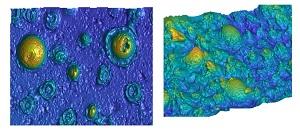
The tongue helps people taste food, but structures on its surface also help them sense textures — something that’s also very important when savoring a meal. Now, researchers reporting in ACS Applied Materials & Interfaces have made a 3D silicone surface that, for the first time, closely mimics the surface features of the human tongue. The material could help food scientists study mechanical interactions of foods, liquids and medicines with the organ.

In humans, the tongue is essential for moving food around in the mouth, sensing taste and texture, and speech. The surface of the tongue is covered in thousands of tiny bumps, or papillae, that contain the taste buds and provide friction and lubrication. Studying how foods and liquids mechanically interact with the tongue could help food scientists, drug developers and manufacturers of toothpastes or mouthwashes make more desirable products. Currently, scientists rely mainly on human tasters to assess texture, or mouth feel, but this is time-consuming, expensive and subjective. There are electronic tongues, or e-tongues, available, but most analyze taste, and the few developed to study texture aren’t very accurate. Anwesha Sarkar and colleagues wanted to develop a soft 3D surface that replicates the topography and wettability of a real human tongue.

The team began by making silicone masks of the tongue surfaces of 15 healthy adults. Using 3D optical scanning and computational surface reconstructions, they created digital models and measured the average density, diameter and height of the two major two types of papillae. Next, they designed a master mold with the appropriate spatial distribution of these papillae and 3D printed it. Then, they used the mold to make soft, tongue-like surfaces out of silicone, with a surfactant added to improve wettability. Testing showed that the 3D biomimetic surface demonstrated similar frictional properties to an actual human tongue, and simulations showed similar mechanical sensing properties. The tongue-like surface could help accelerate the development of nutritional, biomedical and clinical products, as well as find applications in soft robotics, the researchers say.

###

The authors acknowledge funding from the European Union’s Horizon 2020 research and innovation program.

The article is freely available as an ACS AuthorChoice paper here.

The American Chemical Society (ACS) is a nonprofit organization chartered by the U.S. Congress. ACS’ mission is to advance the broader chemistry enterprise and its practitioners for the benefit of Earth and its people. The Society is a global leader in providing access to chemistry-related information and research through its multiple research solutions, peer-reviewed journals, scientific conferences, eBooks and weekly news periodical Chemical & Engineering News. ACS journals are among the most cited, most trusted and most read within the scientific literature; however, ACS itself does not conduct chemical research. As a specialist in scientific information solutions (including SciFinder® and STN®), its CAS division powers global research, discovery and innovation. ACS’ main offices are in Washington, D.C., and Columbus, Ohio.
 

To automatically receive news releases from the American Chemical Society, contact [email protected].
 

Follow us: Twitter | Facebook

Media Contact
Katie Cottingham
[email protected]

Tags: BiochemistryBiomedical/Environmental/Chemical EngineeringBiotechnologyChemistry/Physics/Materials SciencesOlfactory/Taste
Share12Tweet8Share2ShareShareShare2

Related Posts

Miniature Sensor Uses Light to Detect Touch — Chemistry

Miniature Sensor Uses Light to Detect Touch

May 8, 2026
Iron Minerals Determine Whether Dissolved Organic Matter Fuels Microbes or Becomes Long-Term Carbon Storage — Chemistry

Iron Minerals Determine Whether Dissolved Organic Matter Fuels Microbes or Becomes Long-Term Carbon Storage

May 8, 2026

Kate Evans Appointed Associate Lab Director for Biological and Environmental Systems Science at ORNL

May 8, 2026

Advancing Multiscale Modeling and Overcoming Operational Challenges in Autothermal CO₂-to-Methanol Reactors

May 8, 2026
Please login to join discussion

POPULAR NEWS

  • Research Indicates Potential Connection Between Prenatal Medication Exposure and Elevated Autism Risk

    840 shares
    Share 336 Tweet 210
  • New Study Reveals Plants Can Detect the Sound of Rain

    727 shares
    Share 290 Tweet 181
  • Scientists Investigate Possible Connection Between COVID-19 and Increased Lung Cancer Risk

    68 shares
    Share 27 Tweet 17
  • Salmonella Haem Blocks Macrophages, Boosts Infection

    61 shares
    Share 24 Tweet 15

About

We bring you the latest biotechnology news from best research centers and universities around the world. Check our website.

Follow us

Recent News

Urdu Fall Risk Questionnaire Adapted for Elderly

Key Pharmacological Markers for HIV Prevention in MSM

Taking 8,500 Steps Daily May Aid Long-Term Weight Management, Study Finds

Subscribe to Blog via Email

Success! An email was just sent to confirm your subscription. Please find the email now and click 'Confirm' to start subscribing.

Join 82 other subscribers
  • Contact Us

Bioengineer.org © Copyright 2023 All Rights Reserved.

Welcome Back!

Login to your account below

Forgotten Password?

Retrieve your password

Please enter your username or email address to reset your password.

Log In
No Result
View All Result
  • Homepages
    • Home Page 1
    • Home Page 2
  • News
  • National
  • Business
  • Health
  • Lifestyle
  • Science

Bioengineer.org © Copyright 2023 All Rights Reserved.