• HOME
  • NEWS
  • EXPLORE
    • CAREER
      • Companies
      • Jobs
    • EVENTS
    • iGEM
      • News
      • Team
    • PHOTOS
    • VIDEO
    • WIKI
  • BLOG
  • COMMUNITY
    • FACEBOOK
    • INSTAGRAM
    • TWITTER
Saturday, February 7, 2026
BIOENGINEER.ORG
No Result
View All Result
  • Login
  • HOME
  • NEWS
  • EXPLORE
    • CAREER
      • Companies
      • Jobs
        • Lecturer
        • PhD Studentship
        • Postdoc
        • Research Assistant
    • EVENTS
    • iGEM
      • News
      • Team
    • PHOTOS
    • VIDEO
    • WIKI
  • BLOG
  • COMMUNITY
    • FACEBOOK
    • INSTAGRAM
    • TWITTER
  • HOME
  • NEWS
  • EXPLORE
    • CAREER
      • Companies
      • Jobs
        • Lecturer
        • PhD Studentship
        • Postdoc
        • Research Assistant
    • EVENTS
    • iGEM
      • News
      • Team
    • PHOTOS
    • VIDEO
    • WIKI
  • BLOG
  • COMMUNITY
    • FACEBOOK
    • INSTAGRAM
    • TWITTER
No Result
View All Result
Bioengineer.org
No Result
View All Result
Home NEWS Science News Chemistry

New insights into 3D printing of spacers and membranes

Bioengineer by Bioengineer
November 6, 2020
in Chemistry
Reading Time: 2 mins read
0
IMAGE
Share on FacebookShare on TwitterShare on LinkedinShare on RedditShare on Telegram

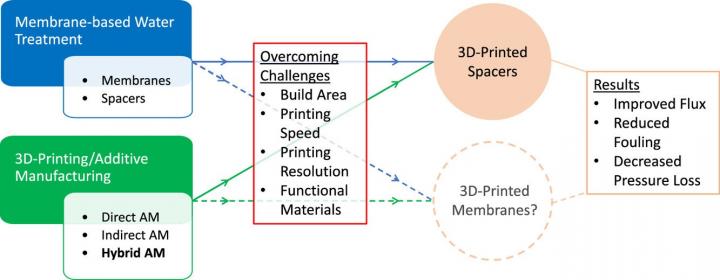
To also address the controversies on the feasibility of 3D printing for membranes, researchers from SUTD and NTU have coined a new term ‘hybrid additive manufacturing’ for the water treatment industry
IMAGE

Credit: SUTD

3D printing has seen great advancements in various aspects over the past few decades, and many industries have seen innovative breakthroughs in their respective fields. Amongst them, the water treatment industry has also reaped benefits off the prospects of 3D printing. High performance spacers and membranes can be fabricated by 3D printing, and they help increase permeate production while minimising energy consumption in purification processes.

Researchers from Nanyang Technological University (NTU) and the Singapore University of Technology and Design (SUTD) reviewed the recent efforts, shortcomings as well as the conflicting reports of 3D printing in membrane-based water treatment (refer to figure). Their research paper entitled ‘A review on spacers and membranes: Conventional or hybrid additive manufacturing?’ has been published in Water Research.

In the paper, they showed the potential of 3D printed spacers. The great freedom of design in 3D printing enables the fabrication of complex and innovative spacers, which was previously impossible with conventional heat extrusion methods. These spacers were able to reduce the number of dead zones within the flow channel, and help mitigate detrimental membrane fouling problems. Some spacer designs such as the helical spacer, turbospacer, and column spacer were even able to reduce energy consumption.

An interesting perspective was also presented in the paper regarding the feasibility of 3D printed membranes. Microfiltration membranes (MF) with pore sizes

In an attempt to resolve this confusion, the paper critically analyses these 3D printed membranes, especially on 3D printing’s role in the overall fabrication process. Hybrid additive manufacturing, a process where 3D printing is used in conjunction with other established fabrication methods, is also introduced in the paper. It shows how 3D printing can still be a powerful tool in the fabrication of membranes when used together with other established processes despite its inadequate printing resolution.

“3D printing is gradually evolving from a single-standalone process to a multi-integrated process. The application continues to grow in the water treatment industry, especially the membrane-based technologies. Future focus is expected to shift from lab scale prototyping to large scale manufacturing,” said principal investigator Associate Professor Chong Tzyy Haur from NTU.

“It will not be an easy challenge to overcome upscaling and material limitations, but consistent research efforts are already evident today. Potentially, 4D printing can even be a possibility in the future to fabricate smart spacers and membranes that adapt to its surrounding environment,” explained co-author Professor Chua Chee Kai from SUTD.

###

Media Contact
Jessica Sasayiah
[email protected]

Related Journal Article

http://dx.doi.org/10.1016/j.watres.2020.116497

Tags: Biomedical/Environmental/Chemical EngineeringChemistry/Physics/Materials SciencesMaterialsResearch/DevelopmentTechnology/Engineering/Computer Science
Share12Tweet8Share2ShareShareShare2

Related Posts

blank

Breakthrough in Environmental Cleanup: Scientists Develop Solar-Activated Biochar for Faster Remediation

February 7, 2026
blank

Cutting Costs: Making Hydrogen Fuel Cells More Affordable

February 6, 2026

Scientists Develop Hand-Held “Levitating” Time Crystals

February 6, 2026

Observing a Key Green-Energy Catalyst Dissolve Atom by Atom

February 6, 2026
Please login to join discussion

POPULAR NEWS

  • Robotic Ureteral Reconstruction: A Novel Approach

    Robotic Ureteral Reconstruction: A Novel Approach

    82 shares
    Share 33 Tweet 21
  • Digital Privacy: Health Data Control in Incarceration

    63 shares
    Share 25 Tweet 16
  • Study Reveals Lipid Accumulation in ME/CFS Cells

    57 shares
    Share 23 Tweet 14
  • Breakthrough in RNA Research Accelerates Medical Innovations Timeline

    53 shares
    Share 21 Tweet 13

About

We bring you the latest biotechnology news from best research centers and universities around the world. Check our website.

Follow us

Recent News

Oxygen-Enhanced Dual-Section Microneedle Patch Improves Drug Delivery and Boosts Photodynamic and Anti-Inflammatory Treatment for Psoriasis

Scientists Identify SARS-CoV-2 PLpro and RIPK1 Inhibitors Showing Potent Synergistic Antiviral Effects in Mouse COVID-19 Model

Neg-Entropy: The Key Therapeutic Target for Chronic Diseases

Subscribe to Blog via Email

Enter your email address to subscribe to this blog and receive notifications of new posts by email.

Join 73 other subscribers
  • Contact Us

Bioengineer.org © Copyright 2023 All Rights Reserved.

Welcome Back!

Login to your account below

Forgotten Password?

Retrieve your password

Please enter your username or email address to reset your password.

Log In
No Result
View All Result
  • Homepages
    • Home Page 1
    • Home Page 2
  • News
  • National
  • Business
  • Health
  • Lifestyle
  • Science

Bioengineer.org © Copyright 2023 All Rights Reserved.