Credit: @Science China Press
Since its birth in the laboratory, organic light-emitting diode (OLED) has developed into an industry worth tens of billions of dollars in the past three decades. In industrial applications, the phosphorescent materials with 100% exciton utilization efficiency (EUE) have been able to meet the needs of three-primary red and green OLEDs for display. However, the long excited-state lifetime (usually > 1 μs) and high excited-states energy ( > 2.8 eV) make blue phosphorescent OLED poorly stable. Therefore, the blue light-emitting emitters currently used are still fluorescent materials with a low EUE but short nanosecond excited-state lifetime.
The traditional f-f transition rare earth complexes have the advantages of 100% EUE and highly pure red and green emissions, hence they have been applied to OLED research even earlier than phosphorescent materials. However, the intrinsic millisecond excited-state lifetime of the f-f transition limits the improvement of device performance, making slow progress of rare-earth complex electroluminescence for many years.
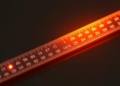
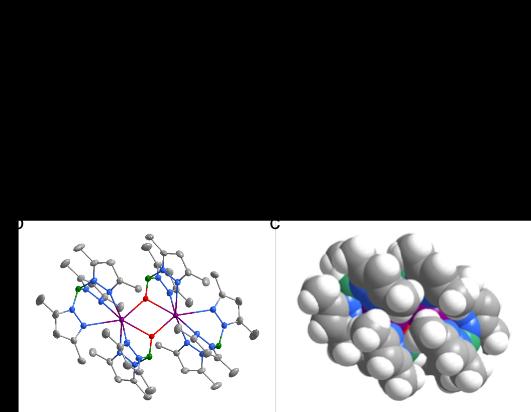
Recently, a research team from Peking University achieved highly efficient sky-blue OLEDs by introducing a d-f transition rare earth cerium(III) complex Ce-2 (pictured above) with nanosecond excited-state lifetime. The authors proved that 100% EUE can be achieved in cerium(III) complex based OLEDs. Most importantly, the device stability of Ce-2 is greatly improved as compared to that of traditional iridium (III) complex with similar emitting color.
Different from other trivalent rare-earth ions, the single electron in Ce(III) ion can produce spin-allowed and parity-allowed 4f-5d transition, and the excited-state lifetime is only tens of nanoseconds. However, due to the quenching effect of ligands and small molecules in the environment, most Ce(III) complexes are not emissive. The ligand of Ce-2 has multidentate coordination ability and a relatively rigid structure, which can effectively protect the central Ce(III) ion. Therefore, the emission efficiency of Ce-2 in the doped film is 95%, and the excited-state lifetime is measured as 52 ns.
Interestingly, Ce-2 based OLED exhibits a maximum external quantum efficiency of 20.8%. Based on this result, it can be inferred that the EUE of the device is close to 100%. Mostly importantly, Ce(III) complex based OLED showed smaller roll-off, higher maximum luminance, and longer operating lifetime by ~70 times, as compared to an Ir(III) complex based OLED with a similar emitting color. Transient electroluminescence study shows that the excited-state lifetime of Ce-2 in OLED is only 1/16 of that of Ir(III) complex in device. It is the main reason for the improvement of device performance.
Since Ce(III) complexes have both 100% EUE and nanosecond luminescence lifetime, such emitters are promising to fabricate blue OLEDs with both high efficiency and stability. Besides, considering that Ce(III) complexes have adjustable emission spectra and lower costs, such materials are expected to become a new generation of emitters to achieve full-color OLED display and lighting.
###
This research received funding from the National Key R&D Program of China, the National Natural Science Foundation of China, and the National Basic Research Program of China, and the China Postdoctoral Science Foundation.
See the article:
Zifeng Zhao, Liding Wang, Ge Zhan, Zhiwei Liu, Zuqiang Bian, and Chunhui Huang
Efficient rare earth cerium(III) complex with nanosecond d-f emission for blue organic light-emitting diodes
Natl Sci Rev (2020)
https:/
Media Contact
Zhiwei Liu
[email protected]
Related Journal Article
http://dx.