Researchers have registered the formation of silver nanoparticles in an ion-exchanged glass as a result of infrared laser irradiation.
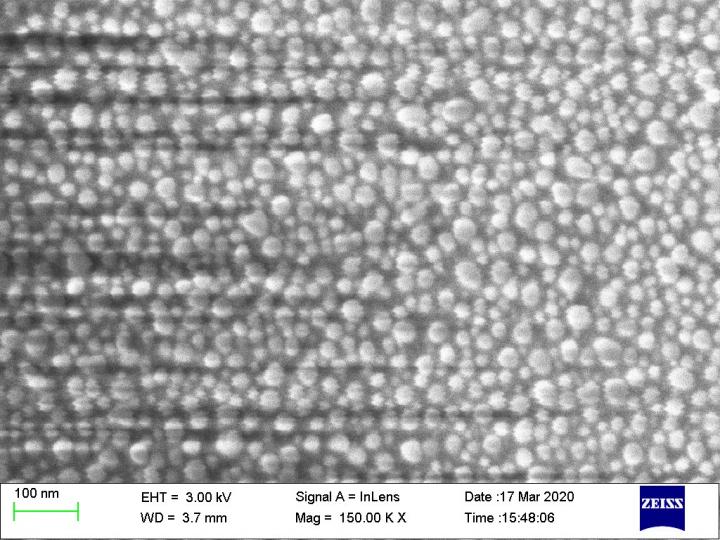
Credit: Peter the Great St.Petersburg Polytechnic University
Researchers from Peter the Great St. Petersburg Polytechnic University (SPbPU) in collaboration with colleagues from the Alferov University, Institute of Problems of Mechanical Engineering RAS and University of Technology of Troyes have registered the formation of silver nanoparticles in an ion-exchanged glass as a result of infrared laser irradiation. The research of current studies were published in the journal of Nanomaterials.
The international scientific group studies the growth and properties of metal nanoparticles placed on the surface of multicomponent glasses. Such structures are highly applicable for surface enhanced Raman spectroscopy (SERS). This special type of spectroscopy is employed for screening, monitoring, and analysis of micro doses of a matter. Substrates with the nanoparticles made of the glasses studied have antibacterial, antifungal and antiviral applications. They are also cheap and easy to prepare.
In this study the group or researchers put efforts to check feasibility of silver nanoparticles (SNPs) formed on the glass surface by infrared nanosecond laser pulses for Raman spectroscopy. There are different ways of placing silver nanoparticles onto the glass surface including lithographic techniques, laser ablation, sedimentation of SNPs from solutions, thermal or reactive reduction of silver ions followed by out-diffusion of neutral silver. Method applied in the study allowed to «draw» the exact structures consisting of the SNPs on the glass surface.
«Silver-to-sodium ion exchanged glass contains silver ions evenly distributed in the subsurface layer of the material. Under the laser irradiation these ions transform to neutral atoms which cluster together into nanoparticles. When SNPs with a diameter of 20-30 nm are formed, collective oscillation of electrons in the metal nanoparticles, being optically excited in the proper wavelength range, demonstrate surface plasmon resonance. And close to the resonance of the system the sharp rise of the electric field at optical frequency takes place. This phenomenon is used for signal enhancement in the Raman spectroscopy», explains Andrey Lipovskii, professor of Higher School of Engineering Physics of SPbPU.
The sensitive elements obtained can be used as substrates for Raman analysis of different kinds of reagents, including the biological ones.
«Notably the signal enhancement increases in 105-106 times. This is a huge gain», adds prof. Lipovskii.
Such sensing elements have a wide range of application. There are commercial substrates with silver nanoparticles suitable for the Raman scattering but they are quite fragile, subject for oxidation and should be preserved only in special settings. In multicomponent silver-to-sodium ion exchanged glasses SNPs are protected by ~20 nm glass layer. The samples could be carried in the pocket which is suitable for the field work. One should only perform slight chemical etching to reveal the inner structures, and the substrate is ready for work.
This research is a result of many years’ collaboration in the study of metal nanoparticles. Now scientists are planning to continue the study.
«We have been working with silver nanoparticles for SERS for a long time. In the next series of experiments, we are going to study the growth of the submicrometer-size silver needles, that could lead to even higher surface enhancement», noted prof. Lipovskii.
###
Media Contact
Raisa Bestugina
[email protected]
Related Journal Article
http://dx.