• HOME
  • NEWS
  • EXPLORE
    • CAREER
      • Companies
      • Jobs
    • EVENTS
    • iGEM
      • News
      • Team
    • PHOTOS
    • VIDEO
    • WIKI
  • BLOG
  • COMMUNITY
    • FACEBOOK
    • INSTAGRAM
    • TWITTER
Sunday, February 8, 2026
BIOENGINEER.ORG
No Result
View All Result
  • Login
  • HOME
  • NEWS
  • EXPLORE
    • CAREER
      • Companies
      • Jobs
        • Lecturer
        • PhD Studentship
        • Postdoc
        • Research Assistant
    • EVENTS
    • iGEM
      • News
      • Team
    • PHOTOS
    • VIDEO
    • WIKI
  • BLOG
  • COMMUNITY
    • FACEBOOK
    • INSTAGRAM
    • TWITTER
  • HOME
  • NEWS
  • EXPLORE
    • CAREER
      • Companies
      • Jobs
        • Lecturer
        • PhD Studentship
        • Postdoc
        • Research Assistant
    • EVENTS
    • iGEM
      • News
      • Team
    • PHOTOS
    • VIDEO
    • WIKI
  • BLOG
  • COMMUNITY
    • FACEBOOK
    • INSTAGRAM
    • TWITTER
No Result
View All Result
Bioengineer.org
No Result
View All Result
Home NEWS Science News Chemistry

Mussels connect antibodies to treat cancer

Bioengineer by Bioengineer
September 29, 2020
in Chemistry
Reading Time: 3 mins read
0
IMAGE
Share on FacebookShare on TwitterShare on LinkedinShare on RedditShare on Telegram

IMAGE

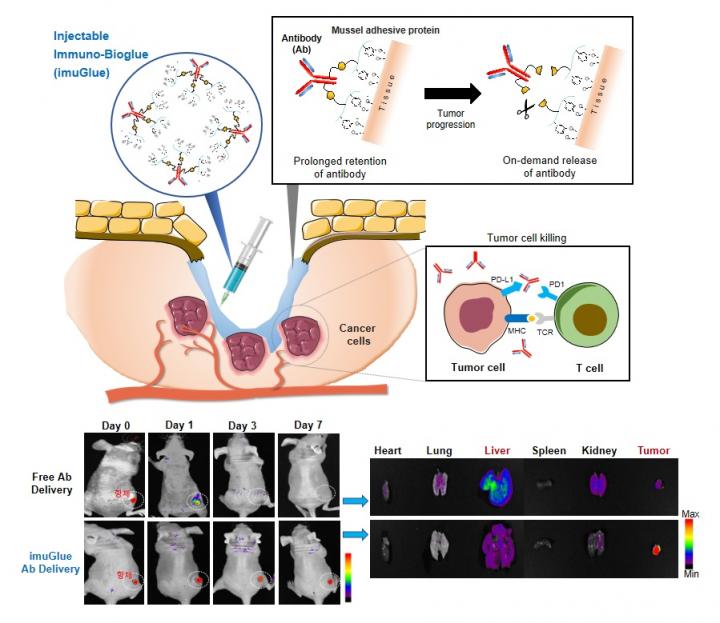
Credit: Hyung Joon Cha (POSTECH)

Antibody-based immunotherapy is one of treatment options for cancer immunotherapy by modulating our immune system with therapeutic antibodies. Among many strategies for cancer therapy, it has been considered as an advanced cancer treatment due to its favorable clinical benefits by effectively activating our immune cells to attack cancer cells in the body. The development of new cancer immunotherapy drugs has gained great attention as the next-generation research area with more than 1,600 clinical trials currently underway worldwide.

However, conventional cancer treatments that require intravenous administration throughout the whole body can cause side effects on normal cells or tissues by continuously supplying large amounts of antibodies. In particular, if large amounts of antibodies are released at once, there is a risk of excessive immune response that can lead to autoimmune diseases. The common localized treatment, such as local injection to tumor, still had a problem of rapidly spreading antibodies out of the target area by blood flow, leaving only a few, resulting in a significant reduction in treatment efficacy.

The POSTECH research team led by professors Hyung Joon Cha, Kye Il Joo, and Dr. Yeonsu Jung of the Department of Chemical Engineering along with Professor Sin-Hyeog Im and Dr. Sung-Min Hwang of the Department of Life Sciences have together developed a novel immunotherapy platform called imuGlue. This new platform can effectively connect mussel adhesive proteins (MPAs) – which has strong adhesion in even underwater conditions – to the antibodies used as immune checkpoint inhibitors (ICIs) in order to deliver the antibodies to the target areas.

ImuGlue can significantly enhance the efficiency of cancer immunotherapy and reduce the side effects by allowing therapeutic antibodies to stay in the target area for long periods of time even in moisture-rich environment and release antibodies on-demand at cancer sites. It was also demonstrated that imuGlue could be utilized for combination therapy with other immunomodulatory drugs often used in cancer immunotherapy.

This new treatment platform for localized cancer immunotherapy has the advantage of not only being able to easily connect various therapeutic antibodies, but also does not mix or lose its property in body fluid- or blood-rich environments and at mucous surfaces. For this reason, it is anticipated to lead in the cancer immunotherapy market as it can be used not just through injections but also by spraying or other unique treatment methods.

“This study is the first immunotherapy that uses the mussel adhesion protein,” commented Professor Hyung Joon Cha who led the study. He added, “As an innovative antibody delivery platform, it should be useful in various forms of immunotherapy.”

###

The study was published in Biomaterials, an authoritative journal in biomaterial field, and was conducted with the support from the National Research Foundation of Korea funded by the Ministry of Science and ICT, Korea, the Basic Science Research Program funded by the Ministry of Education, Korea, and the Marine Biotechnology Program funded by the Ministry of Oceans and Fisheries, Korea.

Media Contact
Jinyoung Huh
[email protected]

Original Source

http://postech.ac.kr/eng/mussels-connect-antibodies-to-treat-cancer/#post-21367

Related Journal Article

http://dx.doi.org/10.1016/j.biomaterials.2020.120380

Tags: BiochemistryBiologyBiomechanics/BiophysicscancerChemistry/Physics/Materials SciencesFisheries/AquacultureMarine/Freshwater BiologyMedicine/HealthSurgery
Share12Tweet8Share2ShareShareShare2

Related Posts

blank

Breakthrough in Environmental Cleanup: Scientists Develop Solar-Activated Biochar for Faster Remediation

February 7, 2026
blank

Cutting Costs: Making Hydrogen Fuel Cells More Affordable

February 6, 2026

Scientists Develop Hand-Held “Levitating” Time Crystals

February 6, 2026

Observing a Key Green-Energy Catalyst Dissolve Atom by Atom

February 6, 2026
Please login to join discussion

POPULAR NEWS

  • Robotic Ureteral Reconstruction: A Novel Approach

    Robotic Ureteral Reconstruction: A Novel Approach

    82 shares
    Share 33 Tweet 21
  • Digital Privacy: Health Data Control in Incarceration

    63 shares
    Share 25 Tweet 16
  • Breakthrough in RNA Research Accelerates Medical Innovations Timeline

    53 shares
    Share 21 Tweet 13
  • Mapping Tertiary Lymphoid Structures for Kidney Cancer Biomarkers

    50 shares
    Share 20 Tweet 13

About

We bring you the latest biotechnology news from best research centers and universities around the world. Check our website.

Follow us

Recent News

Anesthesia Method’s Impact on Elderly Hip Fracture Recovery

Menopause Care: Insights from Workforce Review and Consultation

LRRK2R1627P Mutation Boosts Gut Inflammation, α-Synuclein

Subscribe to Blog via Email

Enter your email address to subscribe to this blog and receive notifications of new posts by email.

Join 73 other subscribers
  • Contact Us

Bioengineer.org © Copyright 2023 All Rights Reserved.

Welcome Back!

Login to your account below

Forgotten Password?

Retrieve your password

Please enter your username or email address to reset your password.

Log In
No Result
View All Result
  • Homepages
    • Home Page 1
    • Home Page 2
  • News
  • National
  • Business
  • Health
  • Lifestyle
  • Science

Bioengineer.org © Copyright 2023 All Rights Reserved.