Zebrafish embryos elucidate unknown effect for cercosporamide
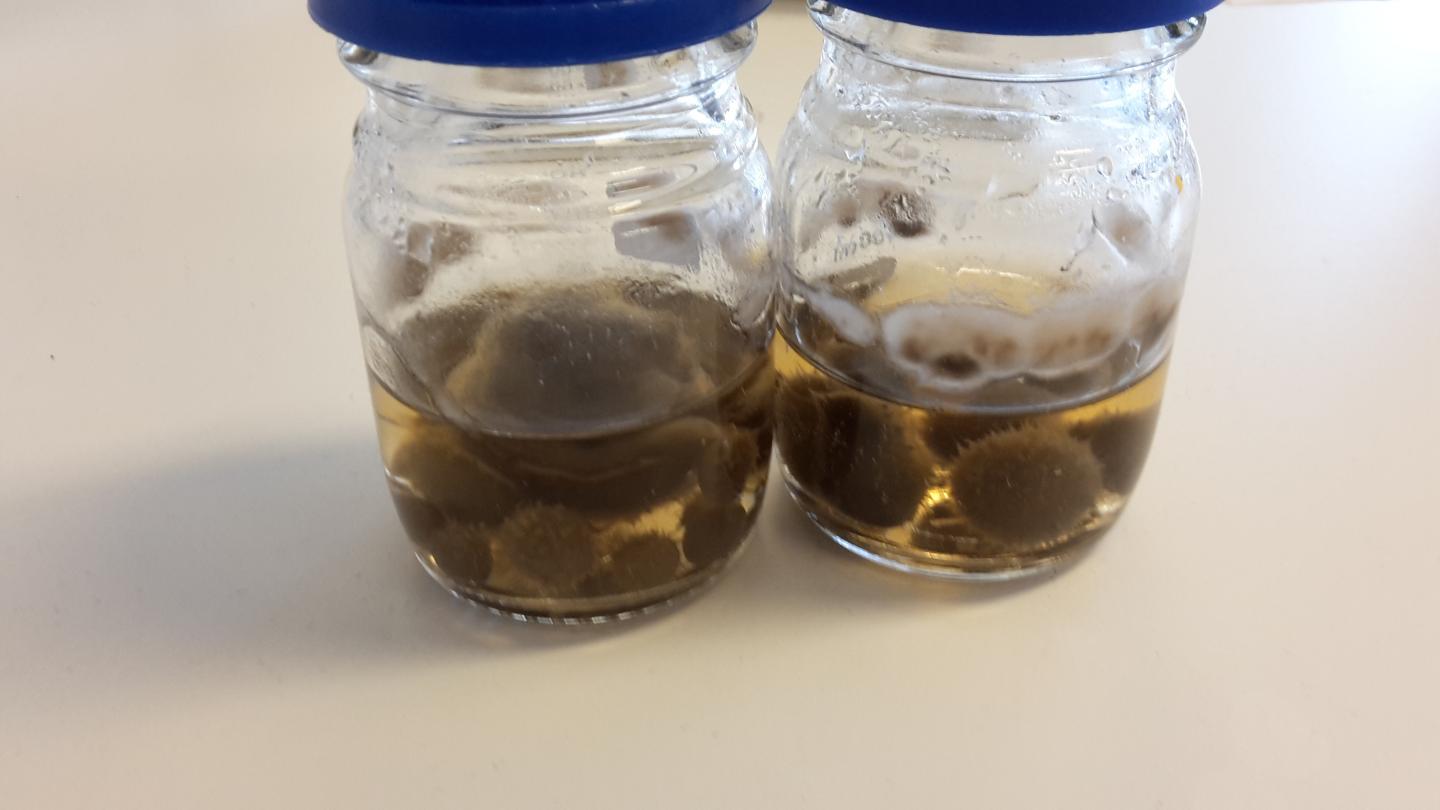
Credit: Jelmer Hoeksma, copyright Hubrecht Institute
Researchers in the group of Jeroen den Hertog, in collaboration with researchers in Leiden, have found that a compound inhibits a group of proteins called BMP receptors. This compound, called cercosporamide, was previously only known to inhibit a different group of proteins. When overactive, BMP receptors can induce several diseases. Studying compounds that may counteract this overactivity may lead to more treatment options in the future. Their results were published in the scientific journal Disease Models & Mechanisms.
Fungi
We constantly need new therapeutic compounds for use in the clinic for various reasons, including our increasing age, corresponding illnesses and resistance to existing drugs. Fungi are an excellent, but underexplored source of these kinds of compounds. Researcher Jelmer Hoeksma explains: “Every year new compounds produced by fungi are identified, but so far we have only investigated a very small subset of all existing fungi. This suggests that many more biologically active compounds remain to be discovered.”
Together with the Westerdijk Fungal Biodiversity Institute, home to the largest collection of live fungi in the world, the researchers set up a large library of filtrates derived from more than ten thousand different fungi. A filtrate contains all the products that the fungus excretes. To search for therapeutic compounds, the researchers investigate the effects of fungal products present in this large library on zebrafish embryos. This enables them to study effects on the whole body during development.
Cercosporamide
Using this approach, the researchers identified a compound, called cercosporamide, that had an effect in zebrafish. This effect is known for a certain type of molecules that inhibit a group of proteins called BMP receptors. When these BMP receptors are overactive, they can induce several diseases, such as Fibrodysplasia ossificans progressiva. In people that suffer from this disease, muscle tissue is progressively replaced with bone tissue, leading to a severe loss of mobility over time. Therefore, finding new compounds that may counteract overactive BMP receptors may provide new options for treatment of such diseases.
Although the compound cercosporamide had been identified before, its effect on BMP receptors was unknown until now. The researchers discovered this additional effect because they tested the effects of compounds on whole zebrafish embryos. Additional tests in both zebrafish and human cells confirmed the results.
Surprisingly, the molecules of cercosporamide have a completely different structure compared to other common BMP receptor inhibitors. So, even if cercosporamide itself turns out unusable as therapeutic drug, there may be a completely different class of structurally related chemicals that may have BMP receptor inhibiting effects.
More compounds
Currently, the researchers are looking for other bioactive compounds. Hoeksma: “For now, we are continuing to look for (new) compounds and understand their effects. Thus far, we only investigated a small subset of all these fungal products – we have only scratched the surface.”
###
Publication
Cercosporamide inhibits bone morphogenetic protein receptor type I kinase activity in zebrafish. Jelmer Hoeksma, Gerard C. M. van der Zon, Peter ten Dijke and Jeroen den Hertog
Jeroen den Hertog is group leader at the Hubrecht Institute and professor of Molecular Developmental Zoology at Leiden University.
About the Hubrecht Institute
The Hubrecht Institute is a research institute focused on developmental and stem cell biology. It encompasses 23 research groups that perform fundamental and multidisciplinary research, both in healthy systems and disease models. The Hubrecht Institute is a research institute of the Royal Netherlands Academy of Arts and Sciences (KNAW), situated on Utrecht Science Park. Since 2008, the institute is affiliated with the UMC Utrecht, advancing the translation of research to the clinic. The Hubrecht Institute has a partnership with the European Molecular Biology Laboratory (EMBL). For more information, visit http://www.
Media Contact
Melanie Fremery
@_Hubrecht
31-683-596-548
Original Source
https:/
Related Journal Article
http://dx.