• HOME
  • NEWS
  • EXPLORE
    • CAREER
      • Companies
      • Jobs
    • EVENTS
    • iGEM
      • News
      • Team
    • PHOTOS
    • VIDEO
    • WIKI
  • BLOG
  • COMMUNITY
    • FACEBOOK
    • INSTAGRAM
    • TWITTER
Monday, August 17, 2026
BIOENGINEER.ORG
No Result
View All Result
  • Login
  • HOME
  • NEWS
  • EXPLORE
    • CAREER
      • Companies
      • Jobs
        • Lecturer
        • PhD Studentship
        • Postdoc
        • Research Assistant
    • EVENTS
    • iGEM
      • News
      • Team
    • PHOTOS
    • VIDEO
    • WIKI
  • BLOG
  • COMMUNITY
    • FACEBOOK
    • INSTAGRAM
    • TWITTER
  • HOME
  • NEWS
  • EXPLORE
    • CAREER
      • Companies
      • Jobs
        • Lecturer
        • PhD Studentship
        • Postdoc
        • Research Assistant
    • EVENTS
    • iGEM
      • News
      • Team
    • PHOTOS
    • VIDEO
    • WIKI
  • BLOG
  • COMMUNITY
    • FACEBOOK
    • INSTAGRAM
    • TWITTER
No Result
View All Result
Bioengineer.org
No Result
View All Result
Home NEWS Science News Biology

Jaws of death: USU Eastern paleontologist renames giant, prehistoric marine lizard

Bioengineer by Bioengineer
September 23, 2020
in Biology
Reading Time: 3 mins read
0
IMAGE
Share on FacebookShare on TwitterShare on LinkedinShare on RedditShare on Telegram

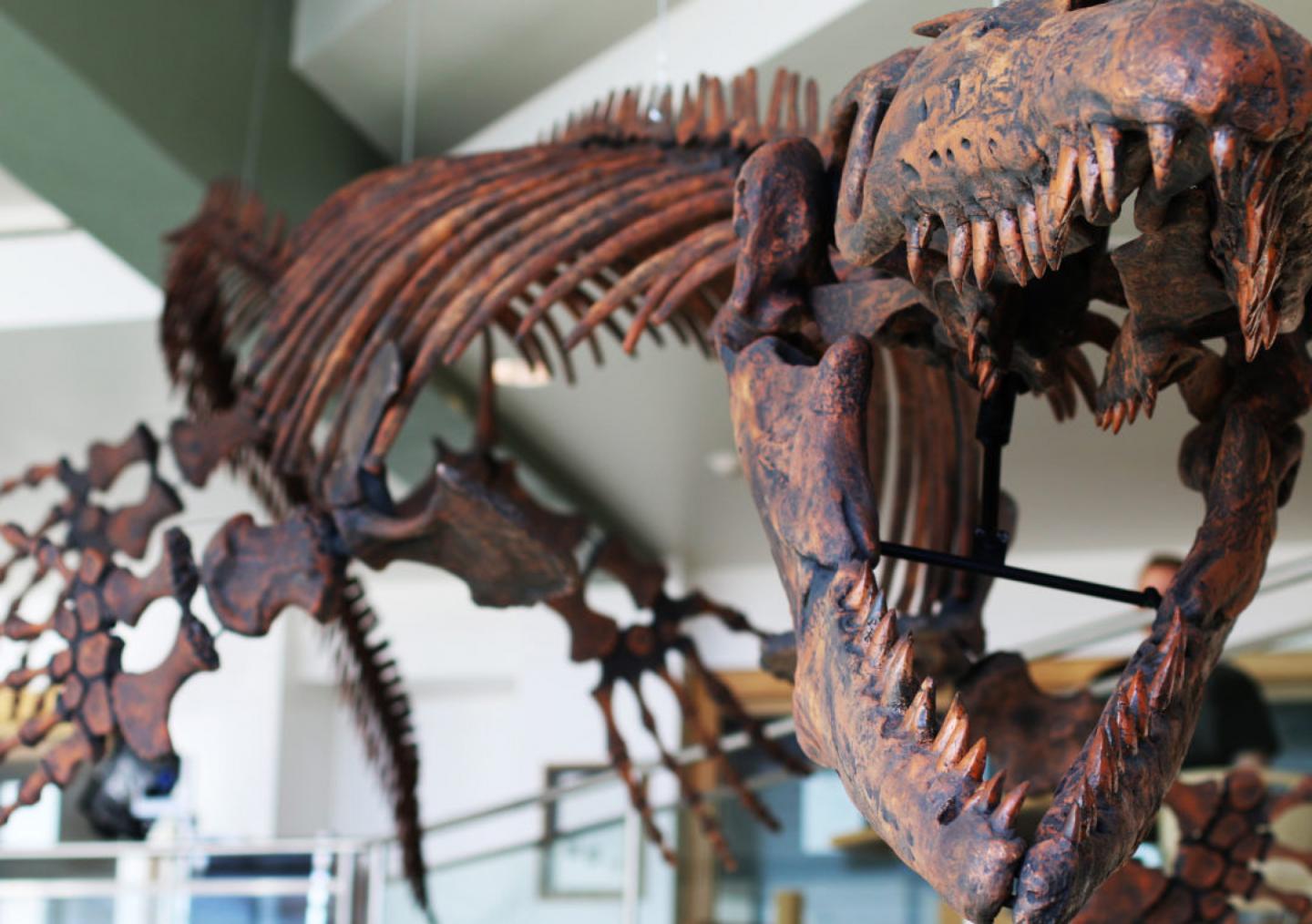
Prehistoric Museum curator Joshua Lively describes a new genus of mosasaur that roamed the oceans
IMAGE

Credit: BYU

PRICE, UTAH, USA – Some 92 to 66 million years ago, as the Age of Dinosaurs waned, giant marine lizards called mosasaurs roamed an ocean that covered North America from Utah to Missouri and Texas to the Yukon. The air-breathing predators were streamlined swimmers that devoured almost everything in their path, including fish, turtles, clams and even smaller mosasaurs.

Coloradoan Gary Thompson discovered mosasaur bones near the Delta County town of Cedaredge in 1975, which the teen reported to his high school science teacher. The specimens made their way to Utah’s Brigham Young University, where, in 1999, the creature that left the fossils was named Prognathodon stadtmani.

“I first learned of this discovery while doing background research for my Ph.D.,” says newly arrived Utah State University Eastern paleontologist Joshua Lively, who recently took the reins as curator of the Price campus’ Prehistoric Museum. “Ultimately, parts of this fossil, which were prepared since the original description in 1999, were important enough to become a chapter in my 2019 doctoral dissertation.”

Upon detailed research of the mosasaur’s skeleton and a phylogenetic analysis, Lively determined the BYU specimen is not closely related to other species of the genus Prognathodon and needed to be renamed. He reclassified the mosasaur as Gnathomortis stadtmani and reports his findings in the most recent issue of the Journal of Vertebrate Paleontology.

His research was funded by the Geological Society of America, the Evolving Earth Foundation, the Texas Academy of Science and the Jackson School of Geosciences at The University of Texas at Austin.

“The new name is derived from Greek and Latin words for ‘jaws of death,'” Lively says. “It was inspired by the incredibly large jaws of this specimen, which measure four feet (1.2 meters) in length.”

An interesting feature of Gnathomortis’ mandibles, he says, is a large depression on their outer surface, similar to that seen in modern lizards, such as the Collared Lizard. The feature is indicative of large jaw muscles that equipped the marine reptile with a formidable biteforce.

“What sets this animal apart from other mosasaurs are features of the quadrate – a bone in the jaw joint that also forms a portion of the ear canal,” says Lively, who returned to the fossil’s Colorado discovery site and determined the age interval of rock, in which the specimen was preserved.

“In Gnathomortis, this bone exhibits a suite of characteristics that are transitional from earlier mosasaurs, like Clidastes, and later mosasaurs, like Prognathodon. We now know Gnathomortis swam in the seas of Colorado between 79 and 81 million years ago, or at least 3.5 million years before any species of Prognathodon.”

He says fossil enthusiasts can view Gnathomortis’ big bite at the BYU Museum of Paleontology in Provo, Utah, and see a cast of the skull at the Pioneer Town Museum in Cedaredge, Colorado. Reconstructions of the full skeleton are on display at the John Wesley Powell River History Museum in Green River, Utah, and in BYU’s Eyring Science Center.

“I’m excited to share this story, which represents years of effort by many citizen scientists and scholars, as I kick off my new position at USU Eastern’s Prehistoric Museum,” Lively says. “It’s a reminder of the power of curiosity and exploration by people of all ages and backgrounds.”

###

Media Contact
Joshua Lively
[email protected]

Related Journal Article

http://dx.doi.org/10.1080/02724634.2020.1784183

Tags: Earth SciencePaleontology
Share12Tweet8Share2ShareShareShare2

Related Posts

Strubbelig–NHL3 Receptor Complex Helps Arabidopsis Respond to Cellulose Deficiency

Strubbelig–NHL3 Receptor Complex Helps Arabidopsis Respond to Cellulose Deficiency

August 15, 2026
Bombyx mori Satellitome Analysis Reveals Evolutionary Stability, Dispersed Chromosomal Organization, Transposon Origins

Bombyx mori Satellitome Analysis Reveals Evolutionary Stability, Dispersed Chromosomal Organization, Transposon Origins

August 15, 2026

Synthetic pyrenoid reconstruction reveals EPYC1-driven carbon concentration mechanisms and evolution

August 15, 2026

Endophytic Flavobacterium boosts root hairs and drought tolerance through ERF–CEP5 signaling

August 15, 2026
Please login to join discussion

POPULAR NEWS

  • Pilot Study Examines Personal Care Use, Social Media Engagement Among NJ Students

    29 shares
    Share 12 Tweet 7
  • KAIST develops semiconductor neuron that harnesses noise to selectively process signals

    29 shares
    Share 12 Tweet 7
  • Imagining natural and extra robotic thumbs together strengthens kinesthetic sensorimotor networks

    29 shares
    Share 12 Tweet 7
  • PARP1 Drives Neuropathic Pain Through GPX4-Dependent Ferroptosis in Injured Mice’s Sensory Neurons

    29 shares
    Share 12 Tweet 7

About

We bring you the latest biotechnology news from best research centers and universities around the world. Check our website.

Follow us

Recent News

Pilot Study Examines Personal Care Use, Social Media Engagement Among NJ Students

KAIST develops semiconductor neuron that harnesses noise to selectively process signals

Imagining natural and extra robotic thumbs together strengthens kinesthetic sensorimotor networks

Subscribe to Blog via Email

Enter your email address to subscribe to this blog and receive notifications of new posts by email.

Join 85 other subscribers
  • Contact Us

Bioengineer.org © Copyright 2023 All Rights Reserved.

Welcome Back!

Login to your account below

Forgotten Password?

Retrieve your password

Please enter your username or email address to reset your password.

Log In
No Result
View All Result
  • Homepages
    • Home Page 1
    • Home Page 2
  • News
  • National
  • Business
  • Health
  • Lifestyle
  • Science

Bioengineer.org © Copyright 2023 All Rights Reserved.