• HOME
  • NEWS
  • EXPLORE
    • CAREER
      • Companies
      • Jobs
    • EVENTS
    • iGEM
      • News
      • Team
    • PHOTOS
    • VIDEO
    • WIKI
  • BLOG
  • COMMUNITY
    • FACEBOOK
    • INSTAGRAM
    • TWITTER
Monday, January 5, 2026
BIOENGINEER.ORG
No Result
View All Result
  • Login
  • HOME
  • NEWS
  • EXPLORE
    • CAREER
      • Companies
      • Jobs
        • Lecturer
        • PhD Studentship
        • Postdoc
        • Research Assistant
    • EVENTS
    • iGEM
      • News
      • Team
    • PHOTOS
    • VIDEO
    • WIKI
  • BLOG
  • COMMUNITY
    • FACEBOOK
    • INSTAGRAM
    • TWITTER
  • HOME
  • NEWS
  • EXPLORE
    • CAREER
      • Companies
      • Jobs
        • Lecturer
        • PhD Studentship
        • Postdoc
        • Research Assistant
    • EVENTS
    • iGEM
      • News
      • Team
    • PHOTOS
    • VIDEO
    • WIKI
  • BLOG
  • COMMUNITY
    • FACEBOOK
    • INSTAGRAM
    • TWITTER
No Result
View All Result
Bioengineer.org
No Result
View All Result
Home NEWS Science News Chemistry

Temporal-spatial order property of hollow multishelled structures enables sequential drug release

Bioengineer by Bioengineer
September 8, 2020
in Chemistry
Reading Time: 2 mins read
0
IMAGE
Share on FacebookShare on TwitterShare on LinkedinShare on RedditShare on Telegram

IMAGE

Credit: YANG Nailiang

Hollow multishelled structures (HoMSs), with relatively isolated cavities and hierarchal pores in the shells, are structurally similar to cells. They can be used as a carrier for antibacterial agent.

A recent research led by Prof. WANG Dan and Prof. ZHANG Suojiang from the Institute of Process Engineering (IPE) of the Chinese Academy of Sciences studied the diffusion and transport mechanism of antimicrobial molecules through HoMSs, and discovered that the unique temporal-spatial order property of HoMSs can realize the sequential drug release for the first time.

This research was published in Nature Communications on Sept. 7.

“We synthesized TiO2-HoMSs through sequential template approach, and introduced antibacterial agent Methylisothiazolinone (MIT) as model molecules into HoMSs,” said Prof. WANG.

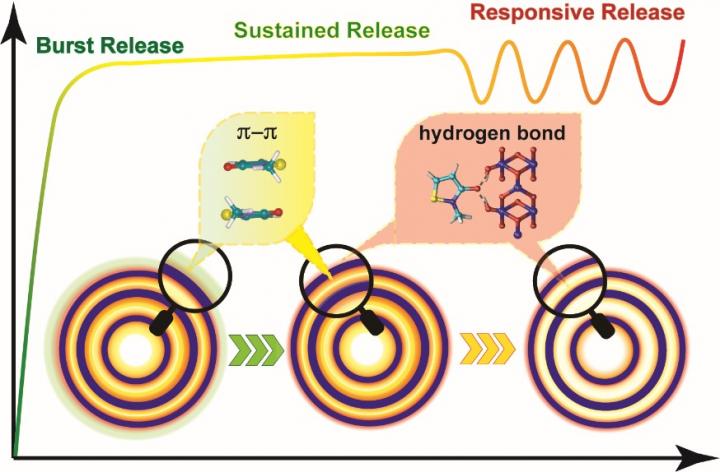
By analyzing the behavior of HoMSs during drug release, the researchers discovered that the release of the molecules from HoMSs went through sequential release stages, namely burst release, sustained release, and stimulus responsive release.

In detail, by simply adjusting the amount of MIT-HoMSs introduced into the environment, the desired concentration can be quickly reached in the burst release stage due to the MIT molecules absorbed on the outer surface of HoMSs.

The sustained release of MIT molecules in π-π stacked state in the cavity of HoMSs could maintain the required concentration for a long period and inhibit the growth of bacteria.

The triple-shelled HoMS could provide a long sterility period in a bacteria-rich environment that is nearly eight times longer than that of the pure antimicrobial agent under the same conditions.

“When the foreign pathogens were added to our HoMSs system, the driving force was strong enough to break the energy barrier, and the drug molecules stored between the shells and absorbed on the surface were released, resulting in the responsive release. More importantly, the drug concentration can be recovered to the desired range automatically,” said Prof. WANG.

Owing to different adsorption characteristics in HoMSs and physical barriers from the multishells, drug molecules in different locations of HoMSs have different release times.

All these advantages could be attributed to chemical diffusion- and physical barrier-driven sequential drug release, providing a route for the design of intelligent nanomaterials.

###

Media Contact
LI Xiangyu
[email protected]

Related Journal Article

http://dx.doi.org/10.1038/s41467-020-18177-2

Tags: Medicine/HealthPharmaceutical Science
Share12Tweet8Share2ShareShareShare2

Related Posts

Stable 2D Perovskites via Intralayer Bidentate Diammoniums

Stable 2D Perovskites via Intralayer Bidentate Diammoniums

January 5, 2026
blank

Mapping Arginine Reactivity Across the Human Proteome

January 3, 2026

Stepwise Catalytic Method Enables Diverse P(V) Stereochemistry

January 2, 2026

Cutting Electrolyte Reduction Boosts High-Energy Battery Performance

December 19, 2025
Please login to join discussion

POPULAR NEWS

  • blank

    PTSD, Depression, Anxiety in Childhood Cancer Survivors, Parents

    140 shares
    Share 56 Tweet 35
  • Exploring Audiology Accessibility in Johannesburg, South Africa

    52 shares
    Share 21 Tweet 13
  • SARS-CoV-2 Subvariants Affect Outcomes in Elderly Hip Fractures

    44 shares
    Share 18 Tweet 11
  • AI Regulation: Fintech Cybersecurity and Privacy in EU vs. Qatar

    44 shares
    Share 18 Tweet 11

About

We bring you the latest biotechnology news from best research centers and universities around the world. Check our website.

Follow us

Recent News

SIGNET: Advancing Skin Care for Extreme Preterms

Immune Checkpoint Blockade Boosts Cervical Cancer Treatment

Sunyaev–Zeldovich Reveals Hot Gas at Redshift 4.3

Subscribe to Blog via Email

Success! An email was just sent to confirm your subscription. Please find the email now and click 'Confirm' to start subscribing.

Join 71 other subscribers
  • Contact Us

Bioengineer.org © Copyright 2023 All Rights Reserved.

Welcome Back!

Login to your account below

Forgotten Password?

Retrieve your password

Please enter your username or email address to reset your password.

Log In
No Result
View All Result
  • Homepages
    • Home Page 1
    • Home Page 2
  • News
  • National
  • Business
  • Health
  • Lifestyle
  • Science

Bioengineer.org © Copyright 2023 All Rights Reserved.