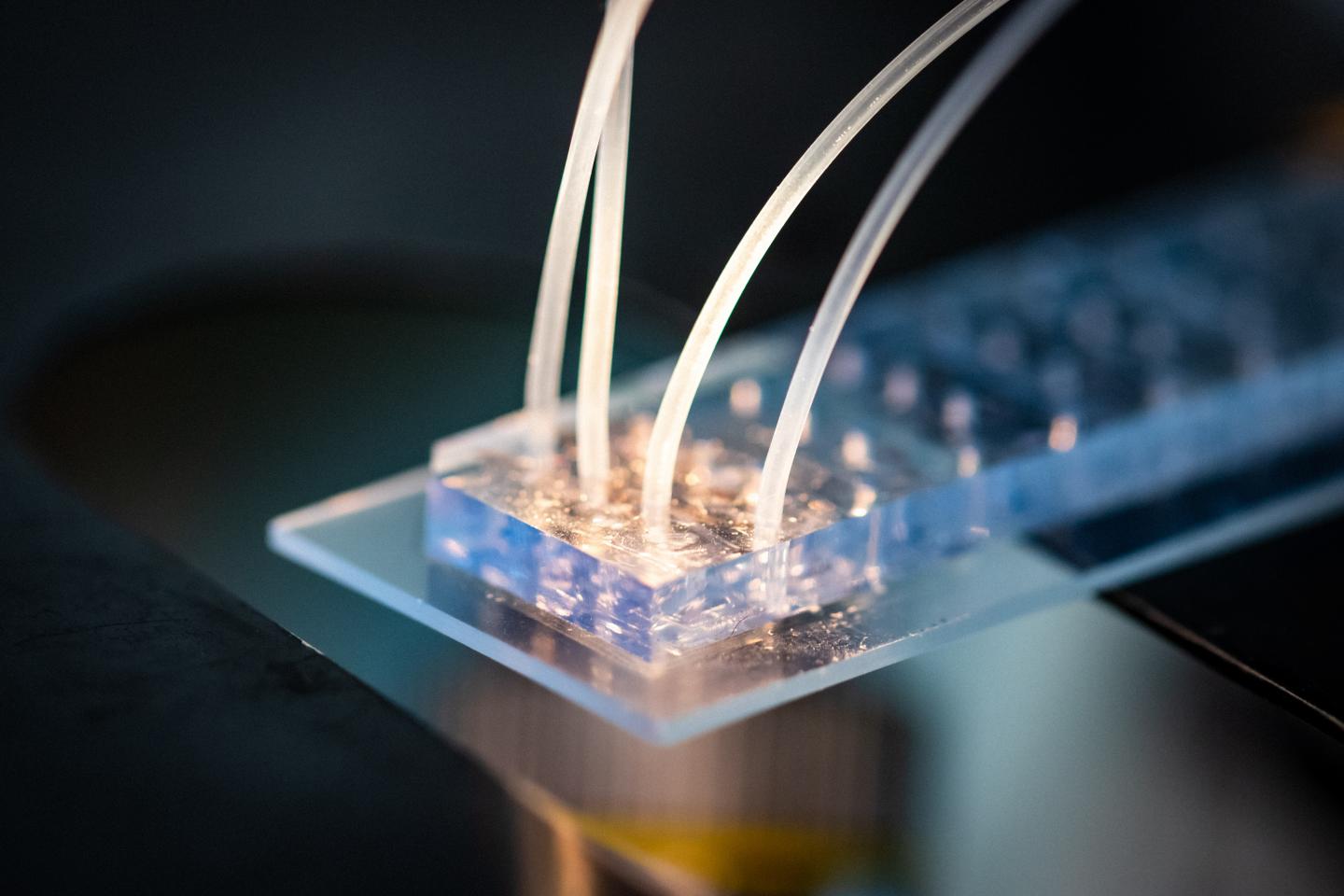
Credit: Felix Petermann, MDC
Hundreds of innovators, research pioneers, clinicians, industry leaders and policy makers from all around Europe are united by a vision of how to revolutionize healthcare. In two publications – a perspective article in the journal Nature and the LifeTime Strategic Research Agenda – they now present a detailed roadmap of how to leverage the latest scientific breakthroughs and technologies over the next decade, to track, understand and treat human cells throughout an individual’s lifetime.
The LifeTime initiative, co-coordinated by the Max Delbrueck Center of Molecular Medicine in the Helmholtz Association (MDC) in Berlin and the Institut Curie in Paris, has developed a strategy to advance personalized treatment for five major disease classes: cancer, neurological, infectious, chronic inflammatory and cardiovascular diseases. The aim is a new age of personalized, cell-based interceptive medicine for Europe with the potential of improved health outcomes and more cost-effective treatment, resulting in profoundly changing a person’s healthcare experience.
Earlier detection and more effective treatment of diseases
To form a functioning, healthy body, our cells follow developmental paths during which they acquire specific roles in tissues and organs. But when they deviate from their healthy course, they accumulate changes leading to disease which remain undetected until symptoms appear. At this point, medical treatment is often invasive, expensive and inefficient. However, now we have the technologies to capture the molecular makeup of individual cells and to detect the emergence of disease or therapy resistance much earlier.
Using breakthrough single-cell and imaging technologies in combination with artificial intelligence and personalized disease models will allow us to not only predict disease onset earlier, but also to select the most effective therapies for individual patients. Targeting disease-causing cells to intercept disorders before irreparable damage occurs will substantially improve the outlook for many patients and has the potential of saving billions of Euros of disease-related costs in Europe.
A detailed roadmap for implementing LifeTime
The perspective article “The LifeTime initiative and the future of cell-based interceptive medicine in Europe” and the LifeTime Strategic Research Agenda (SRA) explain how these technologies should be rapidly co-developed, transitioned into clinical settings and applied to the five major disease areas. Close interactions between European infrastructures, research institutions, hospitals and industry will be essential to generate, share and analyze LifeTime’s big medical data across European borders. The initiative’s vision advocates ethically responsible research to benefit citizens all across Europe.
According to Professor Nikolaus Rajewsky, scientific director of the Berlin Institute for Medical System Biology at the Max Delbrueck Center for Molecular Medicine and coordinator of the LifeTime Initiative, the LifeTime approach is the way into the future: “LifeTime has brought together scientists across fields – from biologists, to clinicians, data scientists, engineers, mathematicians, and physicists ¬- to enable a much improved understanding of molecular mechanisms driving health and disease. Cell-based medicine will allow doctors to diagnose diseases earlier and intercept disorders before irreparable damage has occurred. LifeTime has a unique value proposition that promises to improve the European patient’s health.”
Dr. Geneviève Almouzni, director of research at CNRS, honorary director of the research center from Institut Curie in Paris and co-coordinator of the LifeTime Initiative believes that the future with LifeTime offers major social and economic impact: “By implementing interceptive, cell-based medicine we will be able to considerably improve treatment across many diseases. Patients all over the world will be able to lead longer, healthier lives. The economic impact could be tremendous with billions of Euros saved from productivity gains simply for cancer, and significantly shortened ICU stays for Covid-19. We hope EU leaders will realize we have to invest in the necessary research now.”
###
About LifeTime
The LifeTime Initiative is a growing community of more than 100 leading European research institutions and hospitals, together with international advisers and over 80 supporting companies. LifeTime includes the preeminent European laboratories developing multi-omic strategies, scientific infrastructures, bioimaging and computational technologies, as well as world-renowned laboratories in the area of personalized disease models, bioethicists and a core group of leading clinician scientists. Many of the involved institutions include or are linked to translational/clinical research facilities and hospitals, ensuring that LifeTime discoveries can be rapidly translated into clinical practice.
Media Contact
Valentin Popescu
[email protected]
Related Journal Article
http://dx.