Credit: Nano Letters, School of Physics of Peking University
Professor Wang Jian at Peking University and collaborators investigated the superconducting properties of two-dimensional crystalline superconducting PdTe2 films grown by molecular beam epitaxy. They observed the experimental evidence of anomalous metallic state and detected type-II Ising superconductivity existing in centrosymmetric systems. Moreover, the superconductivity of PdTe2 films remains almost the same for more than 20 months without any protection layer. This macro-size ambient-stable superconducting system with strong spin-orbit coupling shows great potentials in superconducting electronic and spintronic applications. The paper was published online in Nano Letters (DOI: 10.1021/acs.nanolett.0c01356) and selected for the Editors’ Choice of Science with a title of “An unusual superconductor” (Science 369, 388 (2020)).
The magnetic field is normally believed to hinder the formation of superconductivity. For most superconducting systems, strong magnetic field can break the superconducting Cooper pairs and destroy the superconductivity. Recently, a new kind of two-dimensional (2D) superconducting system survives under a large in-plane magnetic field, called Ising superconductors. Previous works suggest that the Ising superconductor requires in-plane inversion symmetry breaking. The broken in-plane inversion symmetry gives rise to Zeeman-type spin-orbit coupling (SOC), which polarizes the electron spins to the out-of-plane direction and leads to a huge in-plane critical magnetic field up to several times of the Pauli limit, normally corresponding to dozens of Tesla. The Pauli limit is defined as the magnetic field required to destroy the Cooper pairs via the spin pair breaking effect in conventional superconductors. Professor Wang Jian and collaborators ever reported the observation of Ising superconductivity in macro-size monolayer NbSe2 films grown by molecular beam epitaxy (MBE) (Nano Lett. 17, 6802 (2017)) and the interface induced Ising superconductivity in ultrathin crystalline Pb films (Phys. Rev. X 8, 021002 (2018)) for the first time.
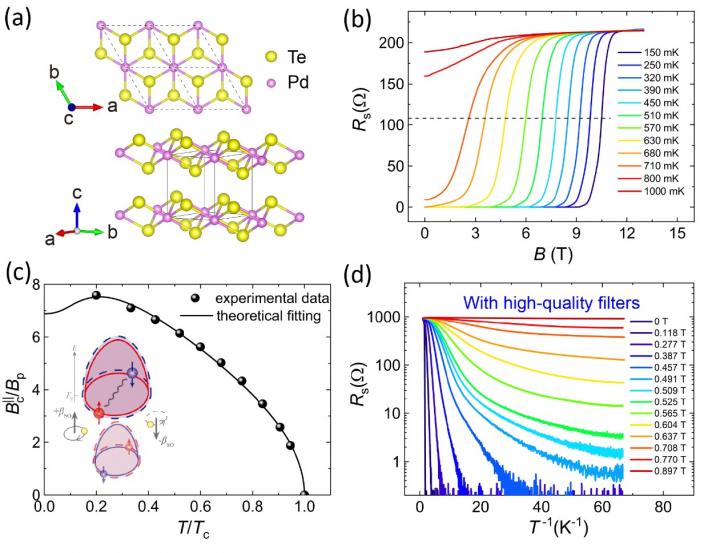
Recently, Professor Wang Jian and Professor Lin Xi at Peking University, in collaboration with Professor Xue Qikun, Professor Wang Lili, Professor Xu Yong, Professor Yao Hong at Tsinghua University, Professor Liu Haiwen at Beijing Normal University detected a new kind of Ising superconductivity in 2D crystalline PdTe2 films grown by MBE. The 6-monolayer (ML) (around 3 nm) PdTe2 film exhibits a large in-plane critical field more than 7 times of the Pauli limit, which is the characteristic of Ising superconductivity. Different from the previously reported Ising superconductors, the PdTe2 film keeps the in-plane inversion symmetry, which indicates that there exists a new mechanism of Ising superconductivity (named type-II Ising superconductivity by Professor Wang Jian in discussion with Professor Xu Yong). Band structure calculation and theoretical analysis reveal that the 3-fold rotational symmetry in the PdTe2 films makes the effective field of SOC along the out-of-plane direction and leads to the out-of-plane spin polarization. The superconducting Cooper pairs formed by the electrons with out-of-plane spin polarization can survive under very large magnetic field parallel to the 2D system, which gives rise to the type-II Ising superconductivity with large in-plane critical field. Theoretical calculations indicate that for 2D superconducting systems with in-plane inversion symmetry, 4 and 6-fold rotational symmetry can also make the orientation of the effective SOC field along out-of-plane direction. Thus, the type-II Ising superconductivity can be generalized to various 2D systems with 3, 4 and 6-fold rotational symmetry. Therefore, the discovery of type-II Ising superconductivity is promising to stimulate a new research direction in condensed matter physics.
Interestingly, under perpendicular magnetic field, the sheet resistance of PdTe2 films drops and then saturates to a temperature-independent constant with decreasing temperature via ultralow temperature transport measurements with high-quality filters. It is the first solid experimental evidence of anomalous metallic states in high-quality 2D crystalline films grown by MBE, which further reveals that besides superconducting and insulating ground states, anomalous metallic state is another quantum ground state for 2D Bosonic systems.
Moreover, most 2D superconducting systems are very sensitive to the atmosphere and easy to lose superconductivity. The superconductivity of PdTe2 films remains almost the same for more than 20 months without any protection layer. This macro-size ambient-stable superconducting system with strong SOC shows great potentials in superconducting electronic and spintronic applications.
The paper entitled “Type-II Ising superconductivity and anomalous metallic state in macro-size ambient-stable ultrathin crystalline films” was published online in Nano Letters and selected for the Editors’ Choice of Science with a title of “An unusual superconductor” (Science 369, 388 (2020)).
Professor Wang Jian at Peking University, Professor Wang Lili at Tsinghua University and Professor Lin Xi at Peking University are corresponding authors of this paper. Dr. Liu Yi at Peking University, Professor Xu Yong at Tsinghua University, Sun Jian at Peking University and Dr. Liu Chong at Tsinghua University contributed equally to this work. Other collaborators include Professor Xue Qikun and Professor Yao Hong at Tsinghua University, Professor Liu Haiwen at Beijing Normal University etc.
This work was financially supported by the National Key Research and Development Program of China, the National Natural Science Foundation of China, the Strategic Priority Research Program of Chinese Academy of Sciences, the Beijing Natural Science Foundation, the Beijing Advanced Innovation Center for Future Chip and the China Postdoctoral Science Foundation.
Noted: Editors’ Choice of Science highlights seven papers from other journals in each issue. This issue includes one paper in Physics.
###
Media Contact
Huang Weijian
[email protected]
Original Source
http://newsen.
Related Journal Article
http://dx.