• HOME
  • NEWS
  • EXPLORE
    • CAREER
      • Companies
      • Jobs
    • EVENTS
    • iGEM
      • News
      • Team
    • PHOTOS
    • VIDEO
    • WIKI
  • BLOG
  • COMMUNITY
    • FACEBOOK
    • INSTAGRAM
    • TWITTER
Friday, April 10, 2026
BIOENGINEER.ORG
No Result
View All Result
  • Login
  • HOME
  • NEWS
  • EXPLORE
    • CAREER
      • Companies
      • Jobs
        • Lecturer
        • PhD Studentship
        • Postdoc
        • Research Assistant
    • EVENTS
    • iGEM
      • News
      • Team
    • PHOTOS
    • VIDEO
    • WIKI
  • BLOG
  • COMMUNITY
    • FACEBOOK
    • INSTAGRAM
    • TWITTER
  • HOME
  • NEWS
  • EXPLORE
    • CAREER
      • Companies
      • Jobs
        • Lecturer
        • PhD Studentship
        • Postdoc
        • Research Assistant
    • EVENTS
    • iGEM
      • News
      • Team
    • PHOTOS
    • VIDEO
    • WIKI
  • BLOG
  • COMMUNITY
    • FACEBOOK
    • INSTAGRAM
    • TWITTER
No Result
View All Result
Bioengineer.org
No Result
View All Result
Home NEWS Science News

Critical genes unravelled to understand human diseases and support drug discovery

Bioengineer by Bioengineer
December 6, 2016
in Science News
Reading Time: 2 mins read
0
Share on FacebookShare on TwitterShare on LinkedinShare on RedditShare on Telegram
IMAGE

Credit: Earlham Institute

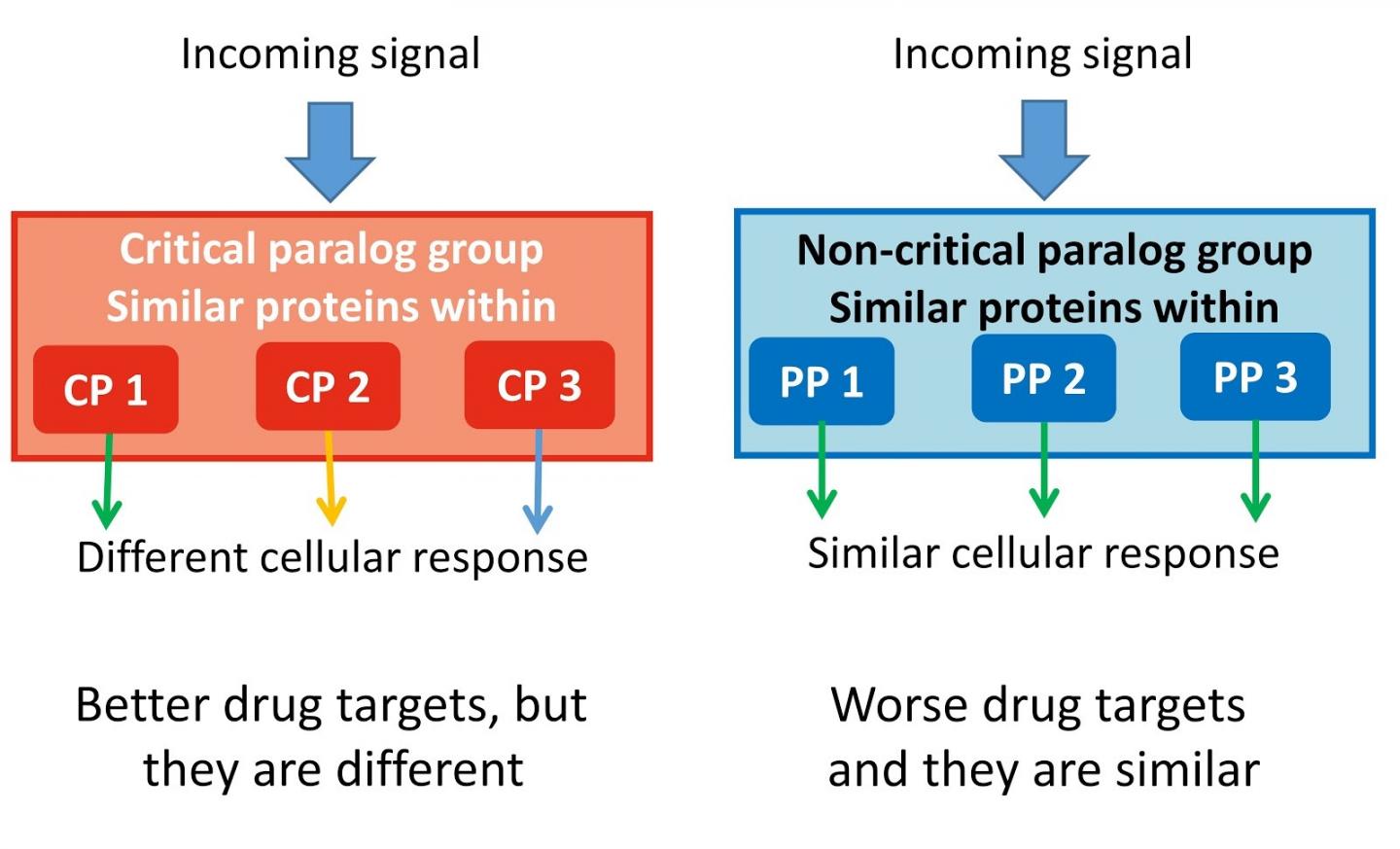
Throughout evolutionary history, there have been genetic elements that have duplicated – giving rise to genes with different functions. These are called 'paralogs'. They are able to form and evolve new functions, which have similar functions in relation to cellular signalling. This also means that there are many duplicated genes within the genome that might be redundant or less prominent when it comes to key cellular signalling pathways.

Scientists in the UK and Hungary, led by Earlham Institute (EI), have discovered which proteins are critical in a range of biological functions, including cellular communication.

The team found 75 so-called critical paralog groups (CPGs) containing proteins with close evolutionary relationship to each other. One or two members in these groups can be critically important for a specific function, and also their changes, called mutations, can cause cancer or other inherited diseases.

The systematic discovery of these proteins identifies their indispensable role in human cellular signalling pathways, as well as how to potentially guide drug targets and find biomarkers for disease diagnosis in the future.

Lead author Tamas Korcsmaros, Fellow at EI and the Institute of Food Research, said: "Our cells must be able to detect and respond to many different pieces of genetic information coming from both internal and external sources. However, not all proteins in the cell are equally important.

In the post-genomic era, we already know there are key groups of proteins responsible for detecting, transmitting and communicating through cross-talk between different cellular pathways. Previously, it was challenging to identify which proteins, in which group, are more critical for the overall function of the cell; and those that are more relevant in causing diseases such as cancer, diabetes or neurodegenerative disorders.

The computational biology workflow we developed and confirmed with known examples provides an easily applicable method for disease-specific analysis. The concept will also help us to understand fundamental biological questions in comparative genomics on how duplication in the course of evolution led to more complex organs (such as the brain) and organisms."

First author Dezs? Módos, Research Associate at the University of Cambridge, added: "Our study shows the importance of similar proteins (paralogs) in signalling networks. Taking into account the paralog specificity in drug discovery because different paralog-specific signal routes could lead to totally different results like cell death or proliferation."

###

The paper titled: "Identification of critical paralog groups with indispensable roles in the regulation of signalling flow" is published in Scientific Reports. DOI:10.1038/srep38588.

Media Contact

Hayley London
[email protected]
07-760-438-218

http://www.earlham.ac.uk/

############

Story Source: Materials provided by Scienmag
Share12Tweet8Share2ShareShareShare2

Related Posts

Anticoagulant Adherence Impacts Valve Surgery Outcomes

April 10, 2026
SNPs in FILIP1-SENP6, FTO Linked to TMJ Osteoarthritis

SNPs in FILIP1-SENP6, FTO Linked to TMJ Osteoarthritis

April 10, 2026

Study Suggests Artificial Sweeteners’ Negative Effects Could Impact Future Generations in Mice

April 10, 2026

Lipid Droplets: Key Players in Neurodegenerative Diseases

April 10, 2026
Please login to join discussion

POPULAR NEWS

  • Boosting Breast Cancer Risk Prediction with Genetics

    44 shares
    Share 18 Tweet 11
  • Popular Anti-Aging Compound Linked to Damage in Corpus Callosum, Study Finds

    44 shares
    Share 18 Tweet 11
  • Imagine a Social Media Feed That Challenges Your Views Instead of Reinforcing Them

    1012 shares
    Share 400 Tweet 250
  • Revolutionary Theory Transforms Quantum Perspective on the Big Bang

    40 shares
    Share 16 Tweet 10

About

We bring you the latest biotechnology news from best research centers and universities around the world. Check our website.

Follow us

Recent News

Anticoagulant Adherence Impacts Valve Surgery Outcomes

SNPs in FILIP1-SENP6, FTO Linked to TMJ Osteoarthritis

Study Suggests Artificial Sweeteners’ Negative Effects Could Impact Future Generations in Mice

Subscribe to Blog via Email

Enter your email address to subscribe to this blog and receive notifications of new posts by email.

Join 78 other subscribers
  • Contact Us

Bioengineer.org © Copyright 2023 All Rights Reserved.

Welcome Back!

Login to your account below

Forgotten Password?

Retrieve your password

Please enter your username or email address to reset your password.

Log In
No Result
View All Result
  • Homepages
    • Home Page 1
    • Home Page 2
  • News
  • National
  • Business
  • Health
  • Lifestyle
  • Science

Bioengineer.org © Copyright 2023 All Rights Reserved.