• HOME
  • NEWS
  • EXPLORE
    • CAREER
      • Companies
      • Jobs
    • EVENTS
    • iGEM
      • News
      • Team
    • PHOTOS
    • VIDEO
    • WIKI
  • BLOG
  • COMMUNITY
    • FACEBOOK
    • INSTAGRAM
    • TWITTER
Saturday, February 7, 2026
BIOENGINEER.ORG
No Result
View All Result
  • Login
  • HOME
  • NEWS
  • EXPLORE
    • CAREER
      • Companies
      • Jobs
        • Lecturer
        • PhD Studentship
        • Postdoc
        • Research Assistant
    • EVENTS
    • iGEM
      • News
      • Team
    • PHOTOS
    • VIDEO
    • WIKI
  • BLOG
  • COMMUNITY
    • FACEBOOK
    • INSTAGRAM
    • TWITTER
  • HOME
  • NEWS
  • EXPLORE
    • CAREER
      • Companies
      • Jobs
        • Lecturer
        • PhD Studentship
        • Postdoc
        • Research Assistant
    • EVENTS
    • iGEM
      • News
      • Team
    • PHOTOS
    • VIDEO
    • WIKI
  • BLOG
  • COMMUNITY
    • FACEBOOK
    • INSTAGRAM
    • TWITTER
No Result
View All Result
Bioengineer.org
No Result
View All Result
Home NEWS Science News Biology

A Politecnico di Milano study reveals DNA “grammar”

Bioengineer by Bioengineer
August 27, 2020
in Biology
Reading Time: 2 mins read
0
IMAGE
Share on FacebookShare on TwitterShare on LinkedinShare on RedditShare on Telegram

Genome Biology published a research on the rules governing the shape of DNA in space
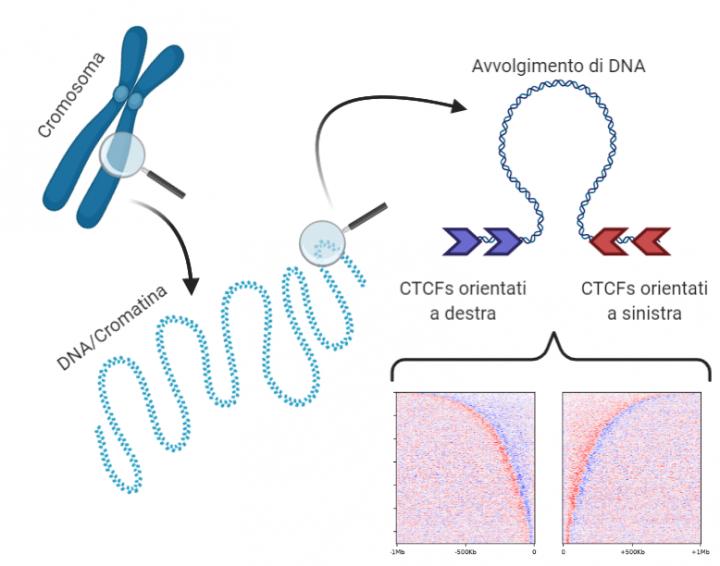
IMAGE

Credit: Luca Nanni

Milan, 27 August 2020 – DNA three-dimensional structure is determined by a series of spatial rules based on particular protein sequences and their order. This was the finding of a study recently published in Genome Biology by Luca Nanni, PhD student in Computer Science and Engineering at Politecnico di Milano, together with Professors Stefano Ceri of the same University and Colin Logie of the University of Nijmegen.

The first author of the study Luca Nanni said: “Our study’s greatest innovation lies in having identified precise rules for the disposition of CTCF proteins. The beauty and simplicity of CTCF’s grammar shows us how nature and evolution produce regularity and incredibly ingenious and functional systems.” “Knowing these rules allow CTCF sequences to be engineered to obtain the desired DNA three-dimensional structure. For example, it should be possible to make two disconnected genes interact. Moulding DNA structure will open doors to the creation of pharmaceuticals for the treatment of diseases such as cancer.”

The DNA molecule, which would be about two metres long if completely unrolled, wraps itself based on a complex system that maintains its accessibility and correct reading to reside in the cell’s nucleus. Crucial in the study of the three-dimensional structure of the genome are topological domains, which are thought to aggregate DNA zones with similar roles and behaviour. For example, genes with similar function are likely to reside in the same topological domain. Nanni continued: “We focused on some specific DNA sequences that encode for the CTCF protein.” “This protein isolates portions of DNA creating barriers between the various topological domains. With the help of computer simulations and the creation of a model for classifying these proteins according to their orientation, we identified a surprising regularity in their arrangement along the DNA sequence.” The study showed that the orientation and order of these DNA sequences makes it possible to reconstruct topological domains. The human genome compresses following a “grammar” logic comprising CTCF sequences, orientation, and the distance between them.

###

Media Contact
Cristina Perini
[email protected]

Original Source

https://www.polimi.it/?id=3936&tx_wfqbe_pi1[id]=1176

Related Journal Article

http://dx.doi.org/10.1186/s13059-020-02108-x

Tags: BioinformaticsBiologyBiomedical/Environmental/Chemical EngineeringBiotechnologyGenesGeneticsMedicine/Health
Share12Tweet8Share2ShareShareShare2

Related Posts

New Study Uncovers Mechanism Behind Burn Pit Particulate Matter–Induced Lung Inflammation

New Study Uncovers Mechanism Behind Burn Pit Particulate Matter–Induced Lung Inflammation

February 6, 2026

DeepBlastoid: Advancing Automated and Efficient Evaluation of Human Blastoids with Deep Learning

February 6, 2026

Navigating the Gut: The Role of Formic Acid in the Microbiome

February 6, 2026

AI-Enhanced Optical Coherence Photoacoustic Microscopy Revolutionizes 3D Cancer Model Imaging

February 6, 2026
Please login to join discussion

POPULAR NEWS

  • Robotic Ureteral Reconstruction: A Novel Approach

    Robotic Ureteral Reconstruction: A Novel Approach

    82 shares
    Share 33 Tweet 21
  • Digital Privacy: Health Data Control in Incarceration

    63 shares
    Share 25 Tweet 16
  • Study Reveals Lipid Accumulation in ME/CFS Cells

    57 shares
    Share 23 Tweet 14
  • Breakthrough in RNA Research Accelerates Medical Innovations Timeline

    53 shares
    Share 21 Tweet 13

About

We bring you the latest biotechnology news from best research centers and universities around the world. Check our website.

Follow us

Recent News

Palmitoylation of Tfr1 Drives Platelet Ferroptosis and Exacerbates Liver Damage in Heat Stroke

Oxygen-Enhanced Dual-Section Microneedle Patch Improves Drug Delivery and Boosts Photodynamic and Anti-Inflammatory Treatment for Psoriasis

Scientists Identify SARS-CoV-2 PLpro and RIPK1 Inhibitors Showing Potent Synergistic Antiviral Effects in Mouse COVID-19 Model

Subscribe to Blog via Email

Enter your email address to subscribe to this blog and receive notifications of new posts by email.

Join 73 other subscribers
  • Contact Us

Bioengineer.org © Copyright 2023 All Rights Reserved.

Welcome Back!

Login to your account below

Forgotten Password?

Retrieve your password

Please enter your username or email address to reset your password.

Log In
No Result
View All Result
  • Homepages
    • Home Page 1
    • Home Page 2
  • News
  • National
  • Business
  • Health
  • Lifestyle
  • Science

Bioengineer.org © Copyright 2023 All Rights Reserved.