• HOME
  • NEWS
  • EXPLORE
    • CAREER
      • Companies
      • Jobs
    • EVENTS
    • iGEM
      • News
      • Team
    • PHOTOS
    • VIDEO
    • WIKI
  • BLOG
  • COMMUNITY
    • FACEBOOK
    • INSTAGRAM
    • TWITTER
Saturday, February 7, 2026
BIOENGINEER.ORG
No Result
View All Result
  • Login
  • HOME
  • NEWS
  • EXPLORE
    • CAREER
      • Companies
      • Jobs
        • Lecturer
        • PhD Studentship
        • Postdoc
        • Research Assistant
    • EVENTS
    • iGEM
      • News
      • Team
    • PHOTOS
    • VIDEO
    • WIKI
  • BLOG
  • COMMUNITY
    • FACEBOOK
    • INSTAGRAM
    • TWITTER
  • HOME
  • NEWS
  • EXPLORE
    • CAREER
      • Companies
      • Jobs
        • Lecturer
        • PhD Studentship
        • Postdoc
        • Research Assistant
    • EVENTS
    • iGEM
      • News
      • Team
    • PHOTOS
    • VIDEO
    • WIKI
  • BLOG
  • COMMUNITY
    • FACEBOOK
    • INSTAGRAM
    • TWITTER
No Result
View All Result
Bioengineer.org
No Result
View All Result
Home NEWS Science News Chemistry

Storing information in antiferromagnetic materials

Bioengineer by Bioengineer
August 24, 2020
in Chemistry
Reading Time: 4 mins read
0
IMAGE
Share on FacebookShare on TwitterShare on LinkedinShare on RedditShare on Telegram

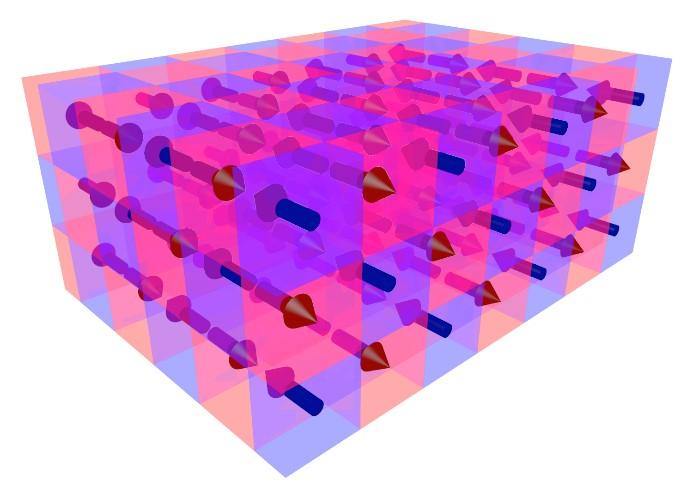
Researchers at Mainz University were able to show that information can be stored in antiferromagnetic materials and to measure the efficiency of the writing operation
IMAGE

Credit: ill./©: Lorenzo Baldrati, JGU

Researchers at Mainz University were able to show that information can be stored in antiferromagnetic materials and to measure the efficiency of the writing operation

We all store more and more information, while the end devices are supposed to get smaller and smaller. However, due to continuous technological improvement, conventional electronics based on silicon is rapidly reaching its limits – for example limits of physical nature such as the bit size or the number of electrons required to store information. Spintronics, and antiferromagnetic materials in particular, offers an alternative. It is not only electrons that are used to store information, but also their spin containing magnetic information. In this way, twice as much information can be stored in the same room. So far, however, it has been controversial whether it is even possible to store information electrically in antiferromagnetic materials.

Physicists unveil the potential of antiferromagnetic materials

Researchers at Johannes Gutenberg University Mainz (JGU), in collaboration with Tohoku University in Sendai in Japan, have now been able to prove that it works: “We were not only able to show that information storage in antiferromagnetic materials is fundamentally possible, but also to measure how efficiently information can be written electrically in insulating antiferromagnetic materials,” said Dr. Lorenzo Baldrati, Marie Sklowdoska-Curie Fellow in Professor Mathias Kläui’s group at JGU. For their measurements, the researchers used the antiferromagnetic insulator Cobalt oxide CoO – a model material that paves the way for applications. The result: Currents are much more efficient than magnetic fields to manipulate antiferromagnetic materials. This discovery opens the way toward applications ranging from smart cards that cannot be erased by external magnetic fields to ultrafast computers – thanks to the superior properties of antiferromagnets over ferromagnets. The research paper has recently been published in Physical Review Letters. In further steps, the researchers at JGU want to investigate how quickly information can be saved and how “small” the memory can be written to.

Active German-Japanese exchange

“Our longstanding collaboration with the leading university in the field of spintronics, Tohoku University, has generated another exciting piece of work”, emphasized Professor Mathias Kläui. “With the support of the German Exchange Service, the Graduate School of Excellence Materials Science in Mainz, and the German Research Foundation, we initiated a lively exchange between Mainz and Sendai, working with theory groups at the forefront of this topic. We have opportunities for first joint degrees between our universities, which is noticed by students. This is a next step in the formation of an international team of excellence in the burgeoning field of antiferromagnetic spintronics.”

###

Related links:

https://spintronicsartes.wordpress.com/ – Antiferromagnetic Spin Transport and Switching (ARTES) project of Marie Sk?odowska-Curie Fellow Dr. Lorenzo Baldrati ;

https://www.klaeui-lab.physik.uni-mainz.de/ – Kläui Lab at the JGU Institute of Physics ;

https://www.blogs.uni-mainz.de/fb08-iph-eng/ – JGU Institute of Physics ;

http://www.mainz.uni-mainz.de/ – Graduate School of Excellence Materials Science in Mainz (MAINZ) ;

https://www.uni-kl.de/trr173/ – DFG Collaborative Research Center/Transregio 173: Spin+X – Spin in its collective environment

Read more:

https://www.uni-mainz.de/presse/aktuell/10211_ENG_HTML.php – press release “Physicists make one step toward using insulating antiferromagnetic materials in future components” (25 Oct. 2019) ;

https://www.uni-mainz.de/presse/aktuell/6140_ENG_HTML.php – press release “New devices based on rust could reduce excess heat in computers” (17 Sept. 2018) ;

http://www.uni-mainz.de/presse/aktuell/4356_ENG_HTML.php – press release “Construction set of magnon logic extended: Magon spin currents can be controlled via spin valve structure” (14 March 2018) ;

http://www.uni-mainz.de/presse/aktuell/3937_ENG_HTML.php – press release “Antiferromagnets prove their potential for spin-based information technology” (29 Jan. 2018)

Media Contact
Dr. Lorenzo Baldrati
[email protected]

Original Source

https://www.uni-mainz.de/presse/aktuell/11958_ENG_HTML.php

Related Journal Article

http://dx.doi.org/10.1103/PhysRevLett.125.077201

Tags: Chemistry/Physics/Materials SciencesComputer ScienceElectrical Engineering/ElectronicsElectromagneticsMaterialsNanotechnology/MicromachinesResearch/DevelopmentTechnology/Engineering/Computer Science
Share12Tweet8Share2ShareShareShare2

Related Posts

blank

Breakthrough in Environmental Cleanup: Scientists Develop Solar-Activated Biochar for Faster Remediation

February 7, 2026
blank

Cutting Costs: Making Hydrogen Fuel Cells More Affordable

February 6, 2026

Scientists Develop Hand-Held “Levitating” Time Crystals

February 6, 2026

Observing a Key Green-Energy Catalyst Dissolve Atom by Atom

February 6, 2026
Please login to join discussion

POPULAR NEWS

  • Robotic Ureteral Reconstruction: A Novel Approach

    Robotic Ureteral Reconstruction: A Novel Approach

    82 shares
    Share 33 Tweet 21
  • Digital Privacy: Health Data Control in Incarceration

    63 shares
    Share 25 Tweet 16
  • Study Reveals Lipid Accumulation in ME/CFS Cells

    57 shares
    Share 23 Tweet 14
  • Breakthrough in RNA Research Accelerates Medical Innovations Timeline

    53 shares
    Share 21 Tweet 13

About

We bring you the latest biotechnology news from best research centers and universities around the world. Check our website.

Follow us

Recent News

Decoding Prostate Cancer Origins via snFLARE-seq, mxFRIZNGRND

Digital Health Perspectives from Baltic Sea Experts

Florida Cane Toad: Complex Spread and Selective Evolution

Subscribe to Blog via Email

Enter your email address to subscribe to this blog and receive notifications of new posts by email.

Join 73 other subscribers
  • Contact Us

Bioengineer.org © Copyright 2023 All Rights Reserved.

Welcome Back!

Login to your account below

Forgotten Password?

Retrieve your password

Please enter your username or email address to reset your password.

Log In
No Result
View All Result
  • Homepages
    • Home Page 1
    • Home Page 2
  • News
  • National
  • Business
  • Health
  • Lifestyle
  • Science

Bioengineer.org © Copyright 2023 All Rights Reserved.