Data-driven approach allows for advanced material screening
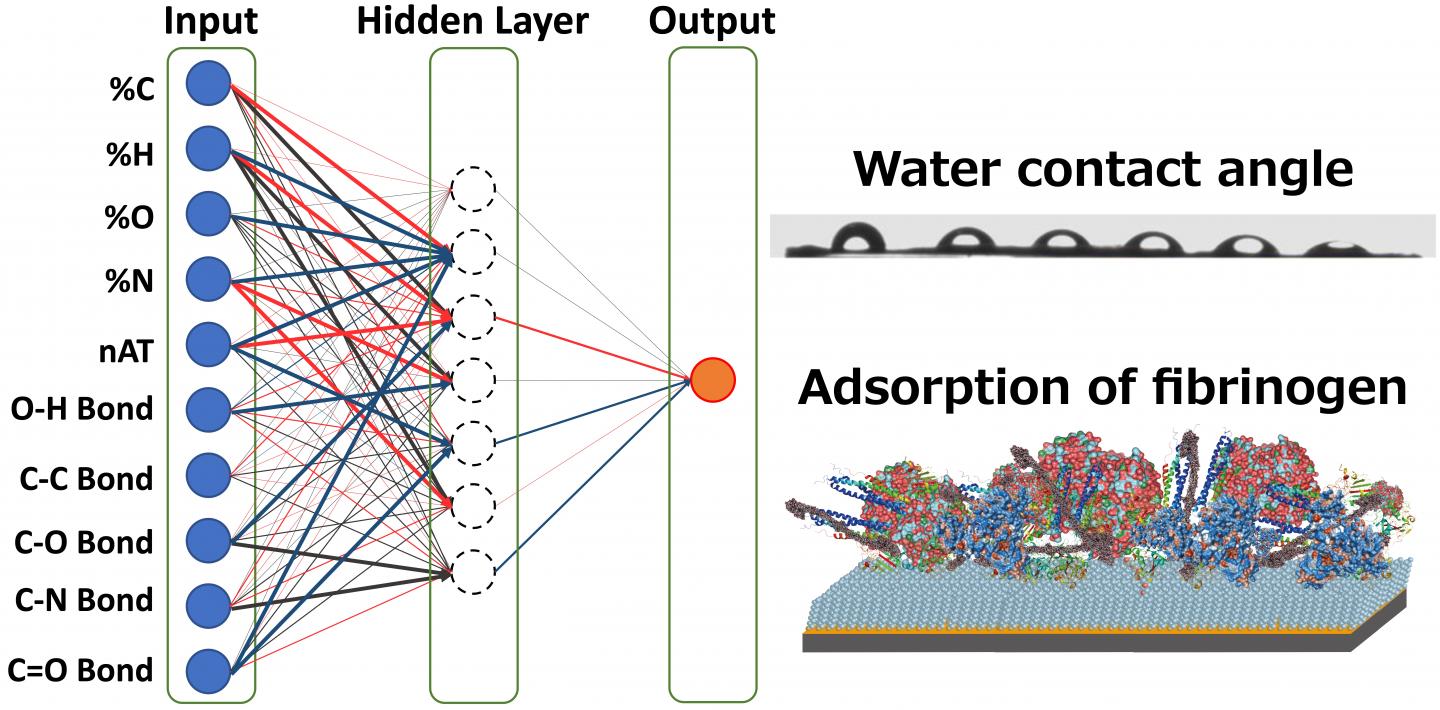
Credit: Biomaterials Science & Engineering
Researchers at Tokyo Institute of Technology (Tokyo Tech) have used artificial intelligence (AI) to predict the degree of water repulsion and protein adsorption by ultra-thin organic materials. By enabling accurate predictions of water repulsion and protein adsorption even by hypothetical materials, the team’s approach opens up new possibilities for the screening and design of organic materials with desired functions.
Using informatics[1] in the field of inorganic material design has led to the rise of new types of catalysts, batteries and semiconductors. In contrast, informatics-based design of biomaterials (i.e. organic as opposed to inorganic solid-state materials) is only just beginning to be explored.
Now, a team of researchers at Tokyo Tech led by Associate Professor Tomohiro Hayashi has successfully made inroads into this emerging field. They used machine learning[2] with an artificial neural network (ANN) [3] model to predict two key properties — the degree of water repulsion and affinity to protein molecules — of ultra-thin organic materials known as self-assembled monolayers (SAMs) [4] . SAMs have been widely used to create model organic surfaces to explore the interaction between proteins and materials due to their ease of preparation and versatility.
By training the ANN using a literature-based database of 145 SAMs, the ANN became capable of predicting water repulsion (measured in terms of the degree of water contact angle[5]) and protein adsorption accurately. The team went on to demonstrate the prediction of water repulsion and protein adsorption even for hypothetical SAMs.
SAMs are attractive for the development of many applications in organic electronics and the biomedical field. The two properties investigated in the study are of enormous interest to biomedical engineers. “For example, implant materials that exhibit low water contact angle enable fast integration with the surrounding hard tissues,” Hayashi says. “In the case of artificial blood vessels, the resistance to the adsorption of blood proteins, in particular fibrinogen, is a critical factor to prevent platelet adhesion and blood clotting.”
Overall, the study opens the door to advanced material screening and design of SAMs with potentially greatly reduced costs and time scales.
The researchers plan to continue scaling up their database and, within a few years, to expand their approach to include polymers, ceramics and metals.
###
Technical terms
[1] informatics: The science of information, here referring to how data can be used to improve materials design.
[2] machine learning: A type of artificial intelligence that enables computers to learn new information without being explicitly programmed.
[3] artificial neural network (ANN): One of the main tools used in machine learning, ANNs are an interconnected group of nodes inspired by natural neurons in the brain.
[4] self-assembled monolayers (SAMs): One-molecule-thick organic materials that bond to a surface in an ordered way.
[5] water contact angle: The quantification of the wettability of a given surface. In general, the larger the water contact angle, the surface is considered hydrophobic, while the smaller the water contact angle, the surface is considered hydrophilic.
Related links
Towards sustainability –From a by-product of the biodiesel industry to a valuable chemical
https:/
Hayashi Laboratory
http://lab.
About Tokyo Institute of Technology
Tokyo Tech stands at the forefront of research and higher education as the leading university for science and technology in Japan. Tokyo Tech researchers excel in fields ranging from materials science to biology, computer science, and physics. Founded in 1881, Tokyo Tech hosts over 10,000 undergraduate and graduate students per year, who develop into scientific leaders and some of the most sought-after engineers in industry. Embodying the Japanese philosophy of “monotsukuri,” meaning “technical ingenuity and innovation,” the Tokyo Tech community strives to contribute to society through high-impact research. https:/
Media Contact
Emiko Kawaguchi
[email protected]
Original Source
https:/
Related Journal Article
http://dx.