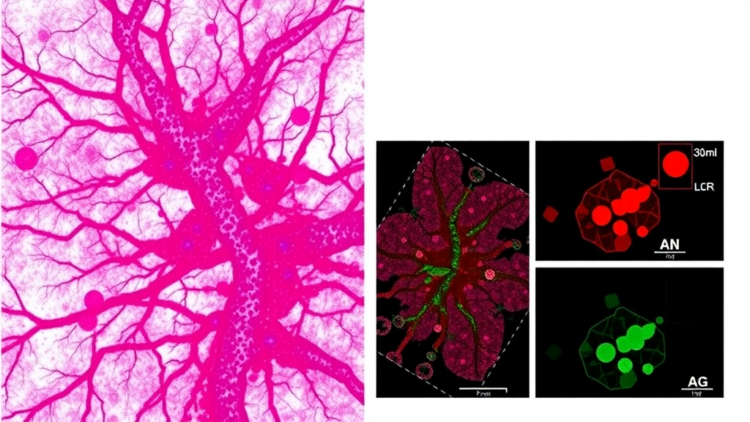
Credit: Mateusz Dyla
Cells send signals through enzyme cascades, where one enzyme passes the signal to the next. In such cascades, it is crucial that the enzyme recognizes the right substrates to ensure that, for example, a hormone activates the right cellular activities. Protein kinases, the enzymes in such cascades, are usually not sufficiently specific on their own, and therefore they rely on other proteins to physically connect them to the right substrates.
“Currently, we describe signalling enzymes with equations developed for metabolic enzymes,” Magnus Kjærgaard explains. “Metabolic enzymes that make energy for our bodies, for example, need to process many substrates per minute. In contrast, signalling enzymes act as switches, and often only need to convert a single substrate to have an effect. Therefore, the equations developed to describe metabolic enzymes are less relevant for signalling enzymes.”
For more than a hundred years, biochemists have described the activity of enzymes using the Michaelis-Menten equation, which describes how activity increases with increased substrate equation. When the enzyme is connected to its substrate, it does not matter how much substrate is present. Instead, the speed of the reaction depends on how the enzyme is connected to the substrate and thus on the connector molecule. Until now, we have not had any description of how the structure of such molecules affected enzymatic reactions.
“Normally, the question you are trying to answer is what graph shape describes the enzyme activity. We had a much more fundamental problem,” says first-author Mateusz Dyla. “What should we put on the X-axis instead of concentration?”
Connector molecules control cellular signalling
The authors made a model system where they could change the connection between the enzyme and the substrate. They used this to measure how the length of a flexible connector affects the first round of catalysis by the enzyme, which took place in milliseconds. Finally, they ended up with an equation that describes how the speed of the enzyme depends on the connection between enzyme and substrate. This equation suggested that connector molecules play an overlooked role in controlling cellular signalling.
The connection between enzyme and substrate also affects which substrates the enzyme prefers. Substrates that look similar can be very different when the enzyme only processes a single connected substrate.
“It is like the difference between how long it takes me to eat a single hotdog, and how many hotdogs I can eat over a whole week,” Magnus explains. “Over the course of a week, I will be limited by how fast I can digest the hotdogs. This is irrelevant to the time it takes to eat the first hotdog. Therefore, the two types of measurements give different results. If you want to understand kinase switches, you have to focus on the first round of catalysis.”
In the long-term, this may have implications for the development of drugs targeting kinases in, for example, cancer. Mateusz explains: “We hope that one day it will be possible to make drugs that not only target the enzyme, but also target how it is connected to its substrate.”
The results have been published in the international journal PNAS.
###
Media Contact
Magnus Kjærgaard
[email protected]
Original Source
https:/
Related Journal Article
http://dx.