• HOME
  • NEWS
  • EXPLORE
    • CAREER
      • Companies
      • Jobs
    • EVENTS
    • iGEM
      • News
      • Team
    • PHOTOS
    • VIDEO
    • WIKI
  • BLOG
  • COMMUNITY
    • FACEBOOK
    • INSTAGRAM
    • TWITTER
Saturday, February 7, 2026
BIOENGINEER.ORG
No Result
View All Result
  • Login
  • HOME
  • NEWS
  • EXPLORE
    • CAREER
      • Companies
      • Jobs
        • Lecturer
        • PhD Studentship
        • Postdoc
        • Research Assistant
    • EVENTS
    • iGEM
      • News
      • Team
    • PHOTOS
    • VIDEO
    • WIKI
  • BLOG
  • COMMUNITY
    • FACEBOOK
    • INSTAGRAM
    • TWITTER
  • HOME
  • NEWS
  • EXPLORE
    • CAREER
      • Companies
      • Jobs
        • Lecturer
        • PhD Studentship
        • Postdoc
        • Research Assistant
    • EVENTS
    • iGEM
      • News
      • Team
    • PHOTOS
    • VIDEO
    • WIKI
  • BLOG
  • COMMUNITY
    • FACEBOOK
    • INSTAGRAM
    • TWITTER
No Result
View All Result
Bioengineer.org
No Result
View All Result
Home NEWS Science News

NASA-NOAA satellite provides overnight watch on hurricane Genevieve

Bioengineer by Bioengineer
August 19, 2020
in Science News
Reading Time: 3 mins read
0
IMAGE
Share on FacebookShare on TwitterShare on LinkedinShare on RedditShare on Telegram

IMAGE

Credit: Credit: NASA Worldview, Earth Observing System Data and Information System (EOSDIS)

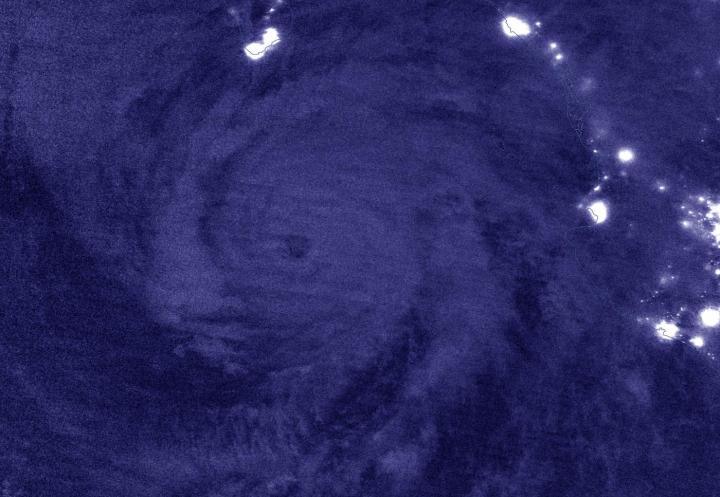
NASA-NOAA’s Suomi NPP satellite kept an eye on Hurricane Genevieve overnight and provided infrared imagery to forecasters who were monitoring the storm’s strength, structure and size. Because Genevieve is close to the coast of western Mexico, warnings and watches were still in effect.

NASA’s Night-Time View of Genevieve

The Visible Infrared Imaging Radiometer Suite (VIIRS) instrument aboard Suomi NPP provided a nighttime image of Hurricane Genevieve on Aug. 18 at 8 p.m. EDT (Aug. 19 at 0000 UTC).The hurricane’s eye was still visible and well defined. It was surrounded by powerful thunderstorms, although deep convection is generally lacking over the southwestern portion of the circulation.  The image was created using the NASA Worldview application.

Warnings and Watches on Aug. 19

NOAA’s National Hurricane Center issued a Hurricane Warning for the southern Baja California peninsula from Los Barriles to Todos Santos, Mexico. A Tropical Storm Warning is in effect for the west coast of the Baja California peninsula from north of Todos Santos to Cabo San Lazaro, and a Tropical Storm Watch is in effect for the east coast of the Baja California peninsula from Los Barriles to La Paz.

Hurricane Genevieve’s Status on Aug. 19

At 11 a.m. EDT (1500 UTC), the center of Hurricane Genevieve was located near latitude 20.9 degrees north and longitude 109.7 degrees west. That puts the eye about 140 miles (225 km) south of the southern tip of Baja California, Mexico. The estimated minimum central pressure is 959 millibars. Genevieve was moving toward the north-northwest near 9 mph (15 kph).

Maximum sustained winds are near 115 mph (185 km/h) with higher gusts.  Genevieve is a category 3 hurricane on the Saffir-Simpson Hurricane Wind Scale.

The NHC Forecast for Genevieve

NOAA’s NHC forecast noted, “Gradual weakening is forecast over the next couple of days, but Genevieve is expected to remain a strong hurricane while it passes west of the southern Baja California peninsula. A turn toward the northwest is expected this afternoon or tonight, with this motion continuing through Friday night.  On the forecast track, the center of Genevieve is expected to move near but just southwest of the southern portion of the Baja California peninsula tonight and Thursday, and move away from the peninsula on Friday.”

About NASA’s EOSDIS Worldview

NASA’s Earth Observing System Data and Information System (EOSDIS) Worldview application provides the capability to interactively browse over 700 global, full-resolution satellite imagery layers and then download the underlying data. Many of the available imagery layers are updated within three hours of observation, essentially showing the entire Earth as it looks “right now.”

NASA Researches Earth from Space

For more than five decades, NASA has used the vantage point of space to understand and explore our home planet, improve lives and safeguard our future. NASA brings together technology, science, and unique global Earth observations to provide societal benefits and strengthen our nation. Advancing knowledge of our home planet contributes directly to America’s leadership in space and scientific exploration.

For updated forecasts, visit: http://www.nhc.noaa.gov

By Rob Gutro 
NASA’s Goddard Space Flight Center

Media Contact
Rob Gutro
[email protected]

Original Source

https://blogs.nasa.gov/hurricanes/2020/08/19/genevieve-eastern-pacific-ocean-3/

Tags: Atmospheric ChemistryAtmospheric ScienceClimate ChangeClimate ScienceEarth ScienceMeteorologyTechnology/Engineering/Computer ScienceTemperature-Dependent PhenomenaWeather/Storms
Share12Tweet8Share2ShareShareShare2

Related Posts

Scientists Identify SARS-CoV-2 PLpro and RIPK1 Inhibitors Showing Potent Synergistic Antiviral Effects in Mouse COVID-19 Model

February 7, 2026

Neg-Entropy: The Key Therapeutic Target for Chronic Diseases

February 7, 2026

Multidisciplinary Evidence-Based Guidelines for Therapeutic Drug Monitoring of Biologics in Inflammatory Bowel Disease

February 7, 2026

Early Tuberculosis Treatment Lowers Sepsis Mortality in People with HIV

February 7, 2026
Please login to join discussion

POPULAR NEWS

  • Robotic Ureteral Reconstruction: A Novel Approach

    Robotic Ureteral Reconstruction: A Novel Approach

    82 shares
    Share 33 Tweet 21
  • Digital Privacy: Health Data Control in Incarceration

    63 shares
    Share 25 Tweet 16
  • Study Reveals Lipid Accumulation in ME/CFS Cells

    57 shares
    Share 23 Tweet 14
  • Breakthrough in RNA Research Accelerates Medical Innovations Timeline

    53 shares
    Share 21 Tweet 13

About

We bring you the latest biotechnology news from best research centers and universities around the world. Check our website.

Follow us

Recent News

Scientists Identify SARS-CoV-2 PLpro and RIPK1 Inhibitors Showing Potent Synergistic Antiviral Effects in Mouse COVID-19 Model

Neg-Entropy: The Key Therapeutic Target for Chronic Diseases

Multidisciplinary Evidence-Based Guidelines for Therapeutic Drug Monitoring of Biologics in Inflammatory Bowel Disease

Subscribe to Blog via Email

Enter your email address to subscribe to this blog and receive notifications of new posts by email.

Join 73 other subscribers
  • Contact Us

Bioengineer.org © Copyright 2023 All Rights Reserved.

Welcome Back!

Login to your account below

Forgotten Password?

Retrieve your password

Please enter your username or email address to reset your password.

Log In
No Result
View All Result
  • Homepages
    • Home Page 1
    • Home Page 2
  • News
  • National
  • Business
  • Health
  • Lifestyle
  • Science

Bioengineer.org © Copyright 2023 All Rights Reserved.