A burst of song early in the morning may help birds nail their songs during the day
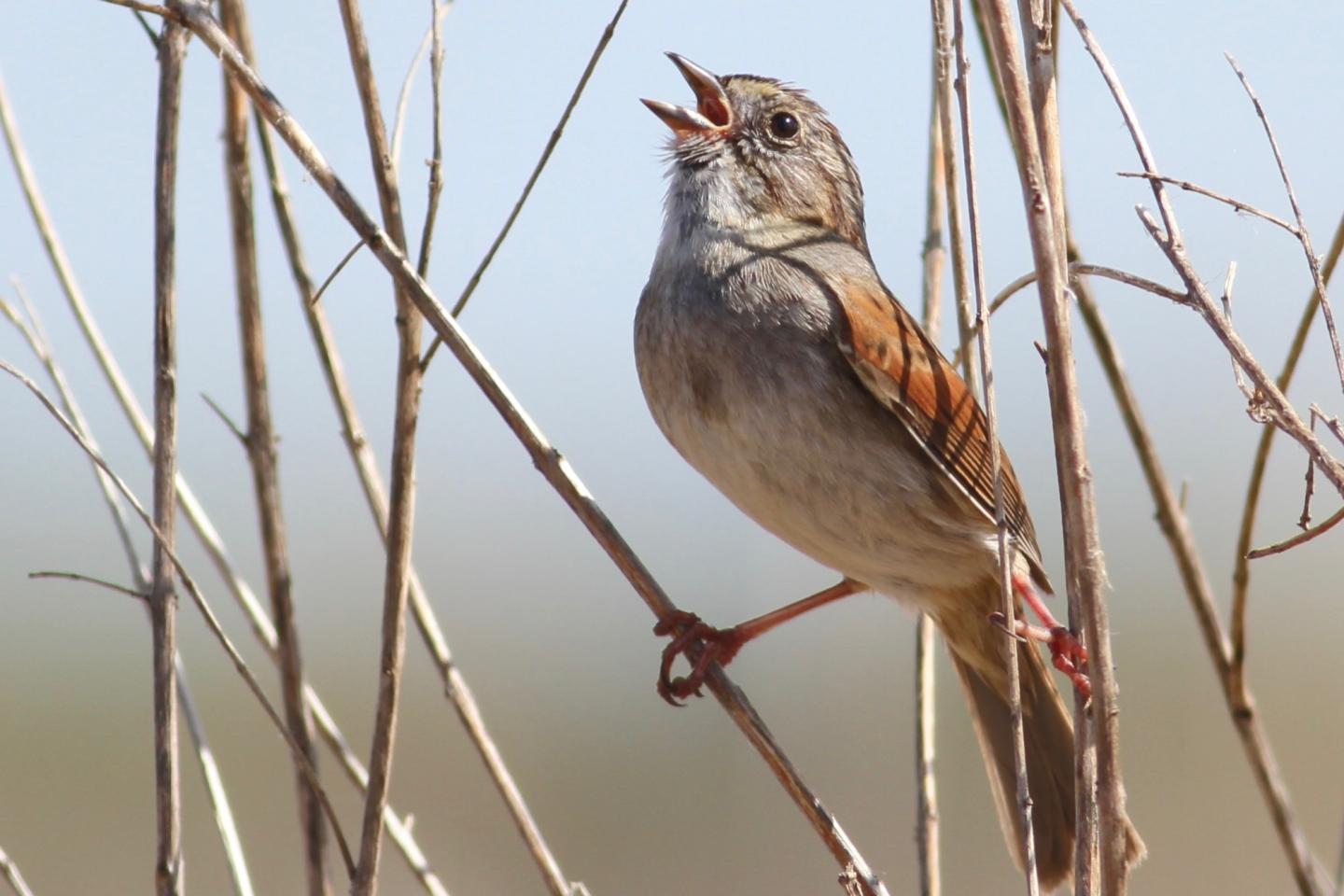
Credit: Photo by Robert Lachlan, Royal Holloway, University of London
DURHAM, N.C. — If you’ve ever been woken up before sunrise by the trilling and chirping of birds outside your window, you may have wondered: why do birds sing so loud, so early in the morning?
Researchers at Duke University say there may be a good reason why birds are most vocal at first light. By singing early and often, a new study suggests, birds perform better during the day.
The morning cacophony is mostly males, whose songs are meant to impress potential mates and rivals.
“It’s like they’re warming up backstage, before the sun comes up and the curtain rises,” said co-author Stephen Nowicki, a biology professor at Duke.
Scientists have proposed various hypotheses for why birds do their most vigorous singing in the early morning hours. One idea is that it’s the best time to broadcast, since there’s little wind to distort their sound. Others have suggested that the dim light makes it difficult to do much else, like hunt for insects.
But a study in the journal Animal Behaviour points to another benefit: the early morning vocal warm-up works wonders for their singing.
To test the “warm-up hypothesis,” Nowicki and Duke biologist Susan Peters recorded 11 male swamp sparrows between 2 a.m. and noon for two to three mornings each.
The song of the swamp sparrow is a simple trill of up to five notes, repeated around 5 to 10 times a second. “It sounds a bit like a melodious police whistle,” Nowicki said.
Birdsong may look effortless, but it requires balancing competing demands of speed and dexterity, said first author Jason Dinh, a biology Ph.D. student who did the study while still an undergraduate at Duke.
Birds switch from one note to the next by opening and closing their beaks. To go from low to high and back down again in rapid-fire succession, a bird must precisely coordinate the movements of their beak and voice box with each breath.
To monitor the birds’ performance, the researchers measured each bird’s trill rate and vocal range over the course of the morning.
For swamp sparrows, the concert can start as early at 2:30 a.m. But they don’t wake up singing like virtuosos, the study found.
Statistical analysis of the recordings revealed that they start off taking it easy; singing slower, or with a more limited range. They only start to nail their songs — picking up the tempo and reaching for higher and lower pitch — just after dawn, after hundreds of takes.
The more they warmed up, the better they got. “They’re able to perform more difficult songs later in the morning,” Dinh said.
While it’s hard to make direct comparisons to the physiological effects in humans, Dinh said, the warm-up up may help get their blood flowing and temperature rising to meet the physical demands of singing.
Previous playback experiments by this research team have shown that a well-sung song, compared to a rusty one, is a bigger turn-on for females and more threatening to eavesdropping males, Peters said.
If male swamp sparrows see improvements in their singing within hours, the researchers say, the next step is to find out if females take note. If so, then males that sing early and often may have an advantage in attracting a mate.
###
This research was supported by the National Science Foundation (IBN-0315377).
CITATION: “Song Performance Improves With Continued Singing Across the Morning in a Songbird,” Jason P. Dinh, Susan Peters, Stephen Nowicki. Animal Behaviour, July 31, 2020. DOI: 10.1016/j.anbehav.2020.06.018
Media Contact
Robin Ann Smith
[email protected]
Original Source
https:/
Related Journal Article
http://dx.