Credit: WWT
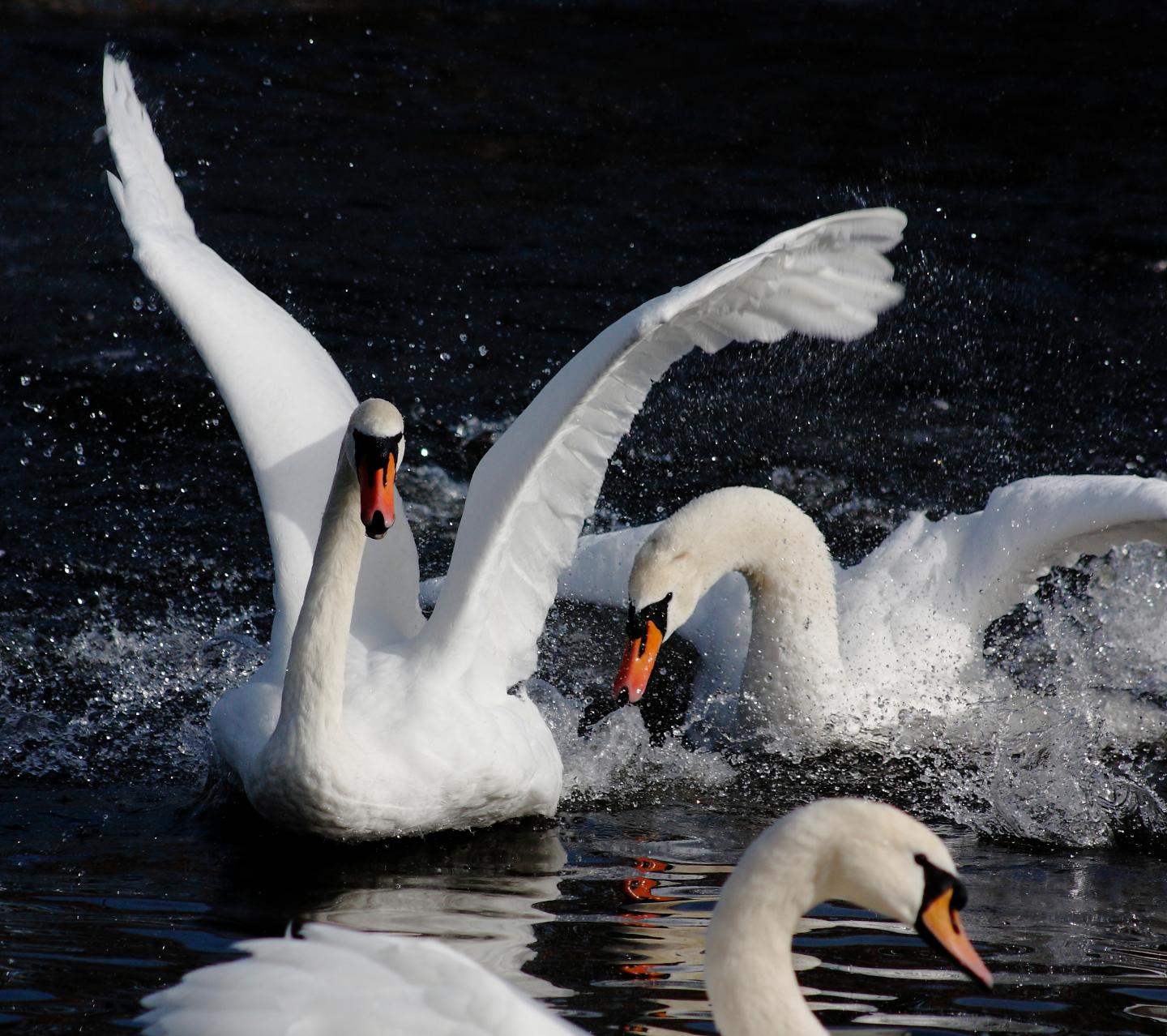
Swans display more aggression to fellow swans than other birds, new research shows.
The study examined three swan species – mute, whooper and Bewick’s – and found all were most frequently aggressive to their own kind.
The findings suggest that similar individuals are the greatest competition for food and other resources such as shelter, which can lead to conflict.
The research, by the Wildfowl and Wetlands Trust (WWT) and the University of Exeter, was undertaken to better understand how swan behaviour affects other waterbirds over winter.
Dr Kevin Wood, Principal Research Officer at WWT, said: “We know that swans have a reputation for aggressiveness but some of us suspected that in reality a lot of the aggression was directed towards other swans rather than smaller birds such as ducks or geese.
“To test that idea, we recruited some great students who used the webcams at Slimbridge and Caerlaverock to collect behavioural data on aggressive interactions between the various waterbirds at those sites over the past two winters.
“Our suspicions were right.
“In fact, almost all of the waterbird species in our study were most aggressive to their own species, which makes ecological sense as the individuals that are most similar to you are your greatest competition for food and other resources.
“It’s valuable to finally have the data to show that, and it’s another rung on the ladder of better-informed judgement on swans.”
The study was carried out by monitoring live-stream webcams on reserves at WWT Slimbridge Wetland Centre in Gloucestershire and WWT Caerlaverock Wetland Centre in Dumfries over the past two years.
It’s one of the first studies that has relied completely on remotely collected data – and could be one of the solutions to continuing research with restrictions in place during the Covid-19 pandemic.
Dr Paul Rose, of Exeter’s Centre for Research in Animal Behaviour, added: “This is a great example of how undergraduate projects can really help wild conservation action by allowing students to practice key research techniques but at the same time collecting data that is valuable to field scientists.
“We’d been thinking of using the WWT webcams for a while, to learn more about the swans’ behaviour without disturbing them, and this project on aggression and species differences seemed to beneficial to the needs of WWT’s conservation work and to the students fulfilling the requirements of their degrees.”
Across whooper, Bewick’s and mute swans, infighting between the same species accounted for up to 80% of negative interactions.
Bewick’s swans in particular were more likely to behave aggressively with one another, which could reflect their extreme lifestyles which involve a 7,000km migration across a continent twice a year.
The number of wintering Bewick’s swans in the UK declined by more than 50% between 1995 and 2015, with numbers continuing to fall.
Conservationists have theorised that this may be due to competing with mute and whoopers swans at their winter sites in Europe and at summer sites in Arctic Russia.
However, these findings show this is unlikely.
The study has also helped demonstrate how remotely-collected data can inform scientific research, without causing as much disturbance to birds and reducing carbon footprint in terms of travel.
It is likely to become an increasingly useful tool as conservationists try to carry out research while potential for field-work is limited.
The next step is to study other waterbirds to see how their behaviour alters depending on the presence and number of swans.
###
The paper, published in the journal Avian Research, is entitled: “Aggressive behavioural interactions between swans (Cygnus spp.) and other waterbirds during winter: a webcam-based study.”
Media Contact
Alex Morrison
[email protected]
Related Journal Article
http://dx.