• HOME
  • NEWS
  • EXPLORE
    • CAREER
      • Companies
      • Jobs
    • EVENTS
    • iGEM
      • News
      • Team
    • PHOTOS
    • VIDEO
    • WIKI
  • BLOG
  • COMMUNITY
    • FACEBOOK
    • INSTAGRAM
    • TWITTER
Saturday, February 7, 2026
BIOENGINEER.ORG
No Result
View All Result
  • Login
  • HOME
  • NEWS
  • EXPLORE
    • CAREER
      • Companies
      • Jobs
        • Lecturer
        • PhD Studentship
        • Postdoc
        • Research Assistant
    • EVENTS
    • iGEM
      • News
      • Team
    • PHOTOS
    • VIDEO
    • WIKI
  • BLOG
  • COMMUNITY
    • FACEBOOK
    • INSTAGRAM
    • TWITTER
  • HOME
  • NEWS
  • EXPLORE
    • CAREER
      • Companies
      • Jobs
        • Lecturer
        • PhD Studentship
        • Postdoc
        • Research Assistant
    • EVENTS
    • iGEM
      • News
      • Team
    • PHOTOS
    • VIDEO
    • WIKI
  • BLOG
  • COMMUNITY
    • FACEBOOK
    • INSTAGRAM
    • TWITTER
No Result
View All Result
Bioengineer.org
No Result
View All Result
Home NEWS Science News Chemistry

Group produces materials via self-organization in chemical systems

Bioengineer by Bioengineer
August 12, 2020
in Chemistry
Reading Time: 3 mins read
0
IMAGE
Share on FacebookShare on TwitterShare on LinkedinShare on RedditShare on Telegram

Applications range from sensors and batteries to fuel cells, among other technological possibilities. Achieving a deeper understanding and control of the processes involved is the goal of the Campinas Electrochemistry Group
IMAGE

Credit: Raphael Nagao

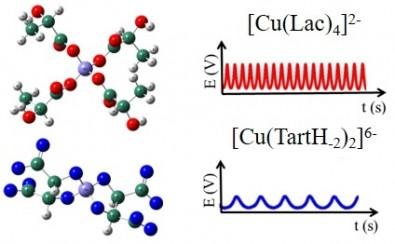
Entirely novel materials and known materials alike can be produced by means of self-organization in chemical systems. Applications range from sensors and batteries to fuel cells, among other technological possibilities. Achieving a deeper understanding and control of the processes involved is the goal of the Campinas Electrochemistry Group (CampEG), affiliated with the University of Campinas’s Institute of Chemistry (IQ-UNICAMP) in the state of São Paulo, Brazil, and led by Raphael Nagao.

Some results of the research were published in a recent article in The Journal of Physical Chemistry (JPC). A review of the group’s work as a whole is featured on the cover of ChemElectroChem.

FAPESP supports the group via several grants, especially a Young Investigator Grant to Nagao for the project “Design and control of self-organized electrochemical patterns”.

“In a reactor with electrodes, the electrochemical process in itself creates self-organizing nanometric or micrometric metal structures. The material grows because of oscillations in the electric potential,” Nagao told Agência FAPESP. “Energy conversion is one possible application of the resulting product – for example, as a catalyst of carbon dioxide (CO2) conversion into ethylene (C2H4), which is a more significant molecule in terms of its potential applications.”

A copper solution was used in the experiment reported in the JPC article. “The electrochemical process produced a deposition on the electrode, detected by means of the variation in potential,” Nagao said. “Using two organic ligands to prevent precipitation of the copper, we were able to control two parameters: the electric oscillation amplitude, which can be correlated with the chemical composition of the resulting material, and the oscillation period, which correlates with the thickness of the layer. Advance knowledge of the structure of the ligands therefore enables growth of the deposit to be controlled.”

Nagao added that the group now wants to achieve a detailed understanding of how these processes work from a basic science standpoint. Potential technological applications will be the next step. “Self-organization in chemical systems can be used as a sophisticated molecular construction mechanism. Exploration of catalytic advantages in terms of the selectivity and efficiency of these materials holds considerable promise going forward,” he said.

###

About São Paulo Research Foundation (FAPESP)

The São Paulo Research Foundation (FAPESP) is a public institution with the mission of supporting scientific research in all fields of knowledge by awarding scholarships, fellowships and grants to investigators linked with higher education and research institutions in the State of São Paulo, Brazil. FAPESP is aware that the very best research can only be done by working with the best researchers internationally. Therefore, it has established partnerships with funding agencies, higher education, private companies, and research organizations in other countries known for the quality of their research and has been encouraging scientists funded by its grants to further develop their international collaboration. You can learn more about FAPESP at http://www.fapesp.br/en and visit FAPESP news agency at http://www.agencia.fapesp.br/en to keep updated with the latest scientific breakthroughs FAPESP helps achieve through its many programs, awards and research centers. You may also subscribe to FAPESP news agency at http://agencia.fapesp.br/subscribe.

Media Contact
Heloisa Reinert
[email protected]

Original Source

https://agencia.fapesp.br/33843/

Related Journal Article

http://dx.doi.org/10.1021/acs.jpcc.0c02959

Tags: Chemistry/Physics/Materials SciencesElectromagneticsEnergy/Fuel (non-petroleum)Materials
Share12Tweet8Share2ShareShareShare2

Related Posts

blank

Breakthrough in Environmental Cleanup: Scientists Develop Solar-Activated Biochar for Faster Remediation

February 7, 2026
blank

Cutting Costs: Making Hydrogen Fuel Cells More Affordable

February 6, 2026

Scientists Develop Hand-Held “Levitating” Time Crystals

February 6, 2026

Observing a Key Green-Energy Catalyst Dissolve Atom by Atom

February 6, 2026
Please login to join discussion

POPULAR NEWS

  • Robotic Ureteral Reconstruction: A Novel Approach

    Robotic Ureteral Reconstruction: A Novel Approach

    82 shares
    Share 33 Tweet 21
  • Digital Privacy: Health Data Control in Incarceration

    63 shares
    Share 25 Tweet 16
  • Study Reveals Lipid Accumulation in ME/CFS Cells

    57 shares
    Share 23 Tweet 14
  • Breakthrough in RNA Research Accelerates Medical Innovations Timeline

    53 shares
    Share 21 Tweet 13

About

We bring you the latest biotechnology news from best research centers and universities around the world. Check our website.

Follow us

Recent News

Digital Health Perspectives from Baltic Sea Experts

Florida Cane Toad: Complex Spread and Selective Evolution

Exploring Decision-Making in Dementia Caregivers’ Mobility

Subscribe to Blog via Email

Enter your email address to subscribe to this blog and receive notifications of new posts by email.

Join 73 other subscribers
  • Contact Us

Bioengineer.org © Copyright 2023 All Rights Reserved.

Welcome Back!

Login to your account below

Forgotten Password?

Retrieve your password

Please enter your username or email address to reset your password.

Log In
No Result
View All Result
  • Homepages
    • Home Page 1
    • Home Page 2
  • News
  • National
  • Business
  • Health
  • Lifestyle
  • Science

Bioengineer.org © Copyright 2023 All Rights Reserved.