• HOME
  • NEWS
  • EXPLORE
    • CAREER
      • Companies
      • Jobs
    • EVENTS
    • iGEM
      • News
      • Team
    • PHOTOS
    • VIDEO
    • WIKI
  • BLOG
  • COMMUNITY
    • FACEBOOK
    • INSTAGRAM
    • TWITTER
Thursday, December 4, 2025
BIOENGINEER.ORG
No Result
View All Result
  • Login
  • HOME
  • NEWS
  • EXPLORE
    • CAREER
      • Companies
      • Jobs
        • Lecturer
        • PhD Studentship
        • Postdoc
        • Research Assistant
    • EVENTS
    • iGEM
      • News
      • Team
    • PHOTOS
    • VIDEO
    • WIKI
  • BLOG
  • COMMUNITY
    • FACEBOOK
    • INSTAGRAM
    • TWITTER
  • HOME
  • NEWS
  • EXPLORE
    • CAREER
      • Companies
      • Jobs
        • Lecturer
        • PhD Studentship
        • Postdoc
        • Research Assistant
    • EVENTS
    • iGEM
      • News
      • Team
    • PHOTOS
    • VIDEO
    • WIKI
  • BLOG
  • COMMUNITY
    • FACEBOOK
    • INSTAGRAM
    • TWITTER
No Result
View All Result
Bioengineer.org
No Result
View All Result
Home NEWS Science News Chemistry

What violin synchronization can teach us about better networking in complex times

Bioengineer by Bioengineer
August 11, 2020
in Chemistry
Reading Time: 2 mins read
0
IMAGE
Share on FacebookShare on TwitterShare on LinkedinShare on RedditShare on Telegram

IMAGE

Credit: Chen Damari

STONY BROOK, NY, August 11, 2020 – Human networking involves every field and includes small groups of people to large, coordinated systems working together toward a goal, be it traffic management in an urban area, economic systems or epidemic control. A new study published in Nature Communications suggests by using a model of violin synchronization in a network of violin players, there are ways to drown out distractions and miscommunications that could be used as a model for human networks in society.

Titled “The Synchronization of Complex Human Networks,” the study was conceived by Elad Shniderman, a graduate student in the Department of Music in the College of Arts and Sciences at Stony Brook University, and scientist Moti Fridman, PhD, at the Institute of Nanotechnology and Advanced Materials at Bar-llan University. He co-authored the paper with Daniel Weymouth, PhD, Associate Professor of Composition and Theory in the Department of Music and scientists at Bar-llan and the Weizmann Institute of Science in Israel. The collaboration was initiated at the Fetter Museum of Nanoscience and Art.

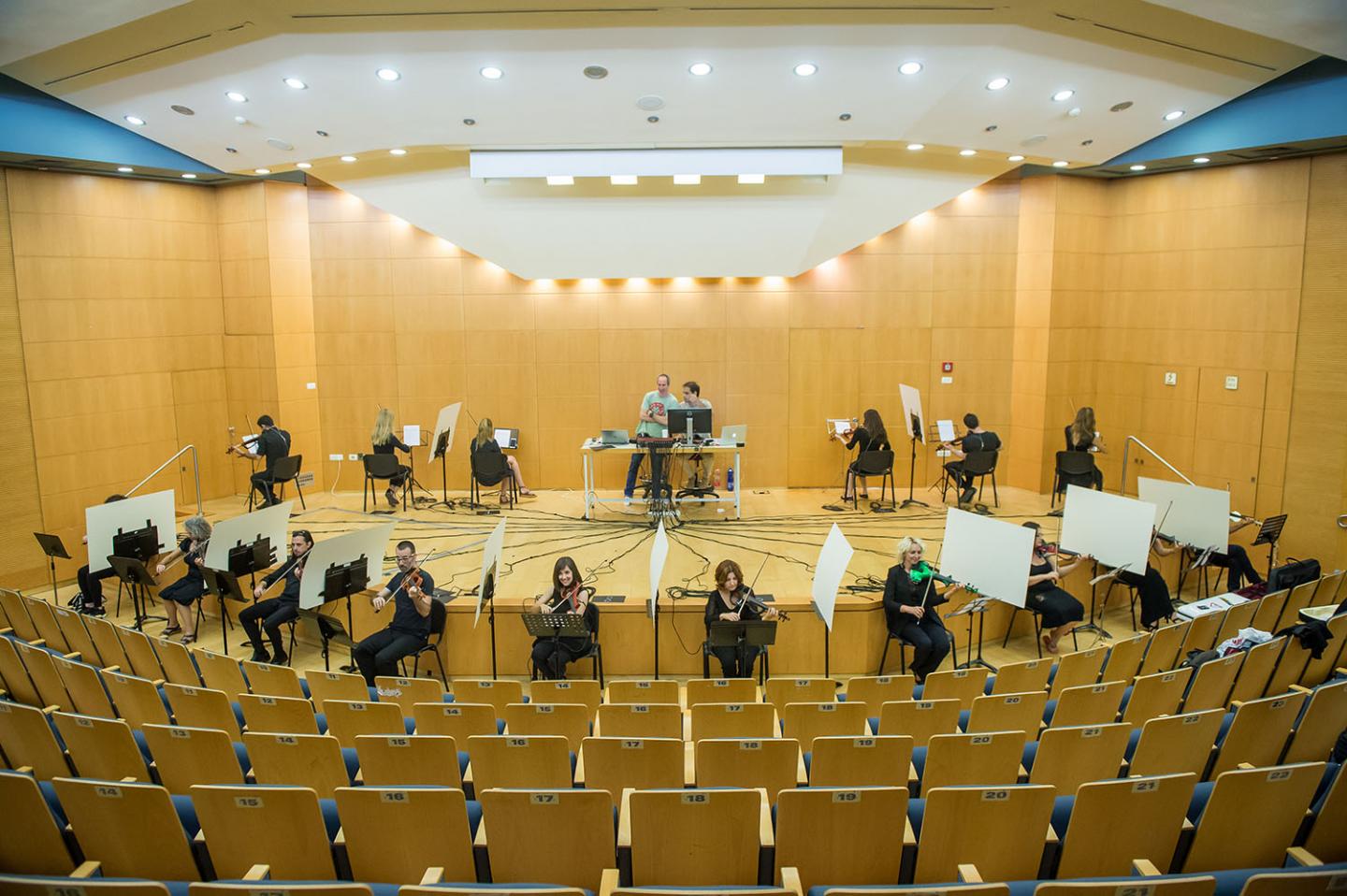
The research team devised an experiment involving 16 violinists with electric violins connected to a computer system. Each of the violinists had sound-canceling headphones, hearing only the sound received from the computer. All violinists played a simple repeating musical phrase and tried to synchronize with other violinists according to what they heard in their headphones.

According to Shniderman, Weymouth and their fellow authors: “Research on network links or coupling has focused predominantly on all-to-do coupling, whereas current social networks and human interactions are often based on complex coupling configurations.

This study of synchronization between violin players in complex networks with full control over network connectivity, coupling strength and delay, revealed that players can tune their playing period and delete connections by ignoring frustrating signals to find a stable solution. These controlled and new degrees of freedom enable new strategies and yield better solutions potentially applicable for other human networking models.”

“Society in its complexity is recognizing how human networks affect a broad range of crucial issues, including economic inequality, stock market crashes, political polarization and the spread of disease,” says Weymouth. “We believe there are a lot of important, real-world applications to the results of this experiment and ongoing work.”

###

To view how the experiment is carried out and for additional perspective from Shniderman, see this video titled SYNC Variations.

Media Contact
Greg Filiano
[email protected]

Tags: AcousticsChemistry/Physics/Materials SciencesComputer ScienceTechnology/Engineering/Computer Science
Share12Tweet8Share2ShareShareShare2

Related Posts

blank

Iridium Catalysis Enables Piperidine Synthesis from Pyridines

December 3, 2025
Neighboring Groups Speed Up Polymer Self-Deconstruction

Neighboring Groups Speed Up Polymer Self-Deconstruction

November 28, 2025

Activating Alcohols as Sulfonium Salts for Photocatalysis

November 26, 2025

Carbonate Ions Drive Water Ordering in COâ‚‚ Reduction

November 25, 2025
Please login to join discussion

POPULAR NEWS

  • New Research Unveils the Pathway for CEOs to Achieve Social Media Stardom

    New Research Unveils the Pathway for CEOs to Achieve Social Media Stardom

    204 shares
    Share 82 Tweet 51
  • Scientists Uncover Chameleon’s Telephone-Cord-Like Optic Nerves, A Feature Missed by Aristotle and Newton

    120 shares
    Share 48 Tweet 30
  • Neurological Impacts of COVID and MIS-C in Children

    107 shares
    Share 43 Tweet 27
  • MoCK2 Kinase Shapes Mitochondrial Dynamics in Rice Fungal Pathogen

    69 shares
    Share 28 Tweet 17

About

We bring you the latest biotechnology news from best research centers and universities around the world. Check our website.

Follow us

Recent News

Boosting Cancer Immunotherapy by Targeting DNA Repair

Evaluating eGFR Equations in Chinese Children

Metformin-Alogliptin Combo vs. Monotherapy in Diabetes

Subscribe to Blog via Email

Enter your email address to subscribe to this blog and receive notifications of new posts by email.

Join 69 other subscribers
  • Contact Us

Bioengineer.org © Copyright 2023 All Rights Reserved.

Welcome Back!

Login to your account below

Forgotten Password?

Retrieve your password

Please enter your username or email address to reset your password.

Log In
No Result
View All Result
  • Homepages
    • Home Page 1
    • Home Page 2
  • News
  • National
  • Business
  • Health
  • Lifestyle
  • Science

Bioengineer.org © Copyright 2023 All Rights Reserved.