

• HOME
  • NEWS
  • EXPLORE
    • CAREER
      • Companies
      • Jobs
    • EVENTS
    • iGEM
      • News
      • Team
    • PHOTOS
    • VIDEO
    • WIKI
  • BLOG
  • COMMUNITY
    • FACEBOOK
    • INSTAGRAM
    • TWITTER
Saturday, June 27, 2026
BIOENGINEER.ORG
No Result
View All Result
  • Login
  • HOME
  • NEWS
  • EXPLORE
    • CAREER
      • Companies
      • Jobs
        • Lecturer
        • PhD Studentship
        • Postdoc
        • Research Assistant
    • EVENTS
    • iGEM
      • News
      • Team
    • PHOTOS
    • VIDEO
    • WIKI
  • BLOG
  • COMMUNITY
    • FACEBOOK
    • INSTAGRAM
    • TWITTER
  • HOME
  • NEWS
  • EXPLORE
    • CAREER
      • Companies
      • Jobs
        • Lecturer
        • PhD Studentship
        • Postdoc
        • Research Assistant
    • EVENTS
    • iGEM
      • News
      • Team
    • PHOTOS
    • VIDEO
    • WIKI
  • BLOG
  • COMMUNITY
    • FACEBOOK
    • INSTAGRAM
    • TWITTER
No Result
View All Result
Bioengineer.org
No Result
View All Result
Home NEWS Science News Biology

Most close relatives of birds neared the potential for powered flight but few crossed its thresholds

Bioengineer by Bioengineer
August 11, 2020
in Biology
Reading Time: 3 mins read
0
IMAGE
Share on FacebookShare on TwitterShare on LinkedinShare on RedditShare on Telegram

IMAGE

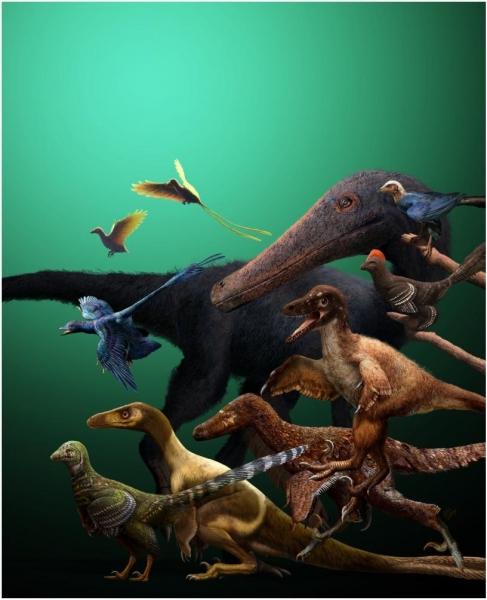
Credit: Julius T Csotonyi / Michael Pittman.

Uncertainties in the evolutionary tree of birds and their closest relatives have impeded deeper understanding of early flight in theropods, the group of dinosaurs that includes birds. To help address this, an international study led by HKU Research Assistant Professor Dr. Michael Pittman (Vertebrate Palaeontology Laboratory, Division of Earth and Planetary Science & Department of Earth Sciences) and co-first-authored by his former Postdoctoral Fellow Dr. Rui Pei (now an Associate Professor at the Institute of Vertebrate Paleontology and Paleoanthropology, Beijing), produced an updated evolutionary tree of early birds and their closest relatives to reconstruct powered flight potential, showing it evolved at least three times. Many ancestors of the closest bird relatives neared the thresholds of powered flight potential, suggesting broad experimentation with wing-assisted locomotion before flight evolved. The ten-man five-country team published their findings in the prestigious high-profile journal Current Biology.

“Our revised evolutionary tree supports the traditional relationship of dromaeosaurid (“raptors”) and troodontid theropods as the closest relatives of birds. It also supports the status of the controversial anchiornithine theropods as the earliest birds,” said Dr. Pei. With this improved evolutionary tree, the team reconstructed the potential of bird-like theropods for power flight, using proxies borrowed from the study flight in living birds. The team found that the potential for powered flight evolved at least three times in theropods: once in birds and twice in dromaeosaurids. “The capability for gliding flight in some dromaeosaurids is well established so us finding at least two origins of powered flight potential among dromaeosaurids is really exciting,” said Dr. Pittman. Crucially, the team found that many ancestors of bird relatives neared the thresholds of powered flight potential. “This suggests that theropod dinosaurs broadly experimented with the use of their feathered wings before flight evolved, overturning the paradigm that this was limited to a much more exclusive club,” added Dr. Pittman.

This study is the latest in the Vertebrate Palaeontology Laboratory’s long-term research into the evolution of early birds and their closest relatives (see Notes). Asked about future plans, Dr. Pittman replied: “We have helped to better constrain the broader functional landscape of theropods just before flight evolved and in its earliest stages. We plan to now focus on the dromaeosaurids and early birds that we have shown to have the potential for powered flight to improve our understanding of what it took to fly and why.”

###

The paper is published in Current Biology and can be accessed here: https://www.sciencedirect.com/science/article/pii/S0960982220309994

A video summary of the study can be viewed here: https://youtu.be/PVzF71t6JSI

A shorter no audio video summary can be viewed here: https://youtu.be/YgUe8HdCOFw

Images download: https://www.scifac.hku.hk/press

Notes:

1. Ancient birds out of the egg running(May 2019): https://www.hku.hk/press/press-releases/detail/19256.html;

2. HKU imaging technology shows first discovered fossil feather did not belong to iconic bird Archaeopteryx (Feb 2019): https://www.hku.hk/press/press-releases/detail/19063.html

3. HKU palaeontologist discovers new bird-like dinosaur with flight associated feathers – Jianianhualong tengi (May 2017): https://www.hku.hk/press/news_detail_16295.html

4. Major breakthrough in knowledge of dinosaur appearance HKU palaeontologist reconstructs feathered dinosaurs in the flesh with new technology (March 2017): https://www.hku.hk/press/press-releases/detail/15989.html

5. Scientists reveal how dinosaurs became able to shake their tail feathers (May 2013):
https://www.hku.hk/press/press-releases/detail/9693.html

Media Contact
Cindy Chan
[email protected]

Original Source

https://hku.hk/press/news_detail_21405.html

Tags: BiologyZoology/Veterinary Science
Share12Tweet8Share2ShareShareShare2

Related Posts

Natural Hallucinogens: Evolution’s Ecological Tools, Not Mere Chemical Byproducts

June 25, 2026

This Famous Butterfly Revealed: Three Distinct Species Hidden in One

June 25, 2026

Scientists Attack Soybean Cyst Nematode by Starving Its Food Source

June 25, 2026

Decoding the Secret Code of a Crucial Immune Sensor

June 24, 2026
Please login to join discussion

POPULAR NEWS

  • Saying Goodbye to PGY-6: Pediatric Fellowship Realities

    103 shares
    Share 41 Tweet 26
  • Multi-Hospital Study Reveals Long Covid Burden Is Twice as High as Current Estimates

    92 shares
    Share 36 Tweet 23
  • Detection of EDCs in Breast Milk and Infant Urine Up to Six Months Highlights Early Exposure Risks

    77 shares
    Share 31 Tweet 19
  • New Drug Candidate Developed at McMaster Shows Potential for Treating Brain Cancer

    58 shares
    Share 23 Tweet 15

About

We bring you the latest biotechnology news from best research centers and universities around the world. Check our website.

Follow us

Recent News

Tracking Lanthanide-Labeled Microplastics in Plants

POSTECH Researchers Slash Cost of Reconstituted Cell-Free Systems by 95%

AI and Physics Collaborate to Design Advanced Hydrogen Storage Materials

Subscribe to Blog via Email

Success! An email was just sent to confirm your subscription. Please find the email now and click 'Confirm' to start subscribing.

Join 82 other subscribers
  • Contact Us

Bioengineer.org © Copyright 2023 All Rights Reserved.

Welcome Back!

Login to your account below

Forgotten Password?

Retrieve your password

Please enter your username or email address to reset your password.

Log In
No Result
View All Result
  • Homepages
    • Home Page 1
    • Home Page 2
  • News
  • National
  • Business
  • Health
  • Lifestyle
  • Science

Bioengineer.org © Copyright 2023 All Rights Reserved.
