Study aims to determine safety and efficacy of experimental monoclonal antibodies
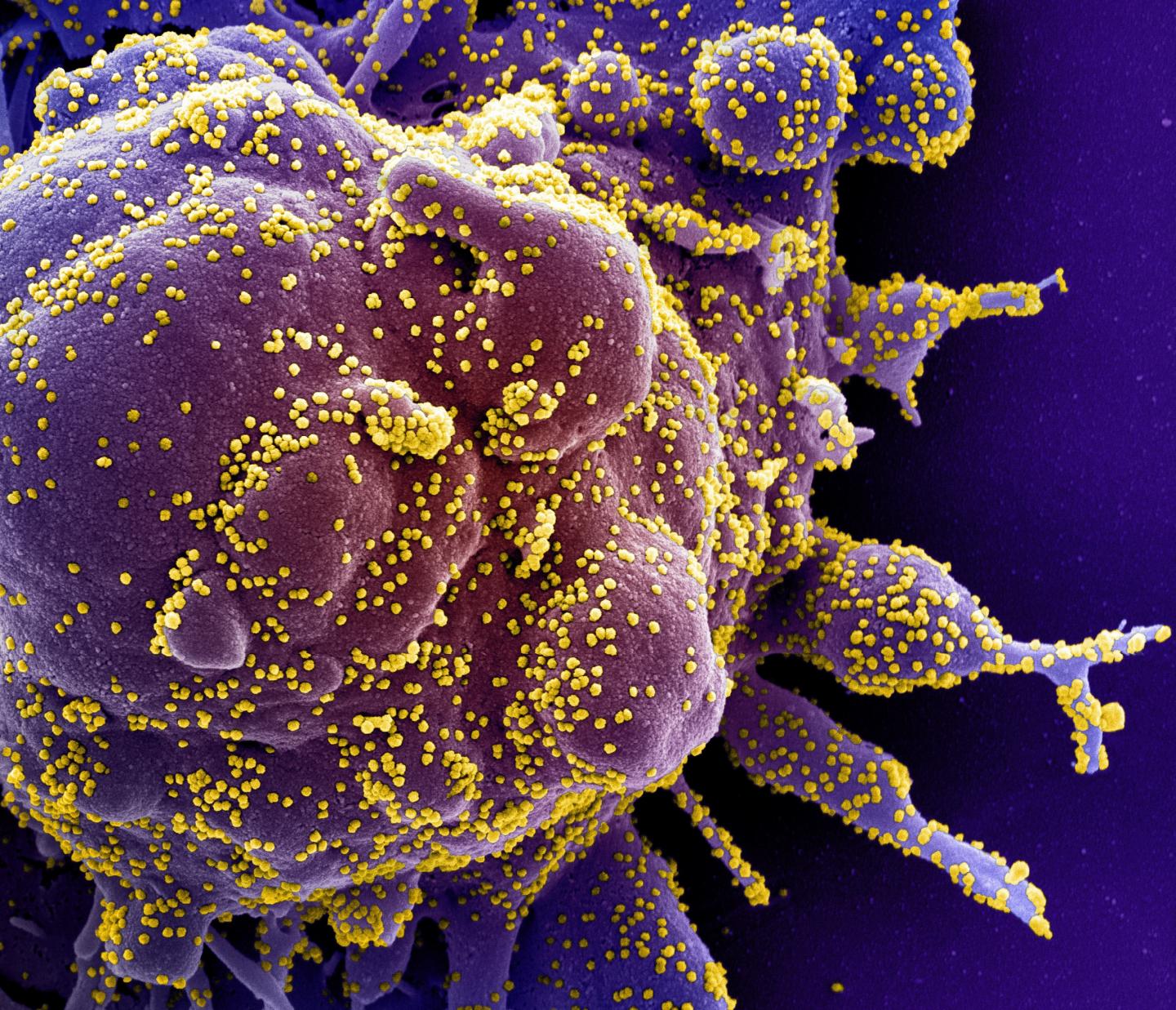
Credit: NIAID
Patients admitted with COVID-19 at select hospitals may now volunteer to enroll in a clinical trial to test the safety and efficacy of a potential new treatment for the disease. The Phase 3 randomized, controlled trial is known as ACTIV-3, and as a “master protocol,” it is designed to expand to test multiple different kinds of monoclonal antibody treatments. It also can enroll additional volunteers in the middle of the trial, if a specific investigational treatment shows promise.
The new study is one of four ongoing or planned trials in the National Institutes of Health’s Accelerating COVID-19 Therapeutic Interventions and Vaccines (ACTIV) program, a public-private partnership to speed development of the most promising treatments and vaccine candidates. It also is receiving support through Operation Warp Speed, the U.S. government’s multi-agency effort to develop, manufacture and distribute medical countermeasures to fight COVID-19.
The trial will take place at select hospitals around the world that are part of existing clinical trial networks. They include the lead network, the International Network of Strategic Initiatives in Global HIV Trials (INSIGHT), operated by the National Institute of Allergy and Infectious Diseases (NIAID), a part of the National Institutes of Health. Collaborating clinical trial networks include the Prevention and Early Treatment of Acute Lung Injury network (PETAL) and Cardiothoracic Surgical Trials Network (CTSN), supported by the NIH’s National Heart, Lung and Blood Institute through the Collaborating Network of Networks for Evaluating COVID-19 and Therapeutic Strategies (CONNECTS) program, and the U.S. Department of Veterans Affairs Medical Centers.
“Under Operation Warp Speed, the U.S. Government has brought together multiple agencies to accelerate the development, manufacture and distribution of medical countermeasures for COVID-19,” said NIH Director Francis S. Collins, M.D., Ph.D. “The ACTIV studies are just a few examples of this critical activity, which emphasizes flexibility and minimizes delays to generate scientifically sound results.”
ACTIV-3 uses an adaptive two-stage Phase 3 protocol design. The ACTIV-3 trial can be modified to test additional experimental therapeutics and flexibly allow novel therapeutics to enter at either stage 1 or stage 2. In addition, if a treatment appears to be safe and effective in the initial stage after review by an independent data and safety monitoring board (DSMB), the investigational therapeutic proceeds to stage 2 testing, where more volunteers are enrolled. If an investigational therapeutic is unsafe or not likely to be effective, it will be dropped.
The ACTIV-3 study will begin by studying the investigational monoclonal antibody LY-CoV555, which was identified in a blood sample from a recovered COVID-19 patient. Antibodies are infection-fighting proteins made by the immune system that can bind to the surface of viruses and prevent them from infecting cells. Synthetic versions of antibodies can be reproduced in a laboratory. These manufactured antibodies are known as monoclonal antibodies. The LY-CoV555 antibody was discovered by AbCellera Biologics (Vancouver, British Columbia) in collaboration with NIAID’s Vaccine Research Center. Subsequently, it was developed and manufactured by Lilly Research Laboratories, Eli Lilly and Company (Indianapolis, Indiana), in partnership with AbCellera. The investigational product also is being tested in another ongoing NIAID study, ACTIV-2, which is studying its safety and efficacy in people with mild to moderate symptoms of COVID-19 who have not been hospitalized. Safety data and other findings will be shared across the ACTIV-2 and ACTIV-3 studies through the DSMB.
“Studying the impact of this investigational therapeutic on multiple patient populations at the same time is critical to determining whether it can help COVID-19 patients with differing levels of disease severity,” said NIAID Director Anthony S. Fauci, M.D. “These concurrent trials have the potential to yield significant and comprehensive clinical data.”
The initial stage of the ACTIV-3 clinical trial aims to enroll approximately 300 volunteers who have been hospitalized with mild to moderate COVID-19 with fewer than 13 days of symptoms. Once their COVID-19 infections have been confirmed and they have consented to take part in the study, participants will be randomly assigned to receive either an intravenous (IV) infusion of LY-CoV555 or a saline placebo infusion. Participants also will receive standard care for COVID-19, including the antiviral remdesivir. After five days, participants’ symptoms will be assessed, as will their need for supplemental oxygen, mechanical ventilation, or other supportive care. Volunteers will be followed for 90 days after enrollment and will receive regular examinations and have blood samples taken periodically during this time to analyze their response to the investivational therapeutic.
Data collected on the fifth day of the volunteers’ participation will determine whether the investigational therapeutic will be administered to a larger group of volunteers. If LY-CoV555 appears to be safe and appears to be effective, the trial will enroll an additional 700 participants. It also will begin enrolling more severely ill participants, such as those with organ failure requiring mechanical support, or COVID-19-associated dysfunction of organs other than the lungs. The primary endpoint of the trial is the participants’ sustained recovery for 14 days after release from the hospital.
The principal investigator of ACTIV-3 is Jens Lundgren, M.D., of the University of Copenhagen and Rigshospitalet. Leads of the participating networks include James Neaton, Ph.D., of the INSIGHT network, Taylor Thompson, M.D., of the PETAL network, Annetine Gelijns, Ph.D., and Alan Moskowitz, M.D., of the CTSN, and Rachel Ramoni, D.M.D., Sc.D., of the U.S. Department of Veterans Affairs. To ensure that the trial is being conducted in a safe and effective manner, an independent DSMB will oversee the trial and conduct periodic reviews of the accumulating data.
###
NIAID conducts and supports research–at NIH, throughout the United States, and worldwide–to study the causes of infectious and immune-mediated diseases, and to develop better means of preventing, diagnosing and treating these illnesses. News releases, fact sheets and other NIAID-related materials are available on the NIAID website.
About the National Institutes of Health (NIH): NIH, the nation’s medical research agency, includes 27 Institutes and Centers and is a component of the U.S. Department of Health and Human Services. NIH is the primary federal agency conducting and supporting basic, clinical, and translational medical research, and is investigating the causes, treatments, and cures for both common and rare diseases. For more information about NIH and its programs, visit http://www.
Media Contact
Elizabeth Deatrick
[email protected]