• HOME
  • NEWS
  • EXPLORE
    • CAREER
      • Companies
      • Jobs
    • EVENTS
    • iGEM
      • News
      • Team
    • PHOTOS
    • VIDEO
    • WIKI
  • BLOG
  • COMMUNITY
    • FACEBOOK
    • INSTAGRAM
    • TWITTER
Saturday, February 7, 2026
BIOENGINEER.ORG
No Result
View All Result
  • Login
  • HOME
  • NEWS
  • EXPLORE
    • CAREER
      • Companies
      • Jobs
        • Lecturer
        • PhD Studentship
        • Postdoc
        • Research Assistant
    • EVENTS
    • iGEM
      • News
      • Team
    • PHOTOS
    • VIDEO
    • WIKI
  • BLOG
  • COMMUNITY
    • FACEBOOK
    • INSTAGRAM
    • TWITTER
  • HOME
  • NEWS
  • EXPLORE
    • CAREER
      • Companies
      • Jobs
        • Lecturer
        • PhD Studentship
        • Postdoc
        • Research Assistant
    • EVENTS
    • iGEM
      • News
      • Team
    • PHOTOS
    • VIDEO
    • WIKI
  • BLOG
  • COMMUNITY
    • FACEBOOK
    • INSTAGRAM
    • TWITTER
No Result
View All Result
Bioengineer.org
No Result
View All Result
Home NEWS Science News Biology

Svalbard Global Seed Vault commences seed experiment that will last 100 years

Bioengineer by Bioengineer
August 4, 2020
in Biology
Reading Time: 3 mins read
0
IMAGE
Share on FacebookShare on TwitterShare on LinkedinShare on RedditShare on Telegram

IMAGE

Credit: Manuela Nagel/ IPK

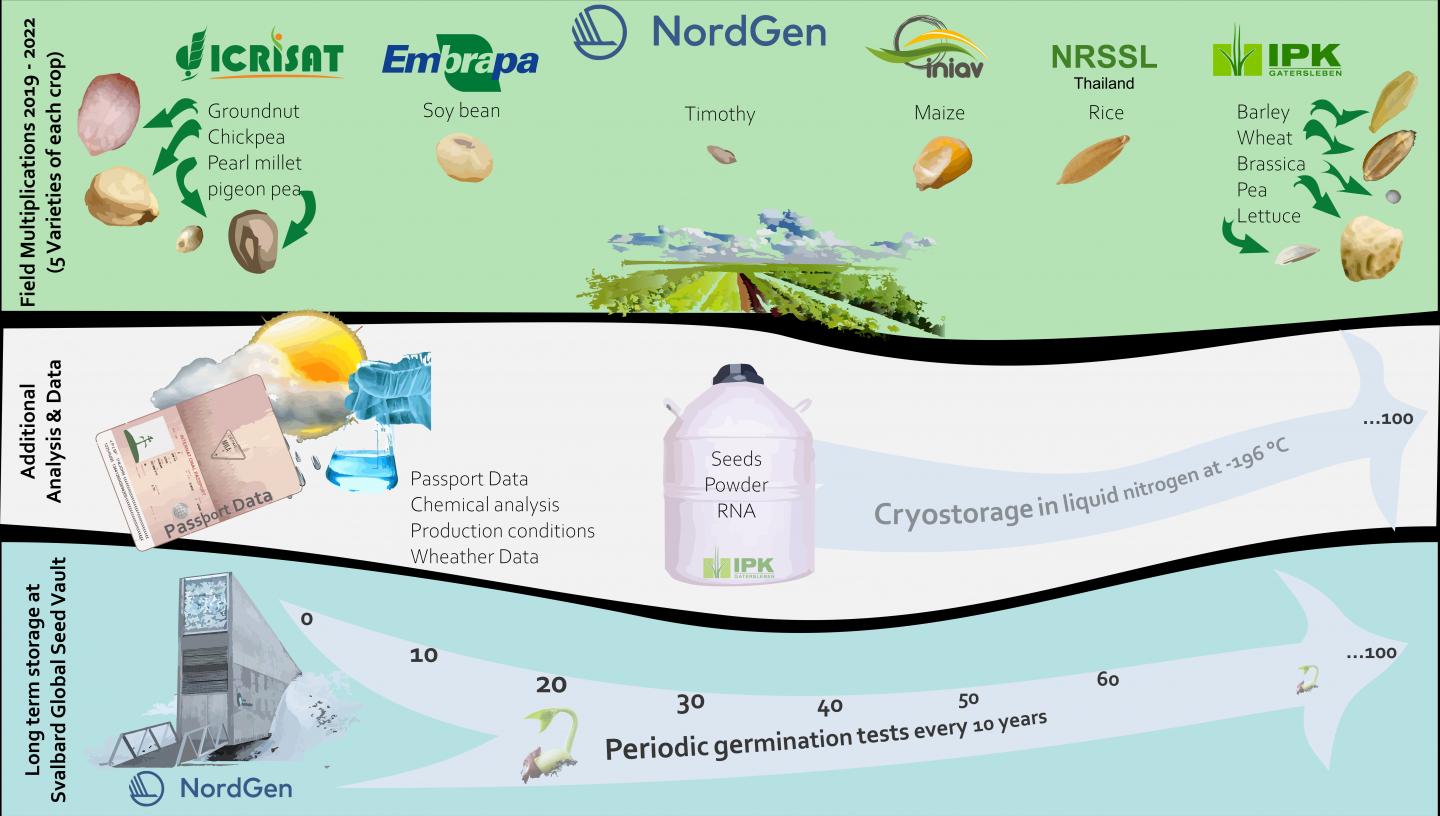
The first experimental seed samples will be brought into the Svalbard Global Seed Vault on the 27th of August. These first test sets consist of seeds produced at the IPK Gatersleben. “We contribute a total of five crops – wheat, barley, pea, lettuce and cabbage. The material was grown on our experimental fields in the last year”, says Prof. Dr. Andreas Börner from the Genebank department at IPK Gatersleben. “The IPK is the first institution to provide seeds. The other partners will follow next year.”

During the following 2-3 years, seeds from nine additional crops will be produced and put into the -18°C seed storage in Svalbard. Seeds will be produced by the project partners that are highly ranked gene banks and research institutes that also have taken advantage of the opportunity to deposit security duplicates of their valuable seed collections in the Svalbard Global Seed Vault.

In parallel, samples of all five gene banks will be stored in cryotanks at IPK. The storage in liquid nitrogen (-196 °C) leads to a deceleration of ageing processes. “The idea is to compare the quality of the initial seeds with material stored at the Svalbard even after 100 years”, says PD Dr. Manuela Nagel from the Genebank department at IPK. “Therefore, we store seeds and seed flour and analyse primary compounds to elucidate processes of seed deterioration over the 100 year storage period.”

“This experiment is one of its kind. It will provide future generations with valuable information about seed viability and more precise knowledge of how often seeds need to be regenerated”, said Åsmund Asdal, Seed Vault Coordinator at Nordic Genetic Resource Center (NordGen), the gene bank responsible for managing the project.

The main principle for conserving seeds is that well dried and frozen seeds of many important food crops can stay alive for a very long time. Exactly for how long seeds can maintain the germination ability after storage under optimal conditions is not fully explored. But it is assumed that seeds of many species can stay alive for centuries.

Gene banks test seeds in their collections regularly, to be able to regenerate seeds in time and keep the genetic resources contained in the seeds viable and available for research and plant breeding. Increased knowledge about how long seeds can stay alive will be extremely useful for gene banks, and also for the management of the Svalbard Global Seed Vault, which is a facility where gene banks can store duplicates of their primary seed collections as a security in case seeds are lost at home. The Seed Vault can be considered as a huge bank box for seeds, and it is crucial to know at which intervals seeds that are conserved here must be replaced by new fresh seeds.

The first experiment seeds that are put into the Seed Vault now will be tested in 2030 and then identical seed samples will be tested every tenth year until 2120, a hundred years from now. Results and reports from the project will be published throughout the whole project period, adding knowledge to management routines and guidelines, both for seed conservation in regular genebanks and for the long-term conservation of seeds in the Seed Vault.

###

Media Contact
Prof. Dr. Andreas Börner
[email protected]
Tags: BiologyCell BiologyClimate ChangeFood/Food ScienceGenesPlant Sciences
Share12Tweet8Share2ShareShareShare2

Related Posts

Florida Cane Toad: Complex Spread and Selective Evolution

Florida Cane Toad: Complex Spread and Selective Evolution

February 7, 2026
New Study Uncovers Mechanism Behind Burn Pit Particulate Matter–Induced Lung Inflammation

New Study Uncovers Mechanism Behind Burn Pit Particulate Matter–Induced Lung Inflammation

February 6, 2026

DeepBlastoid: Advancing Automated and Efficient Evaluation of Human Blastoids with Deep Learning

February 6, 2026

Navigating the Gut: The Role of Formic Acid in the Microbiome

February 6, 2026
Please login to join discussion

POPULAR NEWS

  • Robotic Ureteral Reconstruction: A Novel Approach

    Robotic Ureteral Reconstruction: A Novel Approach

    82 shares
    Share 33 Tweet 21
  • Digital Privacy: Health Data Control in Incarceration

    63 shares
    Share 25 Tweet 16
  • Study Reveals Lipid Accumulation in ME/CFS Cells

    57 shares
    Share 23 Tweet 14
  • Breakthrough in RNA Research Accelerates Medical Innovations Timeline

    53 shares
    Share 21 Tweet 13

About

We bring you the latest biotechnology news from best research centers and universities around the world. Check our website.

Follow us

Recent News

Boosting Remote Healthcare: Stepped-Wedge Trial Insights

Barriers and Boosters of Seniors’ Physical Activity in Karachi

Evaluating Pediatric Emergency Care Quality in Ethiopia

Subscribe to Blog via Email

Enter your email address to subscribe to this blog and receive notifications of new posts by email.

Join 73 other subscribers
  • Contact Us

Bioengineer.org © Copyright 2023 All Rights Reserved.

Welcome Back!

Login to your account below

Forgotten Password?

Retrieve your password

Please enter your username or email address to reset your password.

Log In
No Result
View All Result
  • Homepages
    • Home Page 1
    • Home Page 2
  • News
  • National
  • Business
  • Health
  • Lifestyle
  • Science

Bioengineer.org © Copyright 2023 All Rights Reserved.