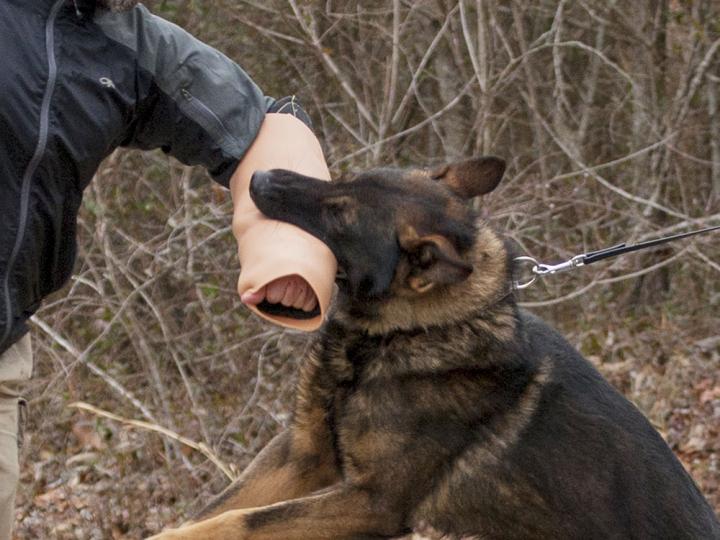
Credit: U.S. Army
RESEARCH TRIANGLE PARK, N.C. (July 23, 2020) — Army scientists designed and developed a realistic canine bite sleeve trainer to improve the performance of military and civilian K9s. Military working dogs often serve an essential role in military operations.
Dogs operate in a wide range of capacities within the military including security, patrol, explosives detection, tracking, search and rescue, guard, sentry and tactical duties. Trainers use bite training on military working dogs to assist in restraining a perpetrator. It also may eliminate the need to use a weapon.
Dr. Stephen Lee, a senior scientist at the Army Research Office, an element of the U.S. Combat Capabilities Development Command’s Army Research Laboratory, led the bite sleeve research, and holds a patent for his work. He developed the product with students from the Wilson College of Textiles and the Materials Science and Engineering Senior Design courses at North Carolina State University in support of the U.S. Army Special Operations Command at Fort Bragg, North Carolina.
“Military working dogs are a very important team member and their training is equally important,” Lee said. “These invaluable dogs have provided incomparable support helping Soldiers accomplish their mission and saving Soldier’s lives. This new bite sleeve training tool has greatly helped in the development of effective combat canines.”
Most current bite training sleeves are too bulky for concealment, making it harder train the dogs for real-world scenarios. Other sleeves are made of materials such as jute that does not provide a truly realistic training scenario and can reduce canine effectiveness on target due to hesitation. Silicone bite products require the trainer to attach additional appendages to a sleeve which limits training scenarios, eliminating realistic concealment, and possibly confusing the canine.
The new bite sleeve provides military working dogs with an authentic human skin texture when biting the forearm region and reducing the circumference of the target. This allows for a full-mouth bite and a more realistic training scenario for the canines.
“Working with ARO on this project was a terrific experience for the students involved,” said Dr. Jesse Jur, associate professor of textile engineering, chemistry and science at N.C. State’s Wilson College of Textiles. “Everyone was inspired to improve the abilities of the military working dog. The goals for the project were challenging and required a multidisciplinary team effort from both a textile and materials engineering perspective.”
When designing the product, a key aspect was ensuring the safety of both the dogs and their handlers. The research team ensured that the materials selected were nontoxic to dogs and that the selected materials would be puncture resistant for the handler.
The bite sleeve is comprised of an outer silicone skin paired with an inner leather-based sleeve. The skin is a proprietary prosthetic-grade silicone product that looks and feels like human flesh and has an internal mesh support system for resilience. The inner sleeve is a low-profile bite platform constructed from a pressure dissipating foam and several layers of Kevlar fabric to allow for a full-mouth bite, and two adjustable straps allow a custom fit for any trainer.
The U.S. Army Special Operations Command currently uses the bite sleeve for training.
Other inventors listed on the patent include Paul Reid, an ARO systems engineering and technical assistance support contractor, Dr. Albena Ivanisevic, ARO program manager who worked on the technology while on the faculty at NC State, U.S. Army Special Operations Command Soldiers, NC State Textiles Engineering undergraduate students and Professors Dr. Jess Jur and Dr. Russell Gorga who were advisors to the design teams.
With Army funding, researchers at Campbell University are further advancing the concept design, making an even more realistic skin that bleeds artificial blood upon bite. The Kinston Police Department successfully tested a prototype earlier this year.
###
CCDC Army Research Laboratory is an element of the U.S. Army Combat Capabilities Development Command. As the Army’s corporate research laboratory, ARL discovers, innovates and transitions science and technology to ensure dominant strategic land power. Through collaboration across the command’s core technical competencies, CCDC leads in the discovery, development and delivery of the technology-based capabilities required to make Soldiers more lethal to win the nation’s wars and come home safely. CCDC is a major subordinate command of the U.S. Army Futures Command.
Media Contact
Lisa B Bistreich-Wolfe
[email protected]
Original Source
https:/