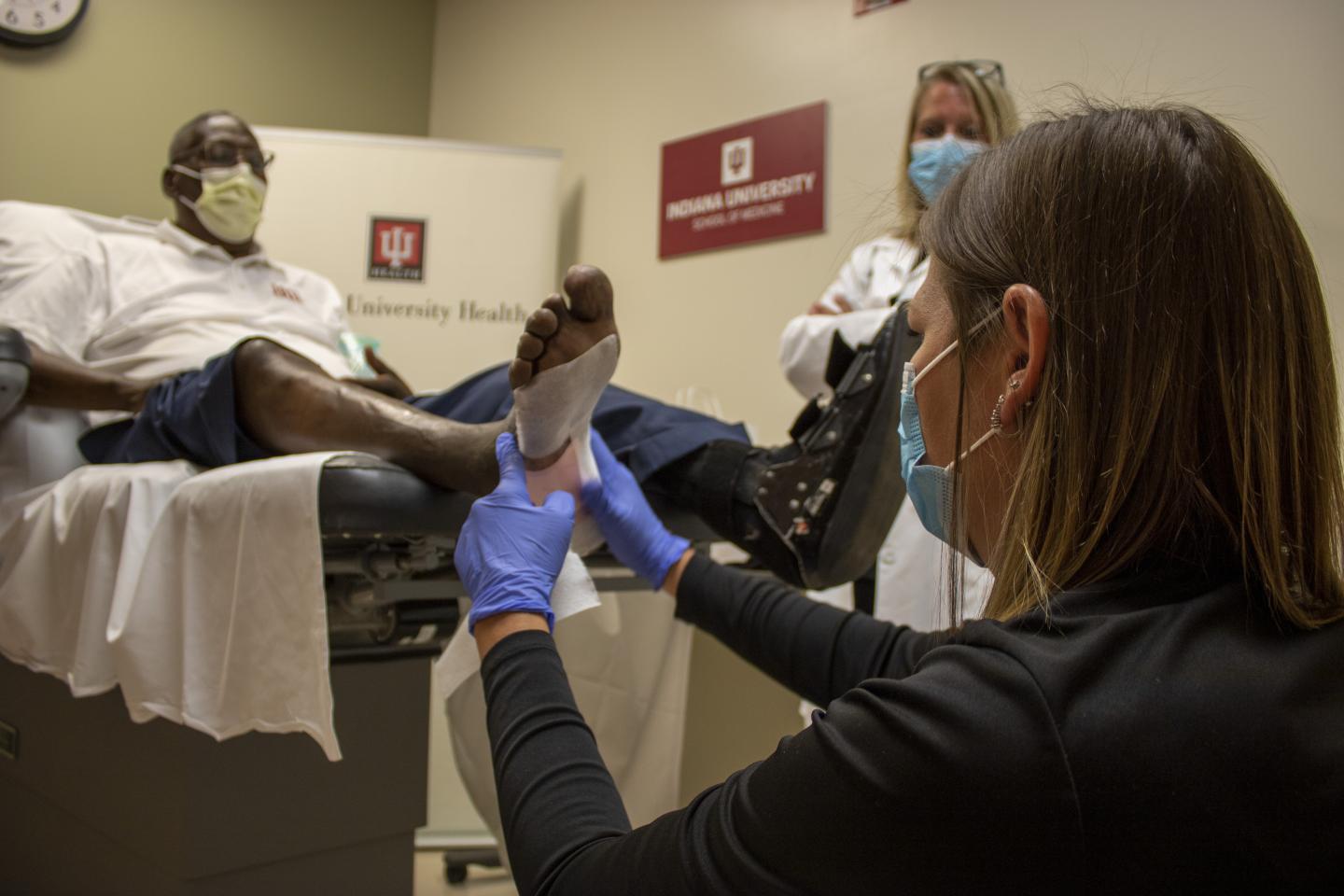
Credit: Credit: Marco Gutierrez, Indiana University School of Medicine.
Funded by the National Institutes of Health, six U.S. research institutions are launching the first-ever multicenter network to study diabetic foot ulcers, a common and burdensome complication of diabetes and the leading cause of lower limb amputations in the United States. The Diabetic Foot Consortium (DFC) aims to lay the foundation for a clinical trial network to test how to improve diabetic wound healing and prevent amputations among the 27 million American adults with diabetes. The DFC is supported by the NIH’s National Institute of Diabetes and Digestive and Kidney Diseases (NIDDK).
“People with diabetic foot ulcers have to manage careful at-home foot care over a long time to avoid infection until the wound heals,” said Dr. Teresa Jones, NIDDK’s project scientist for the consortium. “This consortium will address a major research gap in finding ways to effectively treat diabetic foot ulcers and to prevent the risk of complicated infections and potential amputation.”
The first studies will focus on finding biological clues, called biomarkers, in people with diabetic foot ulcers that can guide treatment and predict how the ulcer will heal and the likelihood of an ulcer returning. For example, the first study of the DFC, led by the Indiana University School of Medicine, will test whether body fluid leaking through the skin on a newly healed ulcer can predict how likely an ulcer might return. A second study, led by the University of Miami, will test whether the presence of or a change in specific cellular proteins in tissue samples from an ulcer can predict the likelihood of healing in the next 12 weeks.
Up to 34% of people with diabetes will develop a foot ulcer in their lifetime, and half of foot ulcers become infected. Each year, about 100,000 Americans with diabetes will lose part of their lower limb because a foot ulcer becomes infected or does not heal.
Each clinical research site in the DFC will recruit up to 70 participants per study who are undergoing foot ulcer treatment or follow-up care. Each biomarker will be tested in its own study within the larger network. Researchers will collect various measurements, biological samples, and other data over two years. In addition, the DFC will build a roadmap and framework that will provide an opportunity for researchers to follow up interesting leads or pursue new studies.
“Many complicating factors of diabetes interrupt the healing process, making diabetic foot ulcers extremely difficult to treat. Those factors also make studying effective treatments challenging,” said DFC Study Chair Dr. Geoffrey Gurtner, professor of surgery at Stanford University. “This group of studies represents a remarkable opportunity to learn if these biomarkers can predict healing or recurrence in a large group of patients and if they can be tools to improve how foot ulcers are treated and healed.”
Participating centers are University of Michigan at Ann Arbor; University of California, San Francisco; Stanford University, Palo Alto, California; University of Miami Miller School of Medicine; University of Pittsburgh; and Indiana University, Indianapolis. The University of Michigan also serves as the data coordinating center for the study. Biomarker analysis will be conducted by the Indiana University and the University of Miami.
“For people with diabetes, foot ulcers can be devastating and lead to even more devastating amputation. They affect quality of life and cost the United States up to $13 billion a year in care,” said NIDDK Director Dr. Griffin P. Rodgers. “Finding biological clues from these ulcers to help tailor treatment to the individual will provide much-needed relief and could prevent future diabetic foot injuries.”
###
For more information about the Diabetic Foot Consortium, please visit diabeticfootconsortium.org.
The Diabetic Foot Consortium is funded through NIH grants DK119085, DK119083, DK119094, DK119099, DK119100, DK119102, and DK122927.
The NIDDK, a component of the NIH, conducts and supports research on diabetes and other endocrine and metabolic diseases; digestive diseases, nutrition and obesity; and kidney, urologic and hematologic diseases. Spanning the full spectrum of medicine and afflicting people of all ages and ethnic groups, these diseases encompass some of the most common, severe and disabling conditions affecting Americans. For more information about the NIDDK and its programs, see https:/
About the National Institutes of Health (NIH): NIH, the nation’s medical research agency, includes 27 Institutes and Centers and is a component of the U.S. Department of Health and Human Services. NIH is the primary federal agency conducting and supporting basic, clinical, and translational medical research, and is investigating the causes, treatments, and cures for both common and rare diseases. For more information about NIH and its programs, visit http://www.
Media Contact
Alyssa Voss
[email protected]
Original Source
https:/