• HOME
  • NEWS
  • EXPLORE
    • CAREER
      • Companies
      • Jobs
    • EVENTS
    • iGEM
      • News
      • Team
    • PHOTOS
    • VIDEO
    • WIKI
  • BLOG
  • COMMUNITY
    • FACEBOOK
    • INSTAGRAM
    • TWITTER
Saturday, February 7, 2026
BIOENGINEER.ORG
No Result
View All Result
  • Login
  • HOME
  • NEWS
  • EXPLORE
    • CAREER
      • Companies
      • Jobs
        • Lecturer
        • PhD Studentship
        • Postdoc
        • Research Assistant
    • EVENTS
    • iGEM
      • News
      • Team
    • PHOTOS
    • VIDEO
    • WIKI
  • BLOG
  • COMMUNITY
    • FACEBOOK
    • INSTAGRAM
    • TWITTER
  • HOME
  • NEWS
  • EXPLORE
    • CAREER
      • Companies
      • Jobs
        • Lecturer
        • PhD Studentship
        • Postdoc
        • Research Assistant
    • EVENTS
    • iGEM
      • News
      • Team
    • PHOTOS
    • VIDEO
    • WIKI
  • BLOG
  • COMMUNITY
    • FACEBOOK
    • INSTAGRAM
    • TWITTER
No Result
View All Result
Bioengineer.org
No Result
View All Result
Home NEWS Science News Biology

Solving the jigsaw puzzle of regional carbon budgets

Bioengineer by Bioengineer
July 24, 2020
in Biology
Reading Time: 3 mins read
0
IMAGE
Share on FacebookShare on TwitterShare on LinkedinShare on RedditShare on Telegram

IMAGE

Credit: ©Science China Press

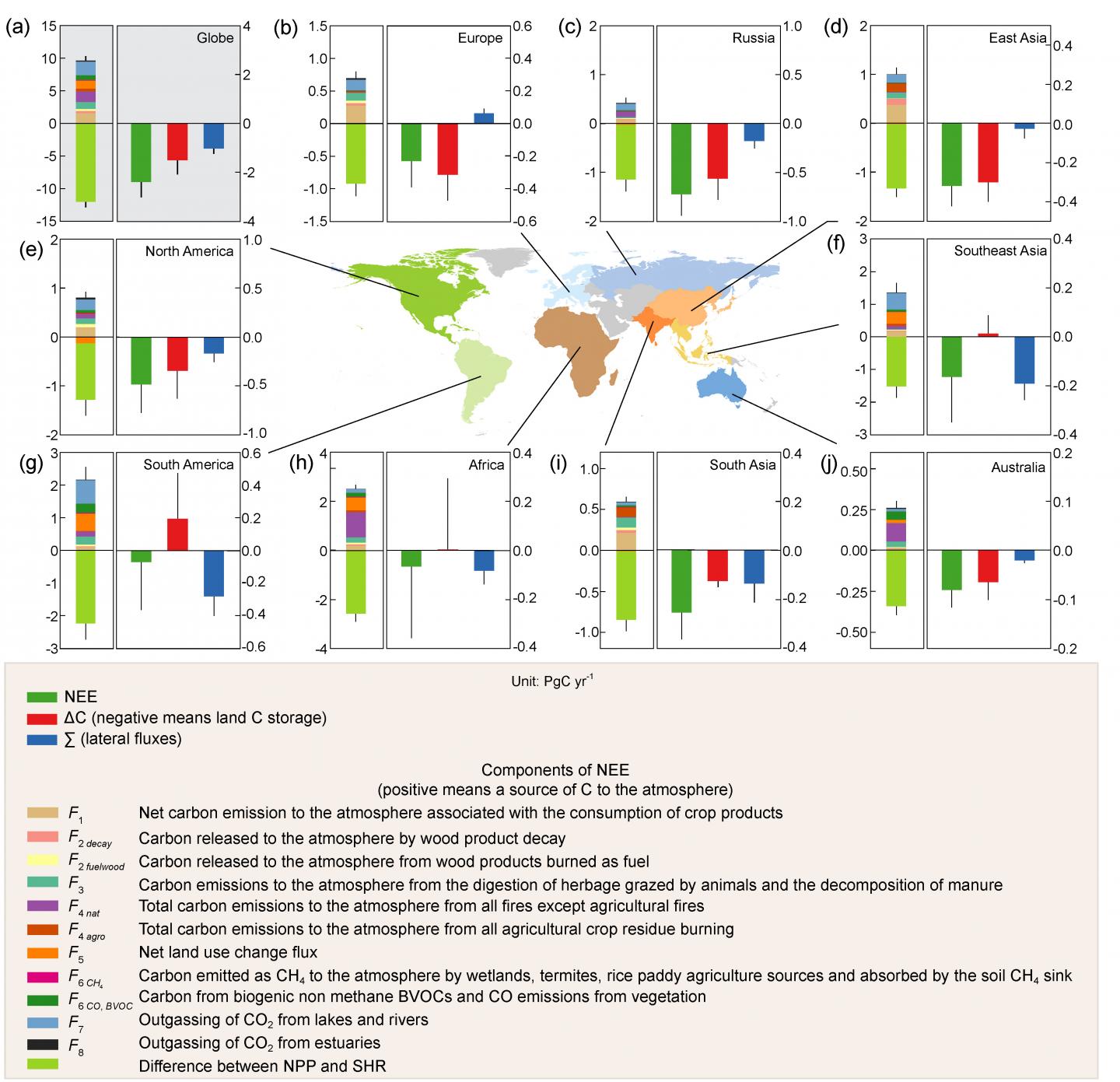
Accurate regional carbon budgets are critical for informing land-based mitigation policy and tracking mitigation progress. For nine regions covering the globe, inventory estimates of carbon stock changes were collected and complemented by satellite estimates of biomass changes where inventory data are missing. The net land-atmospheric carbon exchange was then calculated by taking the sum of the carbon stock changes measured by inventories and lateral carbon fluxes from crop and wood trade and riverine carbon export to the ocean.

Summing up estimates from all regions, the first global ‘bottom-up’ terrestrial carbon budget of anthropogenic CO2 uptake is obtained, giving a net sink of -2.2 ± 0.6 Pg C y-1 (one Pg C being one billion tons of carbon) during the period from 2000 to 2009 consistent with the independent top-down budget derived in previous IPCC assessment reports from observations of the CO2 growth rate and fossil fuel emissions. This new estimate set up an important milestone for global carbon cycle studies.

By decomposing the net land -atmosphere carbon flux of each region into incoming and outgoing fluxes, we showed that a significant part of the carbon fixed in terrestrial ecosystems by plant productivity is moved away from harvest and export to rivers or lost by fires and by emissions of reduced biogenic carbon species like biogenic volatile compounds and methane. In other words, carbon delivered to the soil as litter and available as a substrate for microbial decomposition is a smaller fraction of productivity that previously estimated by carbon models that ignore lateral export processes.

The implication is that global soil heterotrophic respiration, the amount of CO2 released annually from soil microbial processes is only of 39 Pg C yr-1 compared to Net Primary Productivity inputs of 50 Pg C yr-1. In the study, Ciais and co-workers examined the consequences of a smaller heterotrophic respiration for the residence time of carbon and future projections of the carbon cycle and temperature. They found a positive feedback of 15 parts per million in the future CO2 concentration, that is, an additional warming of 0.1 °C.

###

See the article:

Empirical estimates of regional carbon budgets imply reduced global soil heterotrophic respiration.

Philippe Ciais, Yitong Yao, Thomas Gasser, Alessandro Baccini, Yilong Wang, Ronny Lauerwald, Shushi Peng, Ana Bastos, Wei Li, Peter A Raymond, Josep G Canadell, Glen P Peters, Rob J Andres, Jinfeng Chang, Chao Yue, A Johannes Dolman, Vanessa Haverd, Jens Hartmann, Goulven Laruelle, Alexandra G Konings, Anthony W King, Yi Liu, Sebastiaan Luyssaert, Fabienne Maignan, Prabir K Patra, Anna Peregon, Pierre Regnier, Julia Pongratz, Benjamin Poulter, Anatoly Shvidenko, Riccardo Valentini, Rong Wang, Grégoire Broquet, Yi Yin, Jakob Zscheischler, Bertrand Guenet, Daniel S Goll, Ashley-P Ballantyne, Hui Yang, Chunjing Qiu, Dan Zhu

National Science Review, https://doi.org/10.1093/nsr/nwaa145

Media Contact
Dr. Philippe Ciais
[email protected]

Original Source

https://doi.org/10.1093/nsr/nwaa145

Related Journal Article

http://dx.doi.org/10.1093/nsr/nwaa145

Tags: Climate ChangeEarth ScienceEcology/EnvironmentGeographyGeology/SoilTemperature-Dependent Phenomena
Share12Tweet8Share2ShareShareShare2

Related Posts

Florida Cane Toad: Complex Spread and Selective Evolution

Florida Cane Toad: Complex Spread and Selective Evolution

February 7, 2026
New Study Uncovers Mechanism Behind Burn Pit Particulate Matter–Induced Lung Inflammation

New Study Uncovers Mechanism Behind Burn Pit Particulate Matter–Induced Lung Inflammation

February 6, 2026

DeepBlastoid: Advancing Automated and Efficient Evaluation of Human Blastoids with Deep Learning

February 6, 2026

Navigating the Gut: The Role of Formic Acid in the Microbiome

February 6, 2026
Please login to join discussion

POPULAR NEWS

  • Robotic Ureteral Reconstruction: A Novel Approach

    Robotic Ureteral Reconstruction: A Novel Approach

    82 shares
    Share 33 Tweet 21
  • Digital Privacy: Health Data Control in Incarceration

    63 shares
    Share 25 Tweet 16
  • Study Reveals Lipid Accumulation in ME/CFS Cells

    57 shares
    Share 23 Tweet 14
  • Breakthrough in RNA Research Accelerates Medical Innovations Timeline

    53 shares
    Share 21 Tweet 13

About

We bring you the latest biotechnology news from best research centers and universities around the world. Check our website.

Follow us

Recent News

Evaluating Pediatric Emergency Care Quality in Ethiopia

TPMT Expression Predictions Linked to Azathioprine Side Effects

Improving Dementia Care with Enhanced Activity Kits

Subscribe to Blog via Email

Success! An email was just sent to confirm your subscription. Please find the email now and click 'Confirm' to start subscribing.

Join 73 other subscribers
  • Contact Us

Bioengineer.org © Copyright 2023 All Rights Reserved.

Welcome Back!

Login to your account below

Forgotten Password?

Retrieve your password

Please enter your username or email address to reset your password.

Log In
No Result
View All Result
  • Homepages
    • Home Page 1
    • Home Page 2
  • News
  • National
  • Business
  • Health
  • Lifestyle
  • Science

Bioengineer.org © Copyright 2023 All Rights Reserved.