CSU researchers awarded to develop high-efficiency propane engine
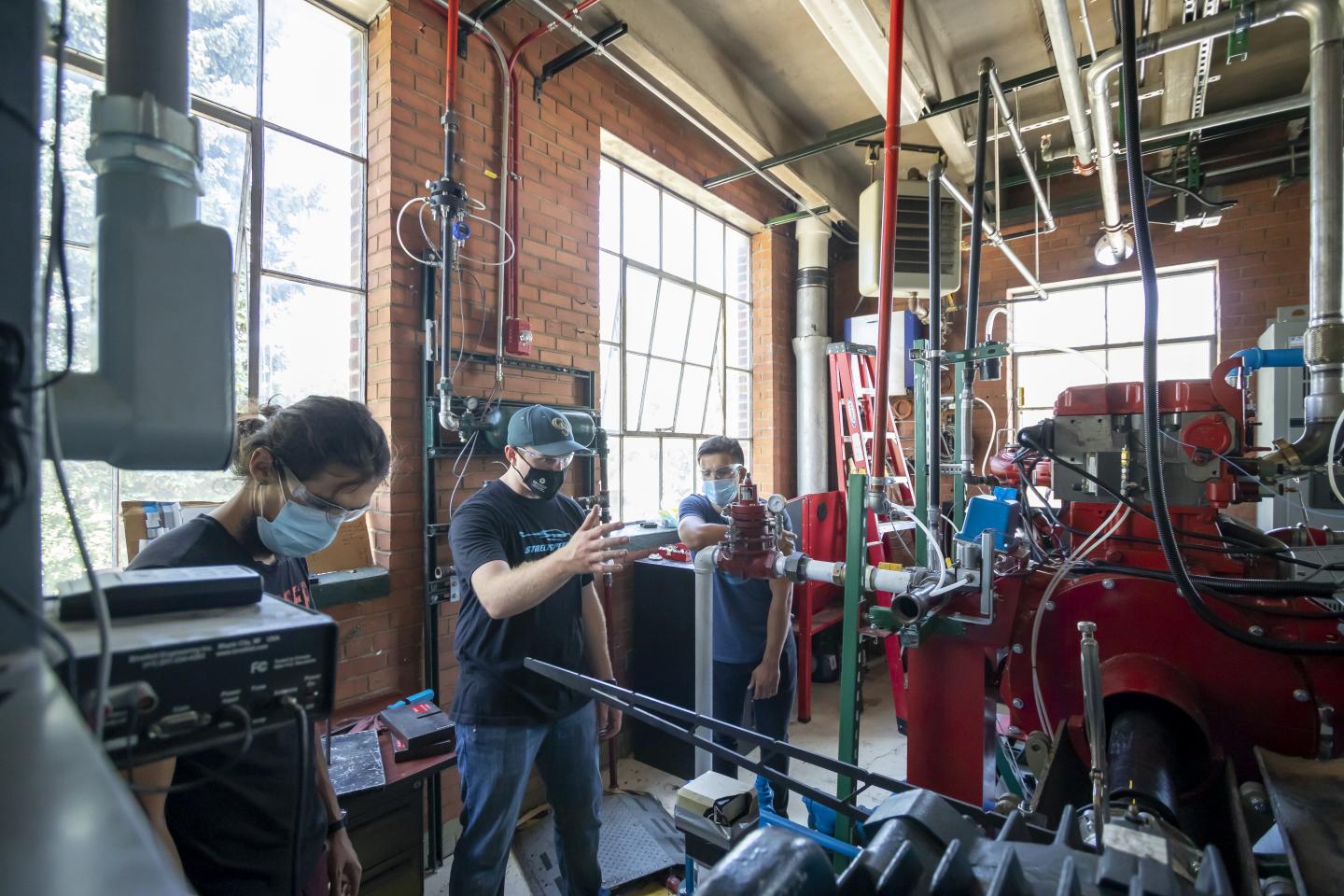
Credit: Allison Vitt/Colorado State University Energy Institute
Propane could be competitive with diesel as a cost-saving, energy-efficient fuel for large trucks and school buses, say Colorado State University mechanical engineers awarded a $3.5 million U.S. Department of Energy grant to develop a new, high-efficiency propane engine.
The research team, led by Professor Daniel Olsen, will spend the next three years working with large engine manufacturer Cummins Inc. and Argonne National Laboratory developing advanced combustion strategies for direct-injection large propane engines.
DOE announced CSU’s award on July 16 with 54 other projects by universities, governments and industry totaling $139 million.
“This project has all of the signature elements of a Powerhouse project,” noted Bryan Willson, director of the CSU Energy Institute and the Powerhouse Energy Campus. “It includes a large team with diverse talents and a commercial partner so there is a direct path from discovery to impact.”
Willson also pointed out that CSU has a 30-year history of developing better engines for use with alternative fuels such as propane, natural gas, hydrogen, and biofuels.
Olsen and his team, including Professor Anthony Marchese and Assistant Professor Bret Windom, are already working on making natural gas engines as efficient as diesel through a current DOE grant and partnership with Cummins and Fort Collins-based Woodward, Inc.
Propane, or liquified petroleum gas, is 40 percent cheaper than gasoline and diesel and cleaner burning, but current propane engines are not as energy efficient as diesel engines so it can lead to higher operating costs and less miles per gallon.
“What’s really exciting is 75 percent of what we’re proposing to do we’ve done with natural gas,” Olsen said. “If we drive up the efficiency, that would be helpful for the environment and the economy and people might be more inclined to purchase more of these types of engines.”
“You use propane in your gas grill, but there’s a lot of potential to use more propane in the transportation sector,” said Marchese, associate dean for Academic and Student Affairs in the Walter Scott, Jr. College of Engineering and co-director with Olsen of the Engines and Energy Conversation Laboratory.
In the first phase of the three-year project, Marchese will test the chemistry and combustion of propane fuels. Windom will examine LPG fuel injection strategies that lead to optimal fuel-air mixtures and required for efficient combustion. He’ll use laser diagnostics to characterize the fuel “spray” and how it evaporates and mixes, which will be critical to share with Argonne researchers who will build new spray models for the project, he said.
The technology they develop takes advantage of a new technique that they call “controlled end-gas autoignition”, which enables “engine knock” to occur in a controlled setting. Normally, engine knock is a problem for spark-ignited engines, but the researchers say they can do it in a way that drives up efficiency.
“Our controls are good enough to operate right at the ragged edge where you wouldn’t hear knock and it wouldn’t do any damage,” Olsen said. “Woodward pioneered this approach – they have a real-time control system and have developed algorithms to sense combustion properties and quickly react.”
Assisting the CSU team from Argonne are Sibendu Som and Lorenzo Nocivelli. Olsen will work with Hui Xu at Cummins to test the technology on a Cummins X15 single cylinder engine currently housed at CSU.
The project will include CSU graduate and undergraduate students and include a training internship for a graduate student at Argonne, Olsen said. Students working on the project will be learning from some of the best researchers in the field.
“Receiving this award shows that the CSU engine research program is on the map,” Marchese said. “DOE – and the engine research community – knows who we are, and they recognize that we have the expertise and the resources. We can do this.”
###
Media Contact
Anne Manning
[email protected]
Original Source
https:/