• HOME
  • NEWS
  • EXPLORE
    • CAREER
      • Companies
      • Jobs
    • EVENTS
    • iGEM
      • News
      • Team
    • PHOTOS
    • VIDEO
    • WIKI
  • BLOG
  • COMMUNITY
    • FACEBOOK
    • INSTAGRAM
    • TWITTER
Saturday, February 7, 2026
BIOENGINEER.ORG
No Result
View All Result
  • Login
  • HOME
  • NEWS
  • EXPLORE
    • CAREER
      • Companies
      • Jobs
        • Lecturer
        • PhD Studentship
        • Postdoc
        • Research Assistant
    • EVENTS
    • iGEM
      • News
      • Team
    • PHOTOS
    • VIDEO
    • WIKI
  • BLOG
  • COMMUNITY
    • FACEBOOK
    • INSTAGRAM
    • TWITTER
  • HOME
  • NEWS
  • EXPLORE
    • CAREER
      • Companies
      • Jobs
        • Lecturer
        • PhD Studentship
        • Postdoc
        • Research Assistant
    • EVENTS
    • iGEM
      • News
      • Team
    • PHOTOS
    • VIDEO
    • WIKI
  • BLOG
  • COMMUNITY
    • FACEBOOK
    • INSTAGRAM
    • TWITTER
No Result
View All Result
Bioengineer.org
No Result
View All Result
Home NEWS Science News Biology

World’s smallest imaging device has heart disease in focus

Bioengineer by Bioengineer
July 21, 2020
in Biology
Reading Time: 2 mins read
0
IMAGE
Share on FacebookShare on TwitterShare on LinkedinShare on RedditShare on Telegram

IMAGE

Credit: Image by Simon Thiele and Jiawen Li.

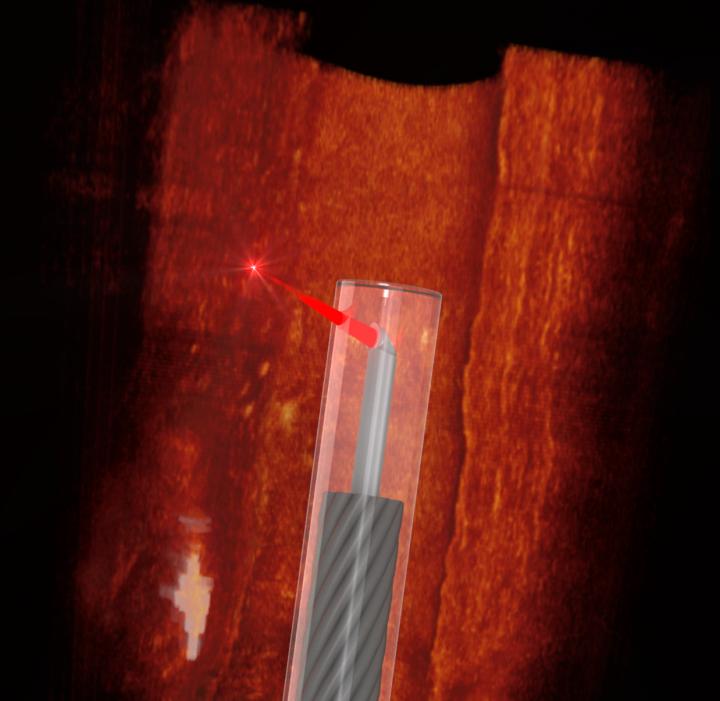
A team of researchers led by the University of Adelaide and University of Stuttgart has used 3D micro-printing to develop the world’s smallest, flexible scope for looking inside blood vessels.

The camera-like imaging device can be inserted into blood vessels to provide high quality 3D images to help scientists better understand the causes of heart attack and heart disease progression, and could lead to improved treatment and prevention.

In a study published in the journal Light: Science & Applications, a multidisciplinary team of researchers and clinicians was able to 3D print a tiny lens on to the end of an optical fibre, the thickness of a human hair.

The imaging device is so small that researchers were able to scan inside the blood vessels of mice.

Dr Jiawen Li, co-author and Heart Foundation Postdoctoral Fellow at the Institute for Photonics and Advanced Sensing, University of Adelaide, says in Australia cardiovascular disease kills one person every 19 minutes.

“A major factor in heart disease is the plaques, made up of fats, cholesterol and other substances that build up in the vessel walls,” Dr Li said.

“Preclinical and clinical diagnostics increasingly rely on visualising the structure of the blood vessels to better understand the disease.

“Miniaturised endoscopes, which act like tiny cameras, allow doctors to see how these plaques form and explore new ways to treat them,” she said.

Dr Simon Thiele, Group Leader, Optical Design and Simulation at the University of Stuttgart, was responsible for fabricating the tiny lens.

“Until now, we couldn’t make high quality endoscopes this small,” Dr Thiele said.

“Using 3D micro-printing, we are able to print complicated lenses that are too small to see with the naked eye.

“The entire endoscope, with a protective plastic casing, is less than half a millimetre across,” he said.

Dr Li explains: “It’s exciting to work on a project where we take these innovations and build them into something so useful.

“It’s amazing what we can do when we put engineers and medical clinicians together,” said Dr Li.

###

The research collaboration also included researchers from The South Australian Health and Medical Research Institute, The Royal Adelaide Hospital and Monash University.

Media Contact
Kelly Brown
[email protected]

Original Source

https://www.adelaide.edu.au/newsroom/news/list/2020/07/21/worlds-smallest-imaging-device-has-heart-disease-in-focus

Related Journal Article

http://dx.doi.org/10.1038/s41377-020-00365-w

Tags: BiotechnologyCardiologyMedicine/HealthStroke
Share12Tweet8Share2ShareShareShare2

Related Posts

New Study Uncovers Mechanism Behind Burn Pit Particulate Matter–Induced Lung Inflammation

New Study Uncovers Mechanism Behind Burn Pit Particulate Matter–Induced Lung Inflammation

February 6, 2026

DeepBlastoid: Advancing Automated and Efficient Evaluation of Human Blastoids with Deep Learning

February 6, 2026

Navigating the Gut: The Role of Formic Acid in the Microbiome

February 6, 2026

AI-Enhanced Optical Coherence Photoacoustic Microscopy Revolutionizes 3D Cancer Model Imaging

February 6, 2026
Please login to join discussion

POPULAR NEWS

  • Robotic Ureteral Reconstruction: A Novel Approach

    Robotic Ureteral Reconstruction: A Novel Approach

    82 shares
    Share 33 Tweet 21
  • Digital Privacy: Health Data Control in Incarceration

    63 shares
    Share 25 Tweet 16
  • Study Reveals Lipid Accumulation in ME/CFS Cells

    57 shares
    Share 23 Tweet 14
  • Breakthrough in RNA Research Accelerates Medical Innovations Timeline

    53 shares
    Share 21 Tweet 13

About

We bring you the latest biotechnology news from best research centers and universities around the world. Check our website.

Follow us

Recent News

Succinate Receptor 1 Limits Blood Cell Formation, Leukemia

Palmitoylation of Tfr1 Drives Platelet Ferroptosis and Exacerbates Liver Damage in Heat Stroke

Oxygen-Enhanced Dual-Section Microneedle Patch Improves Drug Delivery and Boosts Photodynamic and Anti-Inflammatory Treatment for Psoriasis

Subscribe to Blog via Email

Enter your email address to subscribe to this blog and receive notifications of new posts by email.

Join 73 other subscribers
  • Contact Us

Bioengineer.org © Copyright 2023 All Rights Reserved.

Welcome Back!

Login to your account below

Forgotten Password?

Retrieve your password

Please enter your username or email address to reset your password.

Log In
No Result
View All Result
  • Homepages
    • Home Page 1
    • Home Page 2
  • News
  • National
  • Business
  • Health
  • Lifestyle
  • Science

Bioengineer.org © Copyright 2023 All Rights Reserved.