Credit: Hyung Joon Cha (POSTECH)
There floats an enormous plastic garbage island in the North Pacific that is seven times the size of the Korean Peninsula. The island, called the Great Pacific Garbage Patch, is the result of 13 million tons of plastic that flow into the ocean annually from the 20,000 units of plastic consumed per second around the world. Plastic takes decades to hundreds of years to decompose naturally with plastic bags taking 10 to 20 years, nylon products or disposable straws 30 to 40 years, and plastic water bottles – commonly used once then thrown away -500 years to decompose. This problem of plastic, which has been labeled a human disaster, has been recently proven to be decomposable by beetles common in Korea.
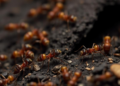
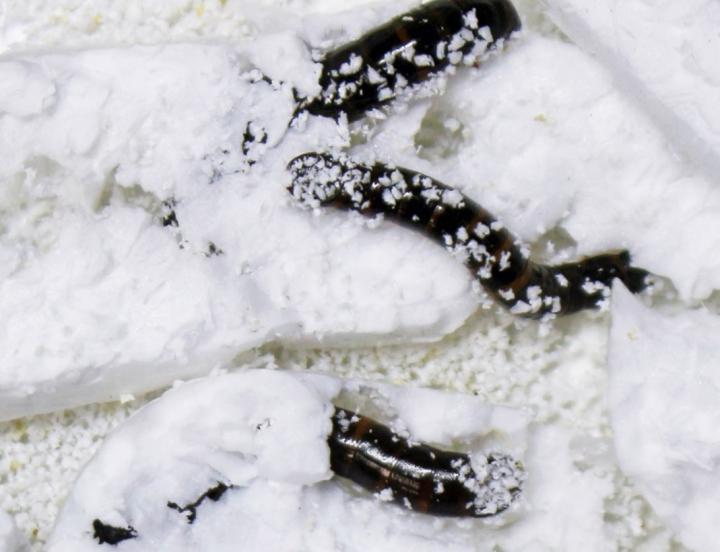
A joint research team consisting of Professor Hyung Joon Cha and a doctoral student Seongwook Woo of the Department of Chemical Engineering at POSTECH with Professor Intek Song of Andong National University has uncovered for the first time that the larvae of the beetle in the order Coleoptera (Plesiophthophthalmus davidis) can decompose polystyrene, a material that is tricky to decompose.
By 2017, 8.3 billion tons of plastic waste were produced across the globe, of which less than 9 percent were recycled. Polystyrene, which accounts for about 6% of total plastic production, is known to be difficult to decompose due to its unique molecular structure.
The research team found that the larvae of a darkling beetle indigenous to East Asia including the Korean peninsula can consume polystyrene and reduce both its mass and molecular weight. The team also confirmed that the isolated gut flora could oxidize and change the surface property of the polystyrene film.
Meanwhile, the research team isolated and identified Serratia from the intestinal tract of P. davidis larvae. When polystyrene was fed to the larvae for two weeks, the proportion of Serratia in the gut flora increased by six fold, accounting for 33 percent of the overall gut flora. Moreover, it was found that the gut flora of this larvae consisted of a very simple group of bacterial species (less than six) unlike the gut flora of other conventional polystyrene-degrading insects.
The unique diet of the darkling beetle larvae that was uncovered in this study presents the possibility that polystyrene can be broken down by other insects that feed on rotten wood. In addition, the development of an effective polystyrene-decomposing flora using the bacterial strains found in the simple gut flora of P. davidis is highly anticipated.
The study is also noteworthy in that the paper’s first author, Seongwook Woo, who has been interested in insects since childhood and wished to make the world a better place through them, sought out Professor Cha as soon as he entered POSTECH and focused on research under his supervision over the years.
As the corresponding author of the paper, Professor Cha commented, “We have discovered a new insect species that lives in East Asia – including Korea – that can biodegrade plastic through the gut flora of its larvae.” He concluded, “If we use the plastic-degrading bacterial strain isolated in this study and replicate the simple gut floral composition of P. davidis, there is the chance that we could completely biodegrade polystyrene, which has been difficult to completely decompose, to ultimately contribute to solving the plastic waste problem that we face.”
###
These research findings were recently published in the online edition of Applied and Environmental Microbiology, a long-standing authoritative journal in applied and environmental microbiology.
Media Contact
Jinyoung Huh
[email protected]
Original Source
http://www.
Related Journal Article
http://dx.