Credit: University of Basel
No year since weather records began was as hot and dry as 2018. A first comprehensive analysis of the consequences of this drought and heat event shows that central European forests sustained long-term damage. Even tree species considered drought-resistant, such as beech, pine and silver fir, suffered. The international study was directed by the University of Basel, which is conducting a forest experiment unique in Europe.
Until now, 2003 has been the driest and hottest year since regular weather records began. That record has now been broken. A comparison of climate data from Germany, Austria and Switzerland shows that 2018 was significantly warmer. The average temperature during the vegetation period was 1.2°C above the 2003 value and as high as 3.3°C above the average of the years from 1961 to 1990.
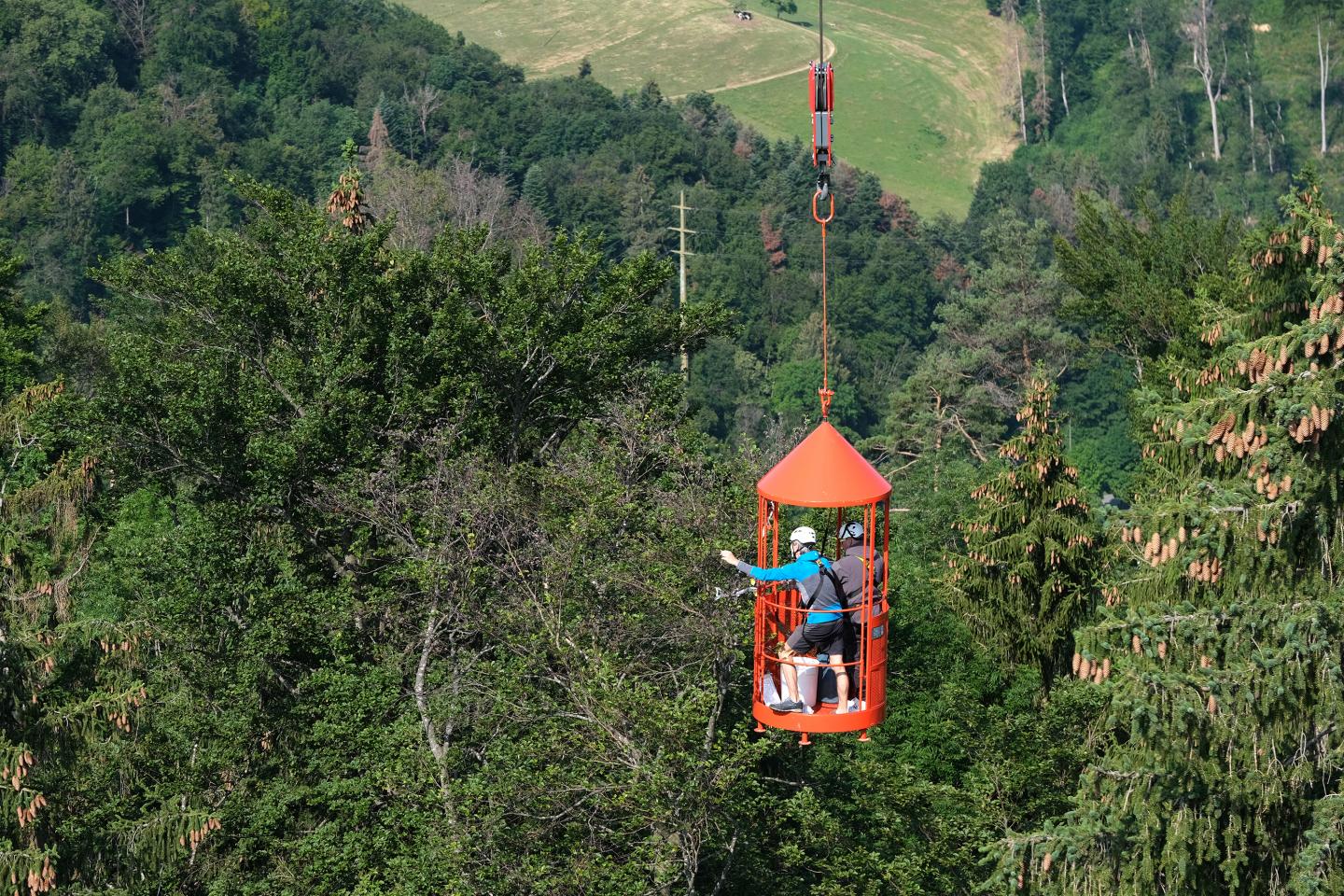
Part of the analysis, which has now been published, includes measurements taken at the Swiss Canopy Crane II research site in Basel, where extensive physiological investigations were carried out in tree canopies. The goal of these investigations is to better understand how and when trees are affected by a lack of water in order to counter the consequences of climate change through targeted management measures.
When trees die of thirst
Trees lose a lot of water through their surfaces. If the soil also dries out, the tree cannot replace this water, which is shown by the negative suction tension in the wood’s vascular tissue. It’s true that trees can reduce their water consumption, but if the soil water reservoir is used up, it’s ultimately only a matter of time until cell dehydration causes the death of a tree.
Physiological measurements at the Basel research site have shown the researchers that the negative suction tension and water shortage in trees occurred earlier than usual. In particular, this shortage was more severe throughout all of Germany, Austria and Switzerland than ever measured before. Over the course of the summer, severe drought-related stress symptoms therefore appeared in many tree species important to forestry. Leaves wilted, aged and were shed prematurely.
Spruce, pine and beech most heavily affected
The true extent of the summer heatwave became evident in 2019: many trees no longer formed new shoots – they were partially or wholly dead. Others had survived the stress of the drought and heat of the previous year, but were increasingly vulnerable to bark beetle infestation or fungus. Trees with partially dead canopies, which reduced the ability to recover from the damage, were particularly affected.
“Spruce was most heavily affected. But it was a surprise for us that beech, silver fir and pine were also damaged to this extent,” says lead researcher Professor Ansgar Kahmen. Beech in particular had until then been classified as the “tree of the future”, although its supposed drought resistance has been subject to contentious discussion since the 2003 heatwave.
Future scenarios to combat heat and drought
According to the latest projections, precipitation in Europe will decline by up to a fifth by 2085, and drought and heat events will become more frequent. Redesigning forests is therefore essential. “Mixed woodland is often propagated,” explains plant ecologist Kahmen, “and it certainly has many ecological and economic advantages. But whether mixed woodland is also more drought-resistant has not yet been clearly proven. We still need to study which tree species are good in which combinations, including from a forestry perspective. That will take a long time.”
Another finding of the study is that it is only possible to record the impacts of extreme climate events on European forests to a limited extent using conventional methods, and thus new analytical approaches are needed. “The damage is obvious. More difficult is precisely quantifying it and drawing the right conclusions for the future,” says Kahmen. Earth observation data from satellites could help track tree mortality on a smaller scale. Spatial patterns that contain important ecological and forestry-related information can be derived from such data: which tree species were heavily impacted, when and at which locations, and which survived without damage? “A system like this already exists in some regions in the US, but central Europe still lacks one.”
###
Further information
Prof. Dr. Ansgar Kahmen, University of Basel, Department of Environmental Sciences, phone +41 61 207 35 71, email: [email protected]
Media Contact
Iris Mickein
[email protected]
Original Source
https:/
Related Journal Article
http://dx.