• HOME
  • NEWS
  • EXPLORE
    • CAREER
      • Companies
      • Jobs
    • EVENTS
    • iGEM
      • News
      • Team
    • PHOTOS
    • VIDEO
    • WIKI
  • BLOG
  • COMMUNITY
    • FACEBOOK
    • INSTAGRAM
    • TWITTER
Monday, May 11, 2026
BIOENGINEER.ORG
No Result
View All Result
  • Login
  • HOME
  • NEWS
  • EXPLORE
    • CAREER
      • Companies
      • Jobs
        • Lecturer
        • PhD Studentship
        • Postdoc
        • Research Assistant
    • EVENTS
    • iGEM
      • News
      • Team
    • PHOTOS
    • VIDEO
    • WIKI
  • BLOG
  • COMMUNITY
    • FACEBOOK
    • INSTAGRAM
    • TWITTER
  • HOME
  • NEWS
  • EXPLORE
    • CAREER
      • Companies
      • Jobs
        • Lecturer
        • PhD Studentship
        • Postdoc
        • Research Assistant
    • EVENTS
    • iGEM
      • News
      • Team
    • PHOTOS
    • VIDEO
    • WIKI
  • BLOG
  • COMMUNITY
    • FACEBOOK
    • INSTAGRAM
    • TWITTER
No Result
View All Result
Bioengineer.org
No Result
View All Result
Home NEWS Science News

Robot jaws shows medicated chewing gum could be the future

Bioengineer by Bioengineer
July 14, 2020
in Science News
Reading Time: 2 mins read
0
IMAGE
Share on FacebookShare on TwitterShare on LinkedinShare on RedditShare on Telegram

IMAGE

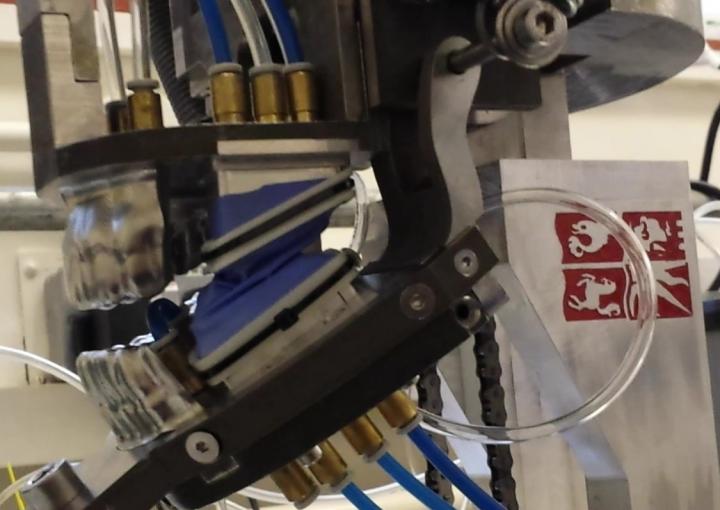
Credit: Dr Kazem Alemzadeh, University of Bristol

Medicated chewing gum has been recognised as a new advanced drug delivery method but currently there is no gold standard for testing drug release from chewing gum in vitro. New research has shown a chewing robot with built-in humanoid jaws could provide opportunities for pharmaceutical companies to develop medicated chewing gum.

The aim of the University of Bristol study, published in IEEE Transactions on Biomedical Engineering, was to confirm whether a humanoid chewing robot could assess medicated chewing gum. The robot is capable of closely replicating the human chewing motion in a closed environment. It features artificial saliva and allows the release of xylitol the gum to be measured.

The study wanted to compare the amount of xylitol remaining in the gum between the chewing robot and human participants. The research team also wanted to assess the amount of xylitol released from chewing the gum.

The researchers found the chewing robot demonstrated a similar release rate of xylitol as human participants. The greatest release of xylitol occurred during the first five minutes of chewing and after 20 minutes of chewing only a low amount of xylitol remained in the gum bolus, irrespective of the chewing method used.

Saliva and artificial saliva solutions respectively were collected after five, ten, 15 and 20 minutes of continuous chewing and the amount of xylitol released from the chewing gum established.

Dr Kazem Alemzadeh, Senior Lecturer in the Department of Mechanical Engineering, who led the research, said: “Bioengineering has been used to create an artificial oral environment that closely mimics that found in humans.

“Our research has shown the chewing robot gives pharmaceutical companies the opportunity to investigate medicated chewing gum, with reduced patient exposure and lower costs using this new method.”

Nicola West, Professor in Restorative Dentistry in the Bristol Dental School and co-author, added: “The most convenient drug administration route to patients is through oral delivery methods. This research, utilising a novel humanoid artificial oral environment, has the potential to revolutionise investigation into oral drug release and delivery.”

###

Media Contact
Joanne Fryer, University of Bristol
[email protected]

Related Journal Article

http://dx.doi.org/10.1109/TBME.2020.3005863

Tags: Dentistry/Periodontal DiseaseMechanical EngineeringMedicine/HealthPharmaceutical Science
Share12Tweet8Share2ShareShareShare2

Related Posts

New Post-Hoc Analysis Explores Daily Oral Orforglipron Use in Adults Over 65 with Obesity, Regardless of Diabetes Status

May 11, 2026

Evaluating Digoxin Use in Patients with Symptomatic Rheumatic Heart Disease

May 10, 2026

Evaluating the Effectiveness and Safety of Digitalis Glycosides in Treating Heart Failure

May 10, 2026

Urdu Fall Risk Questionnaire Adapted for Elderly

May 10, 2026
Please login to join discussion

POPULAR NEWS

  • Research Indicates Potential Connection Between Prenatal Medication Exposure and Elevated Autism Risk

    840 shares
    Share 336 Tweet 210
  • New Study Reveals Plants Can Detect the Sound of Rain

    727 shares
    Share 290 Tweet 181
  • Salmonella Haem Blocks Macrophages, Boosts Infection

    61 shares
    Share 24 Tweet 15
  • Breastmilk Balances E. coli and Beneficial Bacteria in Infant Gut Microbiomes

    57 shares
    Share 23 Tweet 14

About

We bring you the latest biotechnology news from best research centers and universities around the world. Check our website.

Follow us

Recent News

New Post-Hoc Analysis Explores Daily Oral Orforglipron Use in Adults Over 65 with Obesity, Regardless of Diabetes Status

Evaluating Digoxin Use in Patients with Symptomatic Rheumatic Heart Disease

Evaluating the Effectiveness and Safety of Digitalis Glycosides in Treating Heart Failure

Subscribe to Blog via Email

Enter your email address to subscribe to this blog and receive notifications of new posts by email.

Join 82 other subscribers
  • Contact Us

Bioengineer.org © Copyright 2023 All Rights Reserved.

Welcome Back!

Login to your account below

Forgotten Password?

Retrieve your password

Please enter your username or email address to reset your password.

Log In
No Result
View All Result
  • Homepages
    • Home Page 1
    • Home Page 2
  • News
  • National
  • Business
  • Health
  • Lifestyle
  • Science

Bioengineer.org © Copyright 2023 All Rights Reserved.