• HOME
  • NEWS
  • EXPLORE
    • CAREER
      • Companies
      • Jobs
    • EVENTS
    • iGEM
      • News
      • Team
    • PHOTOS
    • VIDEO
    • WIKI
  • BLOG
  • COMMUNITY
    • FACEBOOK
    • INSTAGRAM
    • TWITTER
Tuesday, July 7, 2026
BIOENGINEER.ORG
No Result
View All Result
  • Login
  • HOME
  • NEWS
  • EXPLORE
    • CAREER
      • Companies
      • Jobs
        • Lecturer
        • PhD Studentship
        • Postdoc
        • Research Assistant
    • EVENTS
    • iGEM
      • News
      • Team
    • PHOTOS
    • VIDEO
    • WIKI
  • BLOG
  • COMMUNITY
    • FACEBOOK
    • INSTAGRAM
    • TWITTER
  • HOME
  • NEWS
  • EXPLORE
    • CAREER
      • Companies
      • Jobs
        • Lecturer
        • PhD Studentship
        • Postdoc
        • Research Assistant
    • EVENTS
    • iGEM
      • News
      • Team
    • PHOTOS
    • VIDEO
    • WIKI
  • BLOG
  • COMMUNITY
    • FACEBOOK
    • INSTAGRAM
    • TWITTER
No Result
View All Result
Bioengineer.org
No Result
View All Result
Home NEWS Science News Chemistry

Merging solar cell and liquid battery produces long-lasting solar storage

Bioengineer by Bioengineer
July 13, 2020
in Chemistry
Reading Time: 2 mins read
0
IMAGE
Share on FacebookShare on TwitterShare on LinkedinShare on RedditShare on Telegram

Research opens path for new home solar technology
IMAGE

Credit: Wenjie Li/UW-Madison

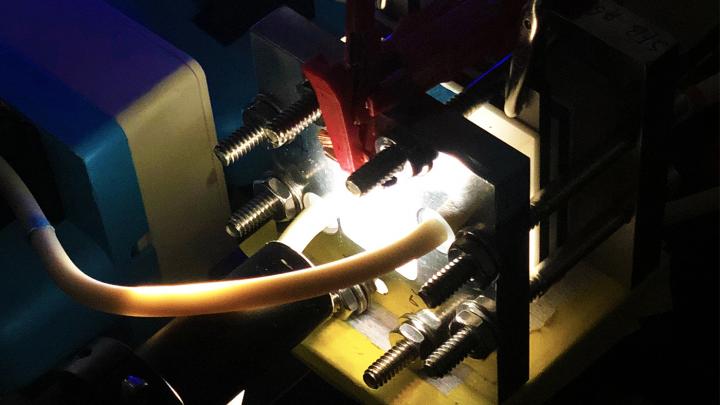
Solar cell researchers at the University of Sydney and University of New South Wales working with chemists at the University of Wisconsin-Madison in the United States have created a highly efficient and long-lasting solar-flow battery, which is a way to generate, store, and redeliver renewable electricity from the sun in one device.

The new device is made of perovskite-silicon tandem solar cells integrated with specially designed chemical battery components. The solar-flow battery achieved a new record efficiency of 20 percent conversion of energy from the sun. This is 40 percent more efficient than the previous record for solar-flow batteries, which were also developed in the University of Wisconsin Jin lab where lead author, PhD student Wenjie Li, is based.

This work is published today in the journal Nature Materials and is a collaboration between UW-Madison, Utah State University, King Abdullah University of Science and Technology in Saudi Arabia, the City University of Hong Kong, UNSW and the University of Sydney.

The researchers turned to an increasingly popular material for photovoltaic cells, halide perovskites, and combined them with silicon solar cells to increase their efficiency by capturing more energy from the sun.

Professor Anita Ho-Baillie at the University of Sydney Nano Institute and postdoctoral researcher Dr Jianghui Zheng at UNSW designed and fabricated the perovskite-silicon tandem solar cells so that they can maintain their performance and stability while withstanding the chemicals in a flow battery.

This research could potentially yield a new way to harvest, store and use the sun’s energy for solar home systems.

###

MEDIA ENQUIRIES

Marcus Strom | [email protected] | +61 423 982 485

INTERVIEWS

Professor Anita Ho-Baillie | [email protected] | +61 416 215 700

DECLARATION

This work was supported in part by the US National Science Foundation and Australian Renewable Energy Agency (ARENA). Other funding agencies include King Abdullah University of Science and Technology (KAUST); China Scholarship Council (CSC).

Media Contact
Marcus Strom
[email protected]

Related Journal Article

http://dx.doi.org/10.1038/s41563-020-0720-x

Tags: Chemistry/Physics/Materials SciencesClimate ChangeEnergy SourcesMaterialsResearch/DevelopmentTechnology/Engineering/Computer Science
Share12Tweet8Share2ShareShareShare2

Related Posts

Salt adaptation linked to higher disease risk, Mizzou study finds

Salt adaptation linked to higher disease risk, Mizzou study finds

July 6, 2026
Intelligent Microgrid Management Promises Lower Household Energy Bills and Reduced Diesel Emissions — Chemistry

Intelligent Microgrid Management Promises Lower Household Energy Bills and Reduced Diesel Emissions

July 4, 2026

Graz University of Technology Deciphers the Structural Secrets of MOF Thin Films

July 2, 2026

Breaking Thermodynamic Limits: Wavelength-Driven Catalysis Advances Ammonia Synthesis

July 2, 2026
Please login to join discussion

POPULAR NEWS

  • Detection of EDCs in Breast Milk and Infant Urine Up to Six Months Highlights Early Exposure Risks

    77 shares
    Share 31 Tweet 19
  • New Drug Candidate Developed at McMaster Shows Potential for Treating Brain Cancer

    58 shares
    Share 23 Tweet 15
  • Saying Goodbye to PGY-6: Pediatric Fellowship Realities

    103 shares
    Share 41 Tweet 26
  • KTU Researchers Explore Ultrasound’s Role in Enhancing Blood Flow Beyond Diagnostics

    53 shares
    Share 21 Tweet 13

About

We bring you the latest biotechnology news from best research centers and universities around the world. Check our website.

Follow us

Recent News

Flame retardant BDE-209 targets molecularly linked to ulcerative colitis

Ultra-high frequency particle impacts mimic rockbursts to shatter hard rock

Kidney transplant outcomes in older adults studied by German researchers

Subscribe to Blog via Email

Enter your email address to subscribe to this blog and receive notifications of new posts by email.

Join 83 other subscribers
  • Contact Us

Bioengineer.org © Copyright 2023 All Rights Reserved.

Welcome Back!

Login to your account below

Forgotten Password?

Retrieve your password

Please enter your username or email address to reset your password.

Log In
No Result
View All Result
  • Homepages
    • Home Page 1
    • Home Page 2
  • News
  • National
  • Business
  • Health
  • Lifestyle
  • Science

Bioengineer.org © Copyright 2023 All Rights Reserved.