• HOME
  • NEWS
  • EXPLORE
    • CAREER
      • Companies
      • Jobs
    • EVENTS
    • iGEM
      • News
      • Team
    • PHOTOS
    • VIDEO
    • WIKI
  • BLOG
  • COMMUNITY
    • FACEBOOK
    • INSTAGRAM
    • TWITTER
Sunday, January 18, 2026
BIOENGINEER.ORG
No Result
View All Result
  • Login
  • HOME
  • NEWS
  • EXPLORE
    • CAREER
      • Companies
      • Jobs
        • Lecturer
        • PhD Studentship
        • Postdoc
        • Research Assistant
    • EVENTS
    • iGEM
      • News
      • Team
    • PHOTOS
    • VIDEO
    • WIKI
  • BLOG
  • COMMUNITY
    • FACEBOOK
    • INSTAGRAM
    • TWITTER
  • HOME
  • NEWS
  • EXPLORE
    • CAREER
      • Companies
      • Jobs
        • Lecturer
        • PhD Studentship
        • Postdoc
        • Research Assistant
    • EVENTS
    • iGEM
      • News
      • Team
    • PHOTOS
    • VIDEO
    • WIKI
  • BLOG
  • COMMUNITY
    • FACEBOOK
    • INSTAGRAM
    • TWITTER
No Result
View All Result
Bioengineer.org
No Result
View All Result
Home NEWS Science News Chemistry

New insights into van der Waals materials found

Bioengineer by Bioengineer
July 6, 2020
in Chemistry
Reading Time: 2 mins read
0
IMAGE
Share on FacebookShare on TwitterShare on LinkedinShare on RedditShare on Telegram

IMAGE

Credit: Qingkai Qian, Penn State

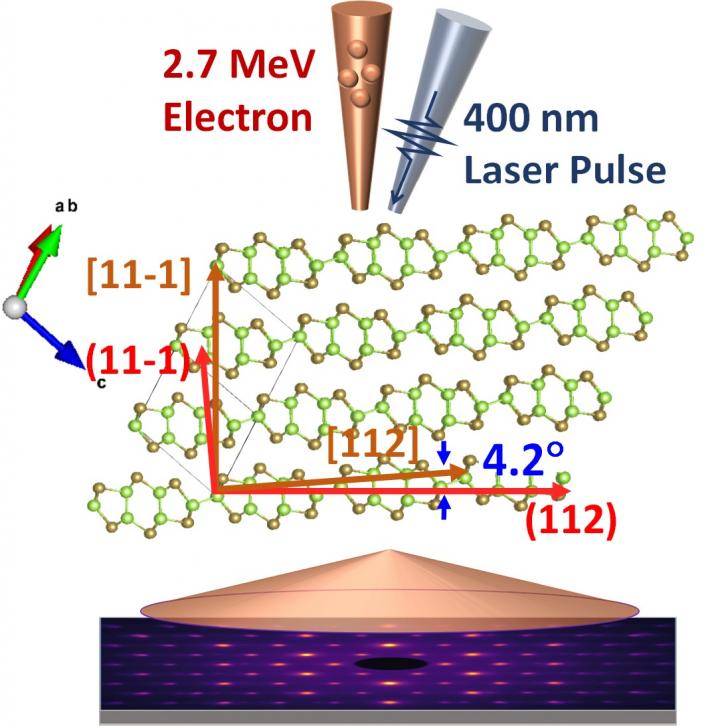
Layered van der Waals materials are of high interest for electronic and photonic applications, according to researchers at Penn State and SLAC National Accelerator Laboratory, in California, who provide new insights into the interactions of layered materials with laser and electron beams.

Two-dimensional van der Waals materials are composed of strongly bonded layers of molecules with weak bonding between the layers.

The researchers used a combination of ultrafast pulses of laser light that excite the atoms in a material lattice of gallium telluride, followed by exposing the lattice to an ultrafast pulse of an electron beam. This shows the lattice vibrations in real time using electron diffraction and could lead to a better understanding of these materials.

“This is a quite unique technique,” said Shengxi Huang, assistant professor of electrical engineering and corresponding author of a paper in ACS Nano that describes their work. “The purpose is to understand fully the lattice vibrations, including in-plane and out-of-plane.”

One of the interesting observations in their work is the breaking of a law that applies to all material systems. Friedel’s Law posits that in the diffraction pattern, the pairs of centrosymmetric Bragg peaks should be symmetric, directly resulting from Fourier transformation. In this case, however, the pairs of Bragg peaks show opposite oscillating patterns. They call this phenomenon the dynamic breaking of Friedel’s Law. It is a very rare if not unprecedented observation in the interactions between the beams and these materials.

“Why do we see the breaking of Friedel’s Law?” she said. “It is because of the lattice structure of this material. In layered 2D materials, the atoms in each layer typically align very well in the vertical direction. In gallium telluride, the atomic alignment is a little bit off.”

When the laser beam shines onto the material, the heating generates the lowest-order longitudinal acoustic phonon mode, which creates a wobbling effect for the lattice. This can affect the way electrons diffract in the lattice, leading to the unique dynamic breaking of Friedel’s law.

This technique is also useful for studying phase change materials, which absorb or radiate heat during phase change. Such materials can generate the electrocaloric effect in solid-state refrigerators. This technique will also be interesting to people who study oddly structured crystals and the general 2D materials community.

###

The lead author on the article, titled “Coherent Lattice Wobbling and Out-of-Phase Intensity Oscillations of Friedel Pairs Observed by Ultrafast Electron Di?raction” is Huang’s postdoctoral scholar Qingkai Qian. Additional Penn State authors in her group are graduate students Kunyan Zhang and Lanxin Jia, and research scholar Yu Zhou. Xijie Wang led the ten-member SLAC team.

The National Science Foundation supported this work. The Department of Energy supports SLAC.

Media Contact
A’ndrea Elyse Messer
[email protected]

Related Journal Article

http://dx.doi.org/10.1021/acsnano.0c02643

Tags: Chemistry/Physics/Materials SciencesMaterials
Share12Tweet8Share2ShareShareShare2

Related Posts

Creating Synthetic Protein-Binding DNA Systems in Cells

January 17, 2026
blank

Chiral Catalysis Powers Rotary Molecular Motors

January 16, 2026

Selective GlcNAc to GalNAc Epimerization via Kinetic Control

January 15, 2026

Thermal [2+2] Cycloaddition Builds Gem-Difluoro Bicycloalkanes

January 13, 2026
Please login to join discussion

POPULAR NEWS

  • Enhancing Spiritual Care Education in Nursing Programs

    155 shares
    Share 62 Tweet 39
  • PTSD, Depression, Anxiety in Childhood Cancer Survivors, Parents

    148 shares
    Share 59 Tweet 37
  • Robotic Ureteral Reconstruction: A Novel Approach

    78 shares
    Share 31 Tweet 20
  • Study Reveals Lipid Accumulation in ME/CFS Cells

    54 shares
    Share 22 Tweet 14

About

We bring you the latest biotechnology news from best research centers and universities around the world. Check our website.

Follow us

Recent News

Revolutionary Rbf Method Tackles Nonlinear Dispersive PDEs

Maximizing Control Authority in Impact-Invariant Systems

Optimizing In Vitro Growth of Bambusa balcooa Roxb.

Subscribe to Blog via Email

Enter your email address to subscribe to this blog and receive notifications of new posts by email.

Join 71 other subscribers
  • Contact Us

Bioengineer.org © Copyright 2023 All Rights Reserved.

Welcome Back!

Login to your account below

Forgotten Password?

Retrieve your password

Please enter your username or email address to reset your password.

Log In
No Result
View All Result
  • Homepages
    • Home Page 1
    • Home Page 2
  • News
  • National
  • Business
  • Health
  • Lifestyle
  • Science

Bioengineer.org © Copyright 2023 All Rights Reserved.