Researchers from the National Institute for Physiological Sciences and Kitasato University in Japan discover that mouse norovirus has two capsid structures and changes from one to the other before infection. Human norovirus also exhibited two similar caps
Credit: Kazuyoshi Murata
Okazaki, Japan – Human noroviruses are a major cause of gastroenteritis outbreaks worldwide. They cause approximately 200,000 deaths each year in developing countries. However, no effective vaccine or antiviral agent for noroviruses yet exists because cell culture methods to produce noroviruses are very limited and there is a lack of the viral structural knowledge about the virus.
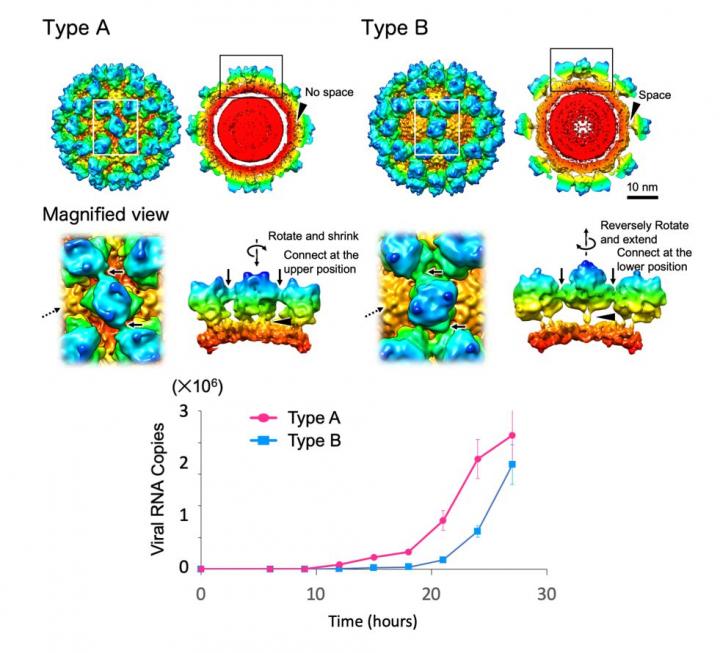
In this study, the researchers have investigated the mouse norovirus structures using cryo-electron microscopy and discovered that the noroviruses present two alternative capsid structures (type A and type B) (Fig. 1 top). Noroviruses are covered by two layered proteinaceous domains, an outer protruding (P) domain and an inner shell (S) domain. Type A shows tight interaction between the two domains, with no space between them, while type B displays the P domain dislocated above the S domain with a space between them. This result has raised the questions, “How do these capsid structures switch?” and “Why do noroviruses need two capsid structures?”.
Further investigations showed that the two structures of mouse norovirus particles switch depending on aqueous conditions. Viral particles showed the type A structure in lower pH solutions including metal ions, while type B structure was favored in higher pH solutions lacking metal ions. Type A was formed by rotation and shrinkage of the P domain and stabilized with an interaction between neighbors at the upper part, while type B was formed by the reverse rotation and extension of the P domain and stabilized with an interaction between neighbors at the lower part (Fig 1 middle).
Mouse noroviruses showing two structures were individually infected into cultured cells. Type B particles showed four hours delay of propagation comparing to type A particles (Fig. 1 bottom). Another experiment found that type B particles showed less adsorption to host cell surface than type A particles. It was concluded that mouse noroviruses change their structure from B to A before infection.
“Why do noroviruses need two structures?” This has not been clarified, but the researchers speculate that it is used to evade the host animal’s immune system. Noroviruses are transmitted primarily through the oral route, and infect cells of the small intestine. Noroviruses may evade the immune system with the type B structure, and approach the small intestine. Then, they finally infect cells by changing to the type A structure (Fig. 2).
The research reveals a part of viral structural change and infection mechanism of mouse noroviruses. Two capsid structures were also identified in the human norovirus VLP, but it has not elucidated the switching mechanism of the structure yet. It is hypothesized that a similar mechanism is also used in human norovirus. Further investigation will clarify the switching mechanism of the structure and infection manner of human norovirus, hopefully assisting development of therapeutic drugs and vaccines in the future.
###
Media Contact
Kazuyoshi Murata
[email protected]
Original Source
https:/
Related Journal Article
http://dx.